
미국 스크류웜: 인간 위험은 낮지만 두개골을 뚫을 수 있다
출처: Ars Technica
당황하지 마세요
    가능성은 낮지만, 영은 아니다.


  스크루웜 파리 유충의 끝부분.


      출처:


      CSIRO
Ravenous, flesh-eating flies have busted through containment barriers and have now reemerged in the US. On Monday and Tuesday, the US Department of Agriculture reported three new cases, bringing the tally to five.
One of the cases is in a dog, though it’s unclear where it became infected; the dog lives in New Mexico, had its infection reported in Texas, and may have recently traveled to Mexico, where the flies are also spreading. But the other four US cases were all in Texas—and all in calves—two in Zavala County and two in La Salle County.
Almost all the attention over screwworm’s resurgence has focused on the threat to livestock, like the calves and, in turn, the financial risk to the cattle industry. The fly’s voracious, screw-shaped larvae can fell cattle if given the chance, and preventing infestations requires intense vigilance. The USDA has estimated that if the flies stage a comeback rivaling isolated outbreaks of the past, they could cost Texas producers $732 million per year and the Texas economy $1.8 billion.
But while livestock are the easiest and costliest prey, humans are also at risk. Human cases are far less frequent than those in livestock, but when they do occur, they are just as severe. As researchers noted in a 2025 review, infestations in humans “cause rapidly enlarging, painful wounds that can progress to deeper tissues, with risks of secondary infection, sepsis, and mortality.” The fly’s larvae can destroy muscle, cartilage, and bone if they aren’t caught in time. They can even break through a human skull.
인간 위험
Understanding the threat requires examining the parasite’s lifecycle. The screwworm—technically New World screwworm or Cochliomyia hominivorax (Coquerel)—is a parasitic blowfly. Females mate only once in their 10–30-day lifespan but can lay up to 3,000 eggs. The flies are attracted to the smell of wounds, mucous membranes, and orifices of warm-blooded animals, and females deposit hundreds of eggs when they find an opening. The eggs hatch within a day, and the resulting eponymous screw-shaped larvae quickly begin ruthlessly boring into and feasting on their victim’s living flesh. This savagery can last up to a week before the mature larvae fall to the ground. There, they pupate in the soil and emerge, 7–54 days later, as adult flies.
This sequence of events used to occur regularly in the US and Central America; screwworm was endemic here but was eradicated after a concerted, decades-long campaign to annihilate its populations. This was done using Sterile Fly Technique, which involves breeding millions of male flies in specialized facilities, sterilizing them with gamma radiation, then dropping them from the air like bombs. It works by exploiting the fact that females mate only once; if they do so with a sterile male, there will be no offspring, and the population will collapse.
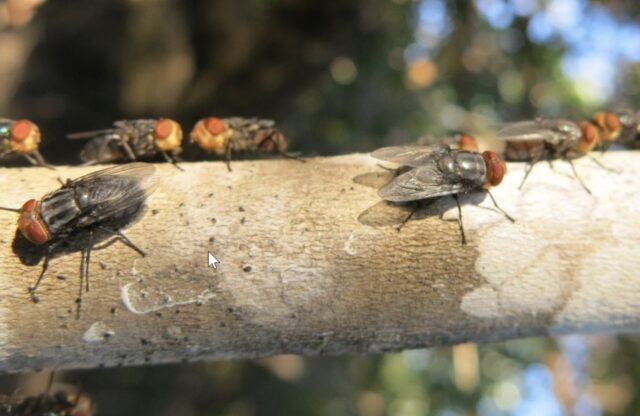
성체 스크루웜 파리.
성체 스크루웜 파리.
출처:
USDA
Screwworms were eradicated from the US Southwest in 1966, though Texas continued to struggle with outbreaks into the 1980s. Mexico declared eradication in 1991, and efforts to zap the flies continued moving southward. Panama declared eradication in 2006, and for years, the flies were held at bay at the Darién Gap, the border of Panama and Colombia, with consistent sterile male fly releases. But around 2022, the barrier was breached, and the flies have been eating their way back up.
With the northward movement, reports of human cases of screwworm infections, called myiasis, have trailed them in Central America. They offer a glimpse of the risk that people in the US now face as the flies invade.
인간 사례 등장
Screwworms will attack any wound in humans—they can find a wound as tiny as a tick bite as a way in. For those caught unaware, the flies will also happily lay eggs in convenient openings such as the nose, mouth, ears, eyes, and even the bum, if available.
In early 2024, researchers in Costa Rica—which declared screwworm eradicated in 2000—reported what is thought to be the first identified human myiasis case in the country since the reemergence. The case was in a 71-year-old man from a small rural community close to the border with Panama. He sought care on January 12, 2024, for wounds on his feet, specifically between his toes, which had developed over the prior four months. The wounds had painful, oozing pus and smelled horrible. Doctors noticed a deep lesion between the first two toes on his right foot. They pulled out approximately 160 screwworm larvae. (A graphic image of the man’s toes is seen here.)
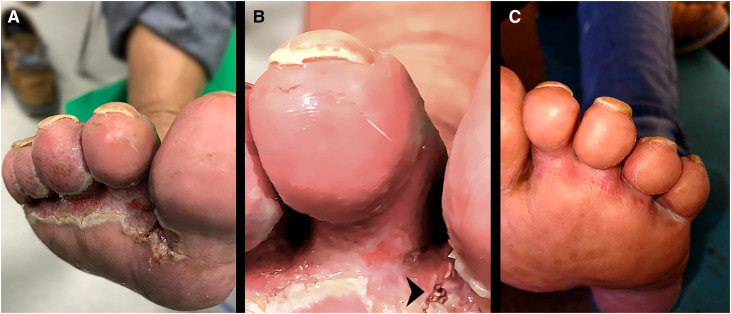
The man was sent to an emergency department for wound care, where doctors found some more larvae. He was also diagnosed with two bacterial infections, Staphylococcus aureus and Pseudomonas aeruginosa. He was treated with antibiotics and creams and had healed by the time of his six-week follow‑up.
In February 2024, a month after the man’s case, Costa Rica declared a national emergency over the screwworm resurgence. By October 10, 2024, the country had logged 8,671 animal cases and 33 human cases. Of those human cases, three died. The cases were said to be in people with significant underlying health conditions, including organ and immune system dysfunction, as well