
Uploading Pirated Books via BitTorrent Qualifies as Fair Use, Meta Argues
Source: Hacker News
Meta’s Bittersweet Victory
Last summer, Meta scored a key win in this case: the court held that using pirated books to train its Llama LLM qualified as fair use, based on the arguments presented. It was a bittersweet victory, however, because Meta remained on the hook for downloading and sharing the books via BitTorrent.
- By downloading books from shadow libraries such as Anna’s Archive, Meta relied on BitTorrent transfers.
- In addition to downloading content, BitTorrent also uploads data to other peers.
- According to the plaintiffs, this means Meta was engaged in widespread and direct copyright infringement.
In recent months, the lawsuit has continued on the remaining direct‑infringement claim. Both parties have gathered additional evidence through discovery, but it has remained unclear which defense Meta will ultimately employ—until now.
Seeding Pirated Books Is Fair Use
Last week, Meta served a supplemental interrogatory response in a California federal court, marking a new direction in its defense. For the first time, the company argued that uploading pirated books to other BitTorrent users during the torrent‑download process also qualifies as fair use.
Meta’s Reasoning
- Inherent Uploading – Anyone who uses BitTorrent to transfer files automatically uploads content to other peers; the uploading is not a discretionary act but a built‑in feature of the protocol.
- Necessity of BitTorrent – The datasets in question (e.g., those from Anna’s Archive) were only available in bulk via torrent downloads, making BitTorrent the only practical method for obtaining the data.
“Meta used BitTorrent because it was a more efficient and reliable means of obtaining the datasets, and in the case of Anna’s Archive, those datasets were only available in bulk through torrent downloads,” Meta’s attorney writes.
“Accordingly, to the extent Plaintiffs can come forth with evidence that their works or portions thereof were theoretically ‘made available’ to others on the BitTorrent network during the torrent download process, this was part‑and‑parcel of the download of Plaintiffs’ works in furtherance of Meta’s transformative fair‑use purpose.”
“Part and Parcel”
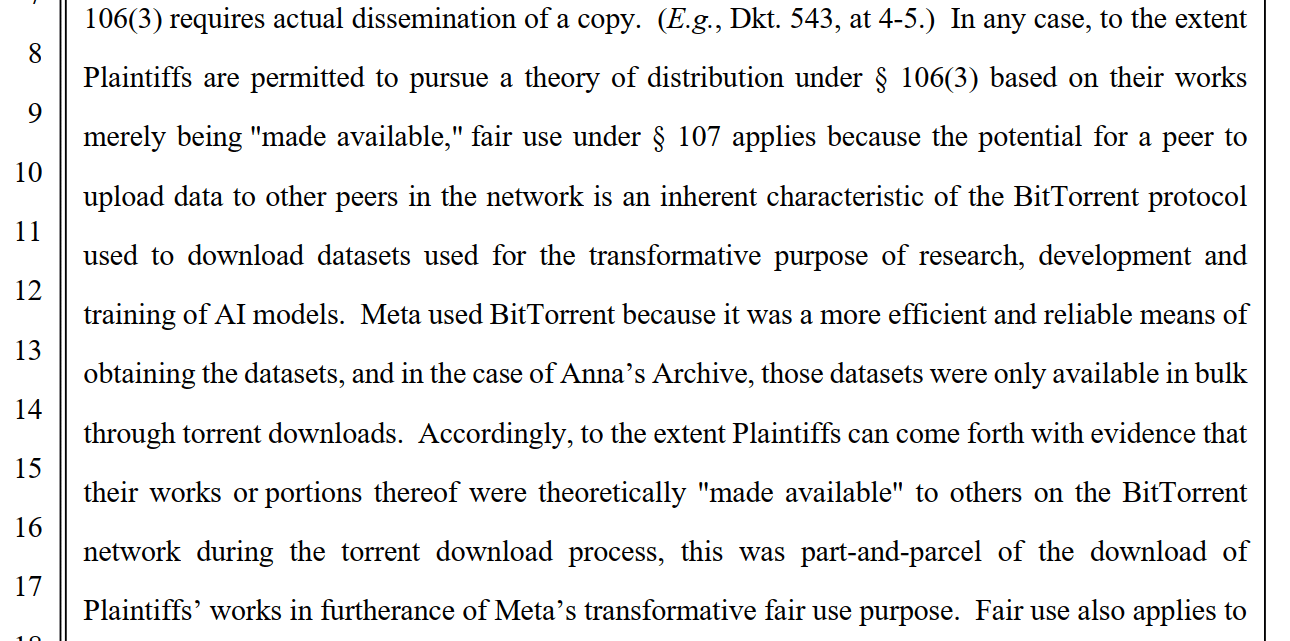
In other words, obtaining the millions of books needed to train its large language model (LLM) required direct downloading, which Meta contends serves the same fair‑use purpose.
Authors and Meta Disagree over Fair Use Timing
The authors were not happy with last week’s late‑Friday submission and the new defense. On Monday morning, their lawyers filed a letter with Judge Vince Chhabria flagging the late‑night filing as an improper end‑run around the discovery deadline.
Authors’ Argument
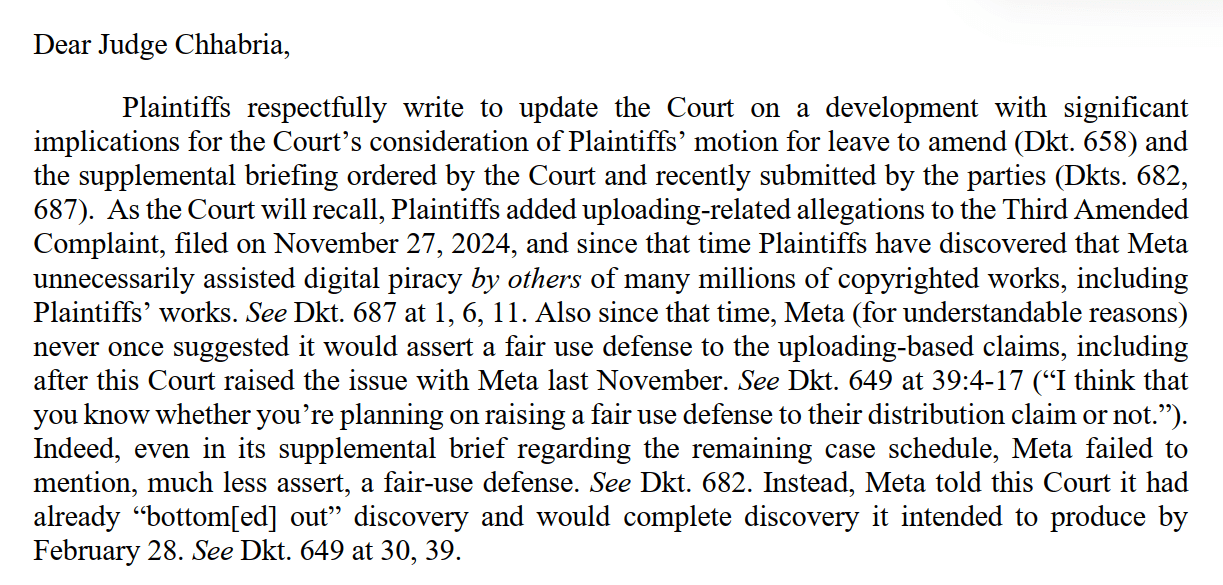
- The authors contend that Meta has been aware of the uploading‑based claims since November 2024, yet it never raised a fair‑use defense—not even when the court asked about it.
- They point out that while Meta has a “continuing duty” to supplement discovery under Rule 26(e), that rule does not create a “loophole” allowing a party to add new defenses after a court deadline has passed.
“Meta (for understandable reasons) never once suggested it would assert a fair‑use defense to the uploading‑based claims, including after this Court raised the issue with Meta last November,” the authors’ lawyers write.
The Letter (excerpt)
Meta’s Response
Meta’s legal team filed a rebuttal the following day. In its letter to Judge Chhabria, Meta argued that the fair‑use argument for the direct copyright‑infringement claim is not new.
- Meta pointed to the parties’ joint December 2025 case‑management statement, in which it explicitly flagged the defense.
- The authors’ own attorney had also addressed the fair‑use issue at a court hearing days later.
“In short, Plaintiffs’ assertion that Meta ‘never once suggested it would assert a fair‑use defense to the uploading‑based claims, including after’ the November 2025 hearing, is false,” Meta’s attorney writes.
Note: The timeline references both November 2024 and November 2025. The original sources should be checked for the correct year.
Authors Admit No Harm, No Infringing Output
Meta’s interrogatory response also cites deposition testimony from the authors themselves, using their own words to bolster its fair‑use defense.
The company notes that every named author has admitted they are unaware of any Meta model output that replicates content from their books. When asked whether it mattered if Meta’s models never output language from her book, Sarah Silverman testified:
“It doesn’t matter at all.”
— Deposition of Sarah Silverman
Authors’ Depositions

Meta argues these admissions undercut any theory of market harm. If the authors themselves cannot point to infringing output or lost sales, the lawsuit is less about protecting their books and more about challenging the training process itself—an issue the court has already ruled was fair use.
These admissions were central to Meta’s fair‑use defense on the training claims, which Meta won last summer. Whether they carry the same weight in the remaining BitTorrent‑distribution dispute remains to be seen.
U.S. AI Leadership at Stake
In its interrogatory response, Meta emphasized that its investment in AI has helped the United States establish global leadership, putting the country ahead of geopolitical competitors. That, Meta suggested, is a valuable asset worth treasuring.
As the case moves forward, Judge Chhabria will have to decide whether to allow this “fair use by technical necessity” defense. The decision will be vital not only for this lawsuit but also for many other AI cases where the use of shadow libraries is at stake.
For now, the BitTorrent‑distribution claims remain the last live piece of a lawsuit filed in 2023. Whether Judge Chhabria will permit Meta’s new defense to proceed has yet to be seen.