
Why Kubernetes Alone Isn’t Enough: The Case for API Gateways and Service Meshes
Source: Dev.to


Canonical URL:
If Kubernetes already handles networking, why do we need API Gateways and Service Meshes like Istio?
Kubernetes (K8s) has become the go‑to platform for deploying and scaling modern applications. It abstracts away infrastructure complexity, automates container orchestration, and provides resilience out of the box.
But there’s one question I often get asked:
👉 “If Kubernetes already handles networking, why do we need API Gateways and Service Meshes like Istio?”
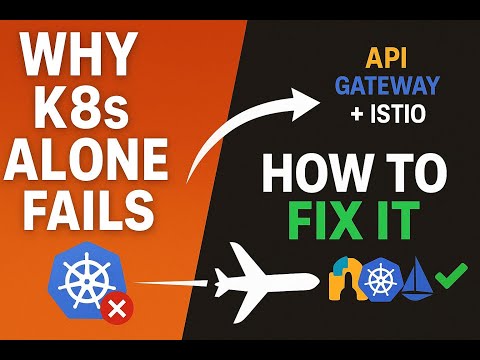
The short answer: Kubernetes provides the runway, but you still need air‑traffic control and security checkpoints to ensure safe, controlled travel.
North‑South vs. East‑West Traffic
To understand the gaps, it’s important to distinguish between two directions of traffic inside Kubernetes:
- North‑South Traffic – communication between external clients and services inside the cluster (e.g., a user accessing your app through an API endpoint).
- East‑West Traffic – communication between services within the cluster (e.g., Service A calling Service B for data).
Kubernetes Services and Ingress provide the basics for connecting this traffic — but “basic” is the key word.
Kubernetes Network Policies: The Built‑in Guardrails
Before diving into advanced tools, let’s acknowledge what Kubernetes does offer.
Kubernetes ships with Network Policies, which act as a basic firewall inside the cluster. They let you define rules such as:
- Which pods can communicate with which other pods.
- Which external IPs or CIDRs are allowed.
- Whether connections are ingress‑only, egress‑only, or both.
This is incredibly valuable. By default, pods in Kubernetes can talk to each other freely — Network Policies put up the first layer of guardrails.
But here’s the catch:
- Network Policies are IP/label‑based. They don’t understand application protocols, authentication headers, or user identity.
- They don’t offer traffic shaping (retries, circuit breaking, canary deployments, etc.).
- They provide no observability or encryption between services.
👉 In other words: Network Policies keep the doors locked, but they don’t check who’s knocking or why they’re there.
This is exactly where API Gateways and Service Meshes step in.
Enter API Gateway: Your Airport Gate (North‑South Traffic)
An API Gateway acts as the gatekeeper at the airport entrance.
It:
- Authenticates incoming requests.
- Validates payloads and enforces rate limits.
- Routes requests to the appropriate backend service.
Think of it as the check‑in counter at an airport: only passengers with the right ticket can proceed, and their baggage is screened before entry.
Without a gateway, every service would have to implement its own external security and request validation — a recipe for duplication and inconsistency.
Enter Istio: Your Airport Security Inside the Terminal (East‑West Traffic)
For east‑west traffic, Istio (a service mesh) is like the airport’s internal security system.
It:
- Provides mTLS encryption between services.
- Enforces fine‑grained, application‑aware policies.
- Offers traffic control (blue/green, canary, retries, circuit breaking).
- Delivers deep observability with metrics and tracing.
Think of Istio as the security gates and flight‑information systems: they keep unauthorized movement in check, scan interactions, and make sure flights (services) run on schedule with full visibility.

The Power‑Up: Gateway + Mesh Together
Individually, an API Gateway and Istio solve specific problems. Together, they give your Kubernetes environment airport‑grade security and control.
- API Gateway secures and manages north‑south traffic.
- Istio secures and manages east‑west traffic.
Combined, they elevate Kubernetes from just a “runway” to a full airport with checkpoints, security, and flight control.
Without them, Kubernetes provides the planes and runway — but leaves you vulnerable to misrouted flights, unauthorized passengers, and security blind spots.
Closing Thoughts
Kubernetes is powerful, but it’s not a security or traffic‑management silver bullet.
- Network Policies give you a solid foundation.
- API Gateways add control over external entry points.
- Service Meshes like Istio bring deep visibility and in‑cluster security.
Together, they transform Kubernetes from “just orchestration” into a resilient, secure, production‑ready platform.
So, next time someone asks:
👉 “Why do we …”
(continue the conversation as needed.)
Need API Gateway and Istio when we already have Kubernetes?
Because Kubernetes gives you the runway — but you still need airport‑grade security to keep the flights safe.
Article originally published on dev.to.