
The Chinese AI app sending Hollywood into a panic
Source: BBC Technology
ByteDance’s New AI Model Sends Shockwaves Through Hollywood
By Osmond Chia, Business Reporter
Suranjana Tewari, Asia Business Correspondent
Getty Images
A new artificial‑intelligence (AI) model developed by the Chinese company behind TikTok has rocked Hollywood this week—not just because of what it can do, but because of what it could mean for creative industries.
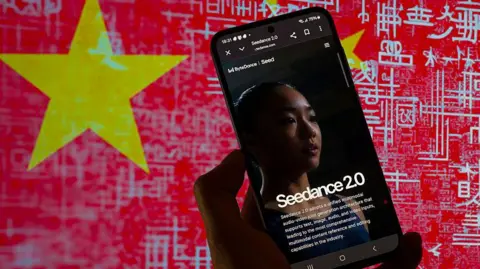
Created by tech giant ByteDance, Seedance 2.0 can generate cinema‑quality video—complete with sound effects and dialogue—from just a few written prompts.
Many of the clips said to have been made using Seedance, featuring popular characters such as Spider‑Man and Deadpool, went viral on social media.
Major studios like Disney and Paramount quickly accused ByteDance of copyright infringement, but concerns about the technology run deeper than legal issues. The emergence of AI‑generated video raises fundamental questions about:
- Intellectual‑property rights in an era where entire scenes can be fabricated from text.
- Creative control and the potential displacement of human writers, directors, and visual effects artists.
- Ethical considerations, including the risk of deep‑fake misinformation and the manipulation of public perception.
As the debate unfolds, the entertainment industry faces a pivotal moment: adapt to a powerful new tool or risk being left behind by the very technology it helped popularize.
What Is Seedance – and Why the Stir?
Seedance was launched with little fanfare in June 2025, but it was the second version—released eight months later—that caused a major stir.
“For the first time, I’m not thinking that this looks good for AI. Instead, I’m thinking that this looks straight out of a real production pipeline,”
— Jan‑Willem Blom, creative studio Videostate
Western AI video models have made impressive strides in turning user instructions into stunning images, but Seedance appears to have tied everything together.
Like other AI tools—Midjourney and OpenAI’s Sora—Seedance can create videos from short text prompts. In many cases, a single prompt is enough to produce a high‑quality video.
It is particularly impressive because it combines text, visuals, and audio in a single system, according to AI‑ethics researcher Margaret Mitchell.
Seedance’s impact is being measured by an unlikely benchmark: how well it generates a clip of Will Smith eating spaghetti.
Not only can Seedance create a remarkably lifelike version of the star tucking into a plate of pasta, it has also spawned viral videos of Smith battling a spaghetti monster—and it looks and feels like a big‑budget movie.
Many industry experts and filmmakers believe Seedance marks a new chapter in video‑generating technology. The complex action sequences it produces look more realistic than those of its competitors, says David Kwok, who runs the Singapore‑based animation studio Tiny Island Productions.
“It almost feels like having a cinematographer or director of photography specializing in action films assisting you.”
The Promise – and the Challenge
Seedance has run into trouble over copyright issues, a growing challenge in the age of AI.
Experts warn that AI companies are prioritising technology over people as they build more powerful tools and use data without paying for it.
Copyright Concerns

Placeholder image

Alamy
Disney owns the rights to multiple franchises, including Marvel’s superheroes.
Major Hollywood groups have cried foul over Seedance’s use of copyrighted characters such as Spider‑Man and Darth Vader. Disney and Paramount issued cease‑and‑desist letters demanding that Seedance stop using their content. Japan is also investigating ByteDance for alleged copyright violations after AI‑generated videos of popular anime characters went viral.
In 2023, The New York Times sued OpenAI and Microsoft, alleging they used its articles without permission to train their AI models. Reddit sued Perplexity last year, claiming the AI firm had illegally scraped user posts. Disney raised similar concerns with Google.
“Clearly labelling content to prevent deception and building public trust in AI is far more important than ‘cooler‑looking’ videos,” says Mitchell.
And that’s why developers must build systems that manage licensing and payments, and provide clear mechanisms for people to contest misuse, she adds.
Disney, for instance, signed a $1 bn (£730 m) deal with OpenAI’s Sora so it could use characters from Star Wars, Pixar and Marvel.
Seedance’s developers were likely aware of potential copyright issues around the use of Western IP and took a risk anyway, says Shaanan Cohney, a computing researcher at the University of Melbourne.
“There’s plenty of leeway to bend the rules strategically, to flout the rules for a while and get marketing clout,” he adds.
Why Small Firms Still Want Seedance
For smaller companies, Seedance is too useful to ignore.
Kwok, from Singapore’s Tiny Island Productions, says AI of this quality will allow companies like his to create films that would otherwise be unaffordable. He cites Asia’s booming short‑form videos and micro‑dramas, which typically run on modest budgets—roughly $140 k for as many as 80 episodes under two minutes each.
These productions have stuck to romance or family drama to keep costs down, as they require fewer visual effects. Now AI can “elevate low‑budget productions into more ambitious genres such as sci‑fi, period drama and, now, action,” Kwok explains.
Robotics Snapshot
Placeholder image
Getty Images
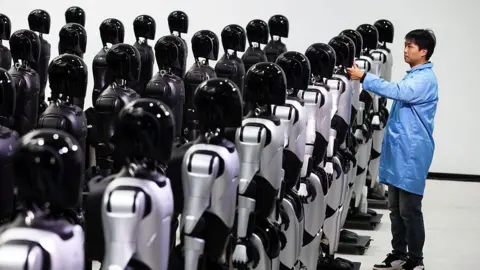
Humanoid robots at a factory in Shanghai
Is China Racing Ahead?
ByteDance once again puts Chinese tech in the spotlight.
“It signals that Chinese models are at the very least matching the frontier of what is available,” Cohney says. “If ByteDance can produce this seemingly out of nowhere, what other kinds of models do Chinese companies have in store?”
Last year, DeepSeek, another Chinese AI model, sent shockwaves around the world with its low‑cost large language model. It quickly overtook ChatGPT as the most‑downloaded free app on Apple’s U.S. store.
Since then, Beijing has placed AI and robotics at the core of its economic strategy, investing heavily in:
- Advanced computer‑chip production
- Automation technologies
- Generative AI, aiming for a technological edge over the United States
While ByteDance 2.0 was making headlines, other major Chinese firms rolled out lower‑profile generative‑AI tools ahead of the Lunar New Year holiday.
The Spring Festival is increasingly becoming an “AI holiday,” with firms timing launches for a period when millions of people are at home experimenting with new apps, Bill Bishop wrote in his newsletter.
Looking Ahead to 2026
Bill Bishop predicts that 2026 could mark a turning point for mass AI adoption in China—not just chatbots, but also:
- AI agents handling everyday transactions
- Coding tools embedded in routine work processes
- Video creators routinely leveraging AI for content production
If these trends continue, the coming years may see Chinese AI technologies moving from novelty to indispensable parts of daily life.