
OpenAI might be fast-tracking its AI phone with a powerful new MediaTek chip
Source: Android Authority
Calvin Wankhede / Android Authority
TL;DR
- OpenAI is now expected to launch its first AI phone sooner, with mass production tipped for the first half of 2027.
- MediaTek is reportedly the frontrunner to supply the device’s processors, which could be a customized Dimensity 9600 built on TSMC’s advanced N2P node.
- The chip is said to prioritize AI and vision features, including a dual‑NPU design, upgraded ISP for HDR sensing, and next‑gen memory and storage.
Would you buy an OpenAI phone?
109 votes
According to analyst Ming‑Chi Kuo, OpenAI is targeting mass production of its first AI phone as early as the first half of 2027—a notable shift from earlier, later timelines. Kuo suggests the company is accelerating development to strengthen its position in the emerging AI‑agent device category and possibly to support a future IPO.
Kuo also claims that MediaTek has emerged as the leading candidate to supply the processor. Qualcomm was previously under consideration, but that appears to have changed.
The new MediaTek chip is tipped to be a customized version of the rumored Dimensity 9600, reportedly built on TSMC’s next‑generation N2P process and expected to be revealed in the second half of 2026.
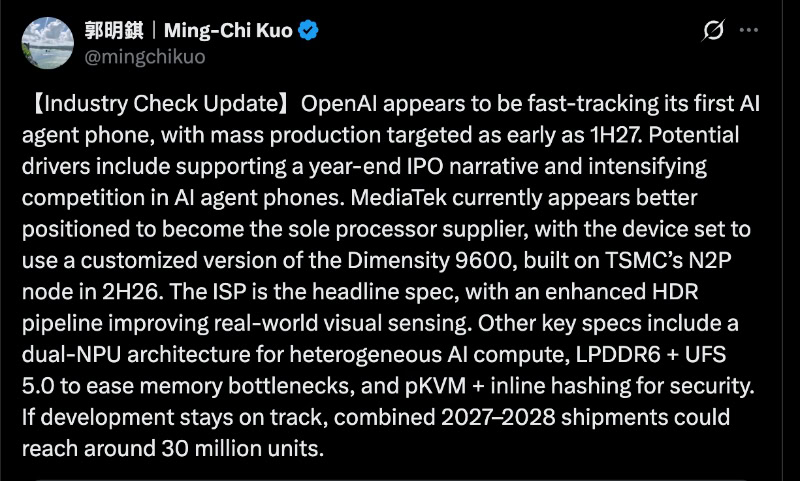
Image credit: Ming‑Chi Kuo/X
Kuo notes that this updated chip will focus on improving AI workloads rather than pure smartphone performance metrics. He highlights the ISP (image signal processor) as the “headline” feature, with an enhanced HDR pipeline designed to improve visual understanding—aligning with the idea of an AI‑focused phone that can continuously perceive its surroundings.
Other spec details mentioned by Kuo include:
- Dual‑NPU architecture for handling different AI workloads efficiently
- LPDDR6 RAM and UFS 5.0 storage
- Security features such as pKVM (protected Kernel‑based Virtual Machine) and inline hashing, similar to protections found in Google’s Pixel devices
If development stays on track, Kuo estimates combined shipments for 2027 and 2028 could reach around 30 million units, an ambitious target for a first‑generation device from a company that has never made a phone before, especially in a nascent category.
OpenAI has not commented on the phone or any plans to produce one.