
NVIDIA Unveils Multi-Agent Intelligent Warehouse and Catalog Enrichment AI Blueprints to Power the Retail Pipeline
Source: NVIDIA AI Blog
Turning Retail’s “That Was Easy” Moments into Reality
Every “that was easy” shopping experience is powered by teams racing against shipping deadlines, fixing missing product details, and curating seamless journeys for shoppers.
Behind the scenes, they grapple with:
- Aging legacy systems
- Siloed data
- Rising customer expectations
These factors make consistency and speed increasingly difficult as new seasons arrive and product catalogs expand with more SKUs.
NVIDIA Blueprints for Retail
New open‑source developer references (launched today) are designed to turn this complexity into a competitive advantage:
| Blueprint | What It Does | Link |
|---|---|---|
| Multi‑Agent Intelligent Warehouse (MAIW) | Automates warehouse operations with coordinated AI agents, improving throughput and error handling. | Explore MAIW |
| Retail Catalog Enrichment | Enriches product data (images, descriptions, attributes) at scale, ensuring accurate, searchable catalogs. | Explore Catalog Enrichment |
These blueprints enable developers to custom‑build AI‑powered solutions across the entire retail value chain—from the warehouse floor to the consumer’s wardrobe—while reducing integration costs and accelerating time‑to‑value.
“Building with these blueprints will reduce the cost of integration and help our customers and partners enable applications fast,” said Tarik Hammadou, Director of Developer Relations for AI for Retail and Consumer Packaged Goods at NVIDIA. “They unlock the efficiency and enterprise‑grade scale the retail industry needs to compete.”
See the Blueprints in Action
The blueprints will be showcased next week at the National Retail Federation: Retail’s Big Show.
📅 Event: NRF Big Show 2024
Empower your retail operations with AI‑driven speed, consistency, and scale.
Easing Warehouse Workflows
Warehouses are dynamic spaces with many moving parts—from boxes carrying a variety of retail goods to massive machines and workers fulfilling thousands of daily orders. Issues can arise in an instant, such as out‑of‑stock items or clean‑ups needed in aisle four.
An ongoing problem in this environment is the disconnect between the IT and operational technology (OT) layers. This gap prevents managers from easily:
- Accurately measuring product inventory
- Efficiently pinpointing technology issues
- Deploying enough workers to areas that need extra help
“The idea of having an agentic AI layer on the IT or OT level is not efficient, but having agents in between IT and OT allows the AI agents to act as the coordinators,” — Tarik Hammadou
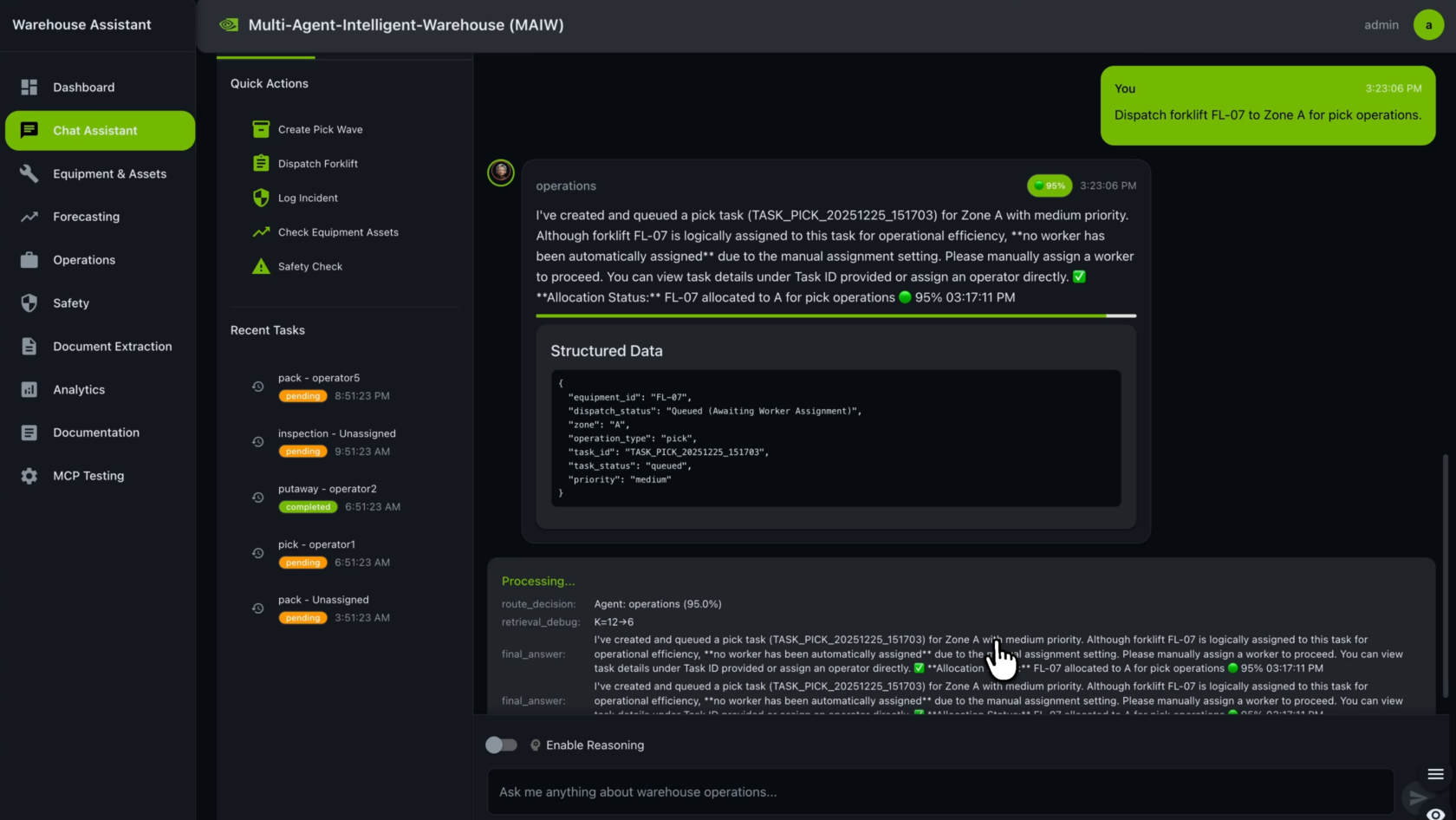
Figure: A look inside the MAIW Blueprint.
What the NVIDIA MAIW Blueprint Does
The NVIDIA MAIW (Manufacturing AI Warehouse) blueprint delivers a synchronized AI system that sits above existing warehouse management systems, enterprise resource planning, robotics, and IoT data. This gives teams real‑time, explainable operational intelligence.
Key components:
| Component | Role |
|---|---|
| Specialized agents | Manage equipment assets, coordinate operations, enforce safety compliance, forecast demand, and process documents |
| Central Warehouse Operational Assistant | Mirrors how warehouses actually run, turning fragmented data into proactive decision‑making |
| Production‑grade capabilities | Role‑based access control, policy guardrails, and audit trails |
How It Works in Practice
A supervisor can ask in natural language, “Why is packing slow?” The assistant then:
- Analyzes equipment status, task queues, and staffing data.
- Highlights the bottleneck with supporting evidence.
- Recommends actions such as rebalancing work or adjusting task priorities.
Because the system enforces role‑based access and policy guardrails, operations teams can trust AI to coordinate real equipment and safety‑critical decisions.
Business Impact
- Detects and resolves issues and safety incidents faster.
- Improves on‑time order fulfillment and SLA adherence.
- Shifts warehouses from constant fire drills to predictable, data‑driven shifts.
Partner Perspective
“Charts and graphs are yesterday; we need predictions and prescribed actions,” — Jeremy Jarrett, CEO of Kinetic Vision
“The NVIDIA MAIW blueprint gives us a central way to answer questions and prompt decision‑making.”
Partners such as Kinetic Vision, a product‑and‑technology development firm, can leverage the MAIW blueprint to innovate and tackle decades‑long challenges in retail supply chains.
Resolving Sparse Product Data
The Retail Catalog Enrichment NVIDIA Blueprint helps businesses of any size create richer, more accurate product listings and deliver localized marketing at scale.
The problem
Retailers often receive product images with minimal or inconsistent text. Teams then spend large amounts of time:
- Writing titles, descriptions, and attributes
- Customizing content for each market and campaign
How the blueprint solves it
The solution leverages generative AI to produce high‑quality, structured, localized, and brand‑aligned product content automatically.
Example workflow
- Input – A home‑goods retailer uploads a set of ceramic‑mug photos.
- Vision‑Language Model (VLM) – An NVIDIA Nemotron VLM processes each image and extracts metadata such as:
- Color
- Material
- Capacity
- Style
- Use cases
- Content generation – From the extracted data the system creates:
- Localized product titles and descriptions
- Normalized attributes for search and recommendation engines (improving SEO and GEO targeting)
- Culturally relevant 2‑D lifestyle images
- Interactive 3‑D assets
- Quality check – An AI “judge” evaluates the outputs for consistency and quality before they are published.
Brand‑aware marketing content
By feeding brand‑voice, tone, and taxonomy instructions (via prompts) together with the product image and target locale, the blueprint can also generate:
- Enriched titles and descriptions that match brand guidelines
- Localized categories and tags
- Culturally appropriate lifestyle image variations tailored to specific marketing intents
Result: Faster onboarding, reduced manual effort, and a consistently high‑quality, localized product catalog that drives better search visibility and customer engagement.
Grid Dynamics’ NVIDIA Blueprint‑Powered Solution
Global tech consulting firm Grid Dynamics has built a catalog enrichment and management system that increases the accuracy of item content and the status of SKUs for large retailers, using the Retail Catalog Enrichment NVIDIA Blueprint.
“The quality of the search and the quality of the browsing experience for customers directly depends on the quality of the catalog data,” said Ilya Katsov, Chief Technology Officer of Grid Dynamics.
“It’s a very critical problem for all retailers with a digital presence to ensure their catalogs have as rich and consistent attributes as possible — and our solution automates this so they don’t need to do manual reviews.”
For bigger retailers with massive product catalogs, attributes can be missing or incorrect. Onboarding new vendors with differing catalog structures can further jumble the data, leading to:
- Inaccurate sales reporting
- Customer frustration
- Loss of customer loyalty
How Grid Dynamics’ solution helps
“Our solution makes product catalogs more discoverable while giving brands the ability to enforce their business rules at scale,” said Dan Guja, Principal Software Engineer at Grid Dynamics.
“With AI‑driven business rules applied across the catalog, brands can improve data quality, sharpen customer‑intent signals, and surface products customers actually want.”
Key benefits
- Improved data quality – automated enrichment reduces manual errors.
- Scalable enforcement – AI‑driven business rules apply consistently across millions of SKUs.
- Better discoverability – richer, more accurate attributes boost search and browsing experiences.
## Piecing Together the NVIDIA Retail Pipeline
The MAIW and Catalog Enrichment NVIDIA Blueprints are part of a larger initiative to re‑imagine the warehouse‑to‑consumer workflow with AI infrastructure at every level.
Backend
- MAIW Blueprint – Helps managers and warehouse workers with daily supply‑chain and data‑management tasks.
- Catalog Enrichment Blueprint – Enables digital teams to curate stylized SKU pages with a single click.
- Nemotron‑Personas‑USA – An open‑source dataset that can be used to develop and train solutions, improving the diversity of synthetically generated data across a variety of shopper demographics.
Front‑end
- NVIDIA Retail Shopping Assistant Blueprint – An agentic, conversational assistant that makes product discovery and the shopping experience more effortless and enjoyable.
“The next step is embedding a physical AI layer into warehouse and store operations, enabling intelligent agents to see, reason, and act on real‑world inventory and supply‑chain challenges,” said Tarik Hammadou. “By training physical agents with capabilities like computer vision, we’re moving toward more adaptive and autonomous operations.”
Learn More
- MAIW Blueprint – [Link]
- Retail Catalog Enrichment Blueprint – [Link]
All links open in a new tab.