
My 5-Day Journey into AI Agents 🚀
Source: Dev.to
Introduction
I joined the 5-Day AI Agents Intensive Course with Google and Kaggle to understand how modern AI agents work and how they can be used to solve real‑world problems.
Before this course, I only used simple chatbots. After this course, I learned how to build real multi‑agent systems with tools, memory, and workflows.
This is my learning journey and project reflection.
🗓️ Day 1 – From Prompts to Real Agents
What I learned
- Difference between a chatbot and an AI agent
- How agents can take actions instead of only replying
- Basic agent architectures
My reflection
This was the biggest mindset shift for me. I learned that agents are not just “smart replies” — they are systems that can think, decide and act.
🛠️ Day 2 – Agent Tools & Interoperability
What I learned
- How agents use tools (functions / APIs)
- How tools help agents interact with external systems
- Best practices for safe tool usage
My application
I created appointment tools that allow my agent to:
- Create new hospital appointments
- Fetch existing appointment details from a CSV database
This made my agent feel like a real working system.
🧠 Day 3 – Sessions & Memory (Context Engineering)
What I learned
- How agents remember conversations
- Session handling and memory storage
- Why memory makes agents feel more human
My implementation
I connected my main agent with:
InMemorySessionServiceInMemoryMemoryService
Now my hospital agent can remember user context during a session.
✅ Day 4 – Agent Quality & Observability
What I learned
- How to measure agent quality
- Observability: tracking what agents think and do
- Why evaluation matters in production agents
My reflection
This day helped me understand that building an agent is not only about features — it’s about trust, reliability, and safety.
🚀 Day 5 – Multi‑Agent System (Agent2Agent)
What I learned
- How agents communicate with other agents
- Agent2Agent (A2A) architecture
- How to deploy agents
My capstone implementation
I built a multi‑agent hospital system:
- Remote Appointment Agent – handles CSV data
- Hospital Orchestrator Agent – talks to users and calls the remote agent
This design makes the system scalable and modular.
🏥 My Capstone Project – Hospital Appointment AI Agent
Project Idea
Many hospitals still use manual appointment systems. I built an AI agent system that can:
- Book appointments
- Assign rooms automatically by time
- Fetch appointment details instantly
Architecture
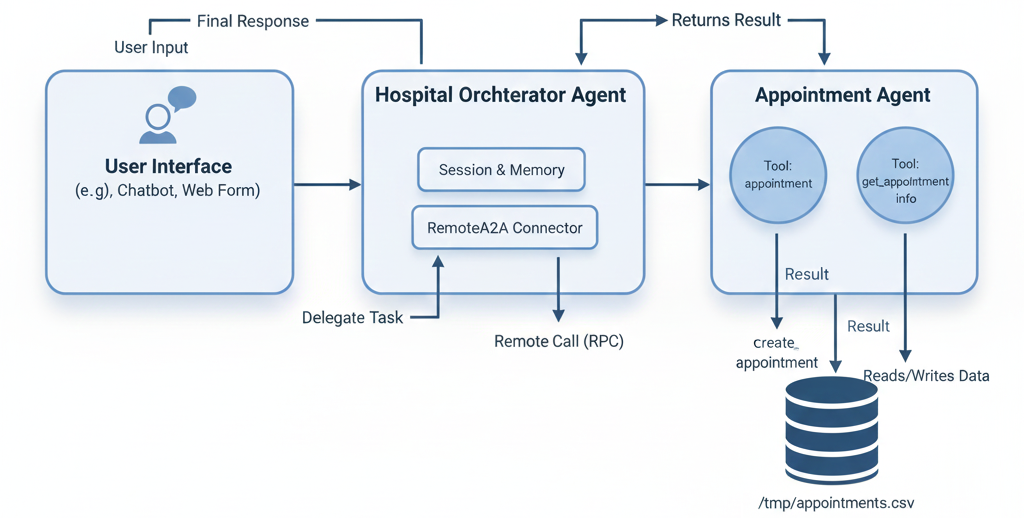
User → Orchestrator Agent → Remote Appointment Agent → CSV Database
This architecture helped me understand real‑world agent system design.
🎯 Key Learnings
- Agents are action‑driven, not only chat‑driven
- Tools turn agents into real applications
- Memory and sessions create personalized experiences
- Multi‑agent systems are powerful and scalable
🙏 Gratitude
I sincerely thank Google and Kaggle for organizing this amazing 5‑Day AI Agents Intensive Course. It gave me hands‑on experience and confidence to build real AI agent systems. This course changed how I see AI — from simple chatbots to intelligent, autonomous systems.
🔮 If I Had More Time
- Add voice support to the agent
- Build a web UI dashboard
- Connect it with real hospital APIs
- Add authentication and security layers
Final Thoughts
This course was not just learning — it was building, experimenting, and growing. I am excited to continue my journey in Agentic AI.
Thank you! 🚀