
A Developer's Guide to Debugging JAX on Cloud TPUs: Essential Tools and Techniques
Source: Google Developers Blog
# JAN. 5, 2026
[Brian Kang](https://developers.googleblog.com/search/?author=Brian+Kang)
Senior Staff – Field Solutions Architect
AI Infrastructure
JAX on Cloud TPUs provides powerful acceleration for machine learning workflows. When working in distributed cloud environments, you need specialized tools to debug your workflows, including accessing logs, hardware metrics, and more. This blog post serves as a practical guide to various debugging and profiling techniques.
## Choosing the right tool: Core Components and Dependencies
At the heart of the system are two main components that nearly all debugging tools depend on:
- **[libtpu](https://pypi.org/project/libtpu/#libtpu-0.0.30-cp314-cp314t-manylinux_2_31_x86_64.whl)** (contains `libtpu.so`, the TPU Runtime):
This is the most fundamental piece of software. It’s a shared library on every Cloud TPU VM that contains the XLA compiler, the TPU driver, and the logic for communicating with the hardware. Almost every debugging tool interacts with or is configured through `libtpu`.
- **[JAX](https://docs.jax.dev/en/latest/) and [jaxlib](https://pypi.org/project/jaxlib/)** (the framework):
JAX is the Python library where you write your model code. `jaxlib` is its C++ backend, which acts as the bridge to `libtpu.so`.
The relationship between these components and the debugging tools is illustrated below.
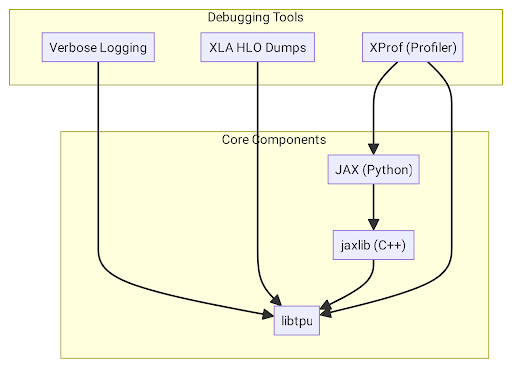
Here is a breakdown of the specific tools, their dependencies, and how they relate to each other.
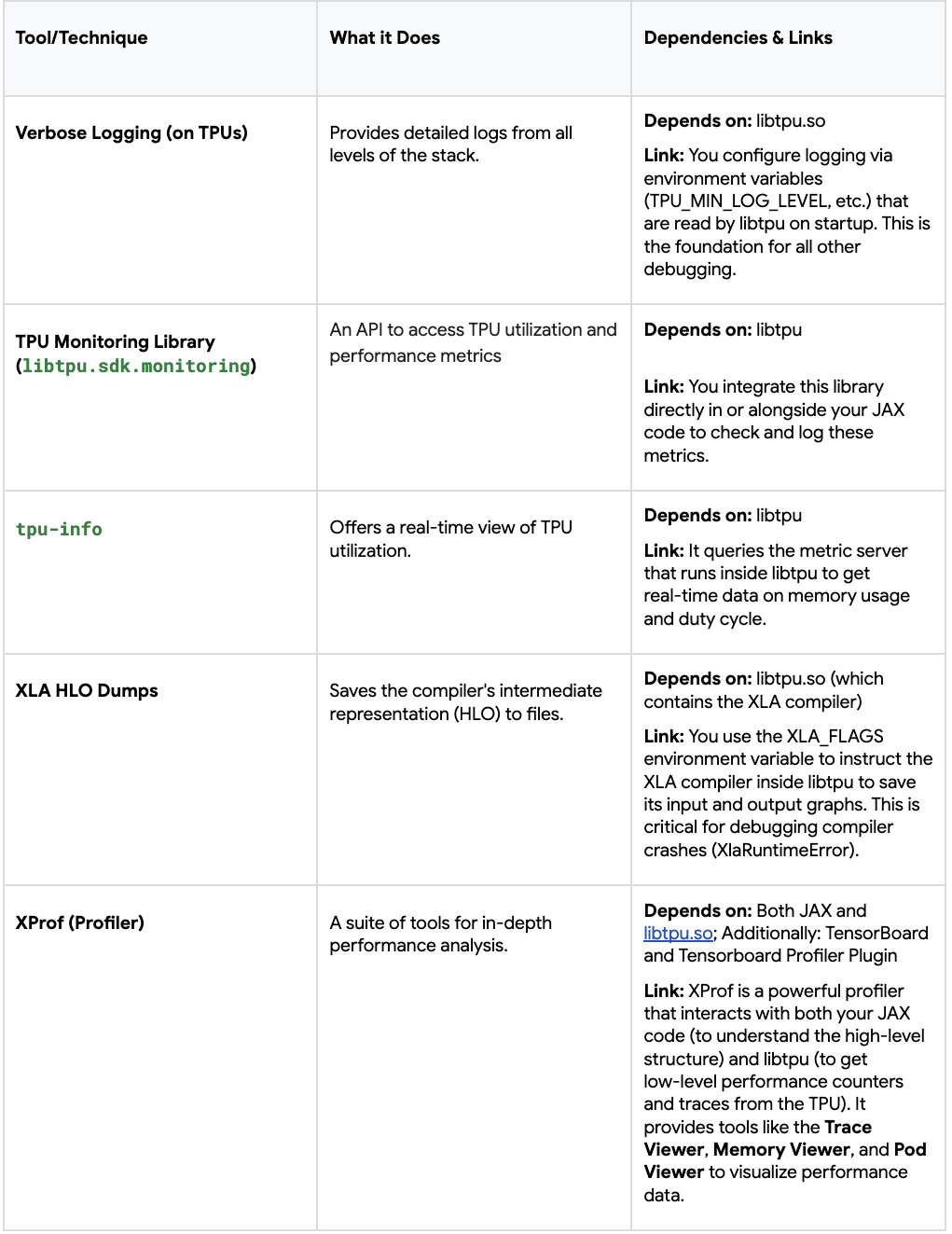
In summary, `libtpu` is the central pillar that most debugging tools rely on, either for configuration (logging, HLO dumps) or for querying real‑time data (monitoring, profiling). Other tools, like XProf, also operate at the Python level to inspect the state of your JAX program directly. By understanding these relationships, you can more effectively choose the right tool for the specific issue you are facing.
## Essential Logging and Diagnostic Flags for Every Workload
### Verbose Logging
The most critical step for debugging is to enable verbose logging. Without it, you are flying blind. These flags should be considered on **every worker** of your TPU slice, to log everything from TPU runtime setup to program execution steps with timestamps.
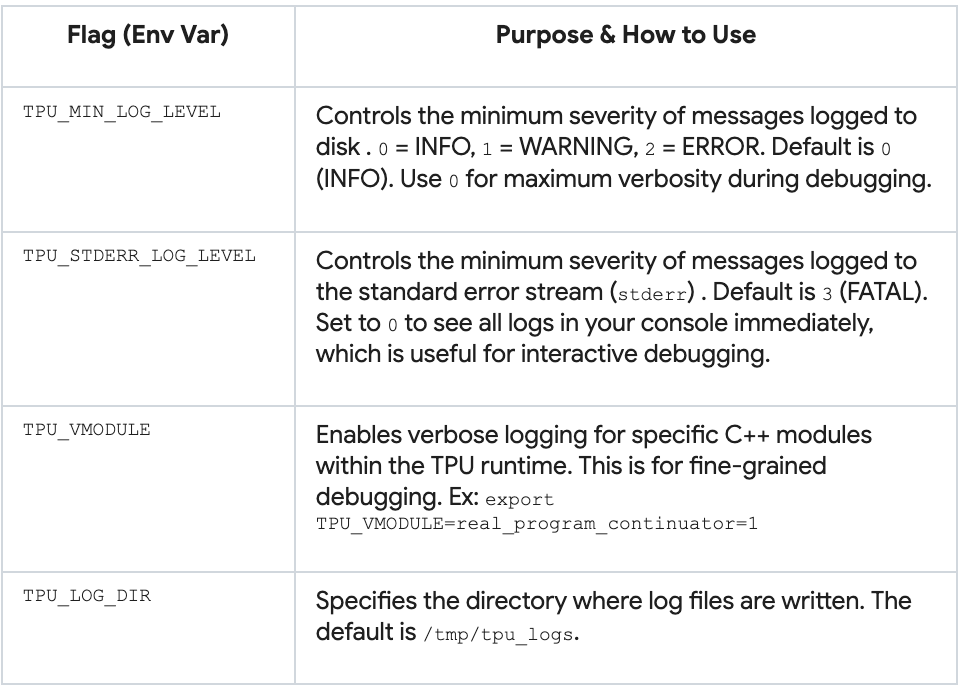
#### Enable default flags on every TPU worker node
```bash
gcloud alpha compute tpus queued-resources ssh ${QUEUED_RESOURCE_ID} \
--project ${PROJECT_ID} \
--zone ${ZONE} \
--worker=all \
--node=all \
--command='TPU_VMODULE=slice_configuration=1,real_program_continuator=1 \
TPU_MIN_LOG_LEVEL=0 TF_CPP_MIN_LOG_LEVEL=0 TPU_STDERR_LOG_LEVEL=0 \
python3 -c "import jax; print(f\"Host {jax.process_index()}: Global devices: {jax.device_count()}, Local devices: {jax.local_device_count()}\")"'libtpu logs are automatically generated in /tmp/tpu_logs/tpu_driver.INFO on each TPU VM. This file is your ground truth for what the TPU runtime is doing. To collect logs from all TPU VMs, run the following script:
#!/bin/bash

TPU_NAME="your-tpu-name"
PROJECT="your-project-id"
ZONE="your-tpu-zone"
BASE_LOG_DIR="path/to/where/you/want/the/logs/downloaded"

NUM_WORKERS=$(gcloud compute tpus tpu-vm describe "$TPU_NAME" \
  --zone="$ZONE" --project="$PROJECT" \
  | grep tpuVmSelflink | awk -F'[:/]' '{print $13}' | uniq | wc -l)

echo "Number of workers = $NUM_WORKERS"

for ((i=0; i<NUM_WORKERS; i++)); do
  mkdir -p "${BASE_LOG_DIR}/$i"
  echo "Downloading logs from worker=$i"
  gcloud compute tpus tpu-vm scp \
    "${TPU_NAME}:/tmp/tpu_logs/*" \
    "${BASE_LOG_DIR}/$i/" \
    --zone="${ZONE}" --project="${PROJECT}" --worker=$i
done
On Google Colab, you can set the above environment variables using os.environ, and access the logs in the Files section of the left sidebar.
Example log snippets
...
I1031 19:02:51.863599     669 b295d63588a.cc:843] Process id 669
I1031 19:02:51.863609     669 b295d63588a.cc:848] Current working directory /content
...
I1031 19:02:51.863621     669 b295d63588a.cc:866] Build tool: Bazel, release r4rca-2025.05.26-2 (mainline @763214608)
I1031 19:02:51.863621     669 b295d63588a.cc:867] Build target:
I1031 19:02:51.863624     669 b295d63588a.cc:874] Command line arguments:
I1031 19:02:51.863624     669 b295d63588a.cc:876] argv[0]: './tpu_driver'
...
I1031 19:02:51.863784     669 init.cc:78] Remote crash gathering hook installed.
I1031 19:02:51.863807     669 tpu_runtime_type_flags.cc:79] --tpu_use_tfrt not specified. Using default value: true
I1031 19:02:51.873759     669 tpu_hal.cc:448] Registered plugin from module: breakpoint_debugger_server
...
I1031 19:02:51.879890     669 pending_event_logger.cc:896] Enabling PjRt/TPU event dependency logging
I1031 19:02:51.880524     843 device_util.cc:124] Found 1 TPU v5 lite chips.
...
I1031 19:02:53.471830     851 2a886c8_compiler_base.cc:3677] CODE_GENERATION stage duration: 3.610218ms
I1031 19:02:53.471885
All code snippets are provided for illustrative purposes; adapt paths and identifiers to your environment.
```markdown
851 isa_program_util_common.cc:486] (HLO module jit_add): Executable fingerprint:0cae8d08bd660ddbee7ef03654ae249ae4122b40da162a3b0ca2cd4bb4b3a19c
TPU Monitoring Library
The TPU Monitoring Library is a way to programmatically gain insights about workflow performance on TPU hardware (utilization, capacity, latency, and more). It is part of the libtpu package, which is automatically installed (as a dependency) with jax[tpu], so you can start using the monitoring API directly.
# Explicit installation
pip install "jax[tpu]" libtpu
You can view all supported metrics with tpumonitoring.list_supported_metrics() and get specific metrics with tpumonitoring.get_metric. For example, the following snippet prints the duty_cycle_pct data and description:
from libtpu.sdk import tpumonitoring

duty_cycle_metric = tpumonitoring.get_metric("duty_cycle_pct")
duty_cycle_data = duty_cycle_metric.data
print("TPU Duty Cycle Data:")
print(f"  Description: {duty_cycle_metric.description}")
print(f"  Data: {duty_cycle_data}")
You would typically integrate tpumonitoring directly in your JAX programs—during model training, before inference, etc. Learn more about the Monitoring Library in the Cloud TPU documentation.
tpu‑info
The tpu‑info command‑line tool provides a real‑time view of TPU memory and other utilization metrics, similar to nvidia‑smi for GPUs.
Install on all workers and nodes
gcloud alpha compute tpus queued-resources ssh ${QUEUED_RESOURCE_ID} --project ${PROJECT_ID} \
  --zone ${ZONE} --worker=all --node=all \
  --command='pip install tpu-info'
Check chip utilization metrics
gcloud alpha compute tpus queued-resources ssh ${QUEUED_RESOURCE_ID} --project ${PROJECT_ID} \
  --zone ${ZONE} --worker=0 --node=0

tpu-info
When chips are in use, process IDs, memory usage, and duty‑cycle % will be displayed.
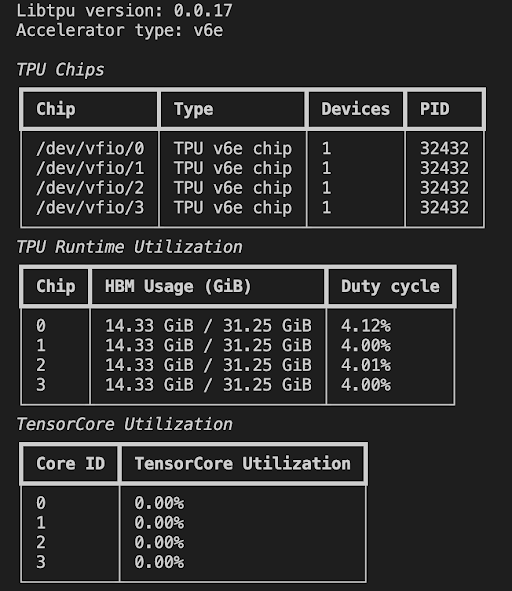
When no chips are in use, the TPU VM will show no activity.
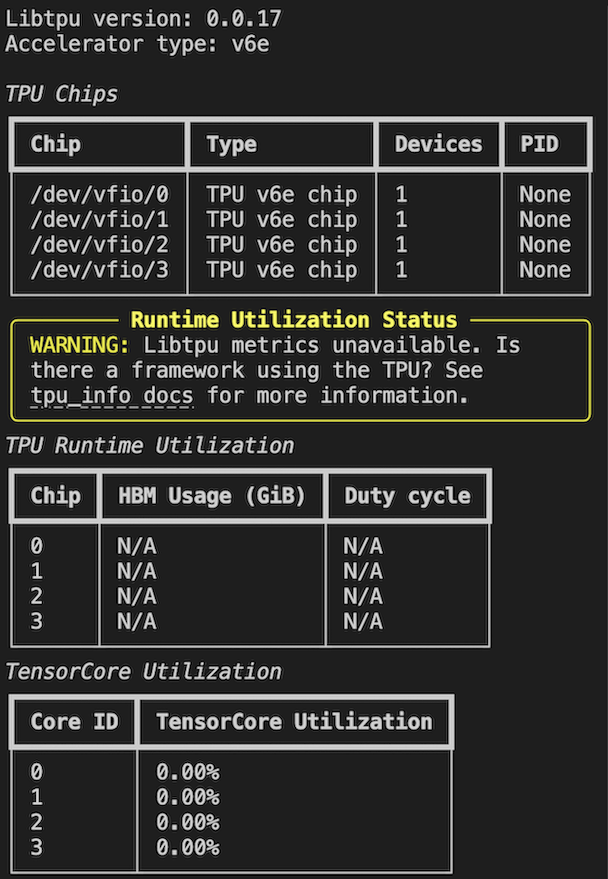
Learn more about other metrics and streaming mode in the documentation.
In this post we discussed some TPU logging and monitoring options. Next in this series we’ll explore how to debug your JAX programs, starting with generating HLO dumps and profiling your code with XProf.
[Previous] | [Next]