
随着新徽章设计,Crew-13 宇航员显然不迷信
Source: Ars Technica
It comes after 12
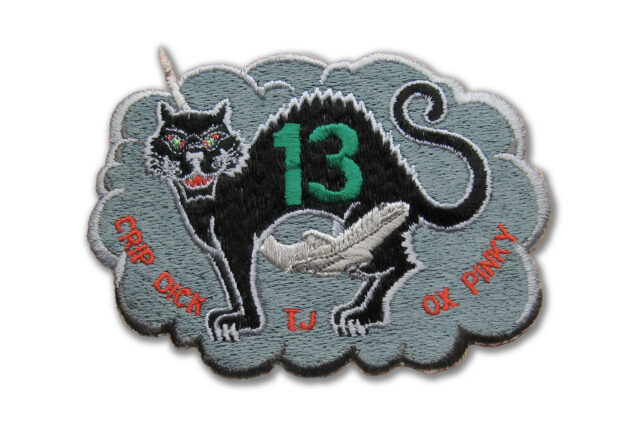
The STS‑13 crew, redesignated STS‑41‑C, created this patch that highlights superstitions and triskaidekaphobia.
Credit: collectSPACE.com
Shuttle numbering and triskaidekaphobia
Prior to Crew‑13, NASA managers leaned into the superstition and devised a less intuitive but more data‑driven designation that went into effect after the ninth space shuttle mission. Hence, what would have been STS‑13 became STS‑41‑C, where:
- 4 – fiscal year (1984)
- 1 – launch site (Kennedy Space Center, Florida)
- C – order of launch (the third planned flight of the year)
“I mentioned it was 41‑C that originally was STS‑13, and my friend Jim Beggs, who was the administrator of NASA, had triskaidekaphobia, and he said, ‘There’s not going to be [another] Apollo 13 or a Shuttle 13, so come up with a new numbering system.’ So we did come up with this complex system for numbering the shuttles during that period of time,” said Bob Crippen, STS‑41C commander, in a NASA oral history interview.
NASA later reverted to a straightforward numerical designation after the loss of the space shuttle Challenger and the STS‑51L crew in January 1986.
STS‑113 and the Apollo 13 parallel
There was an STS‑113, which launched aboard space shuttle Endeavour in 2002, but not before having to make late crew changes due to medical issues. The last time that NASA faced the same decision was on Apollo 13.
“We were joking a lot about being number 113,” commander Ken Bowersox told the press at the time. He added that to play it safe, the mission patch used Roman numerals (CXIII).
International Space Station: Expedition 13
On board the International Space Station, the 13th crewed expedition began on April 1, 2006, 10 days before the 36th anniversary of the Apollo 13 launch.
Russian program and the number 13
The Russian space program launched six crewed missions designated as number 13. At least once, the head of the country’s space agency suggested skipping the number.
“Many people have superstitious beliefs,” said Roscosmos director Anatoly Perminov, according to his press secretary, in 2008. “That’s why I think that it is a good idea to change the number of the next spaceship.”
Despite the concern, Soyuz TMA‑13 went forward as planned, as did Soyuz 13, Soyuz T‑13, and Soyuz TM‑13 before it.
- Soyuz TMA‑13M launched Reid Wiseman.
- Soyuz MS‑13 landed with Christina Koch.
Both astronauts later flew aboard NASA’s Artemis II mission earlier this month, a crewed fly‑by of the Moon that broke the distance record set by the Apollo 13 astronauts.