
마드리드 지하철을 저렴하게 건설한 방법 (2024)
출처: Hacker News
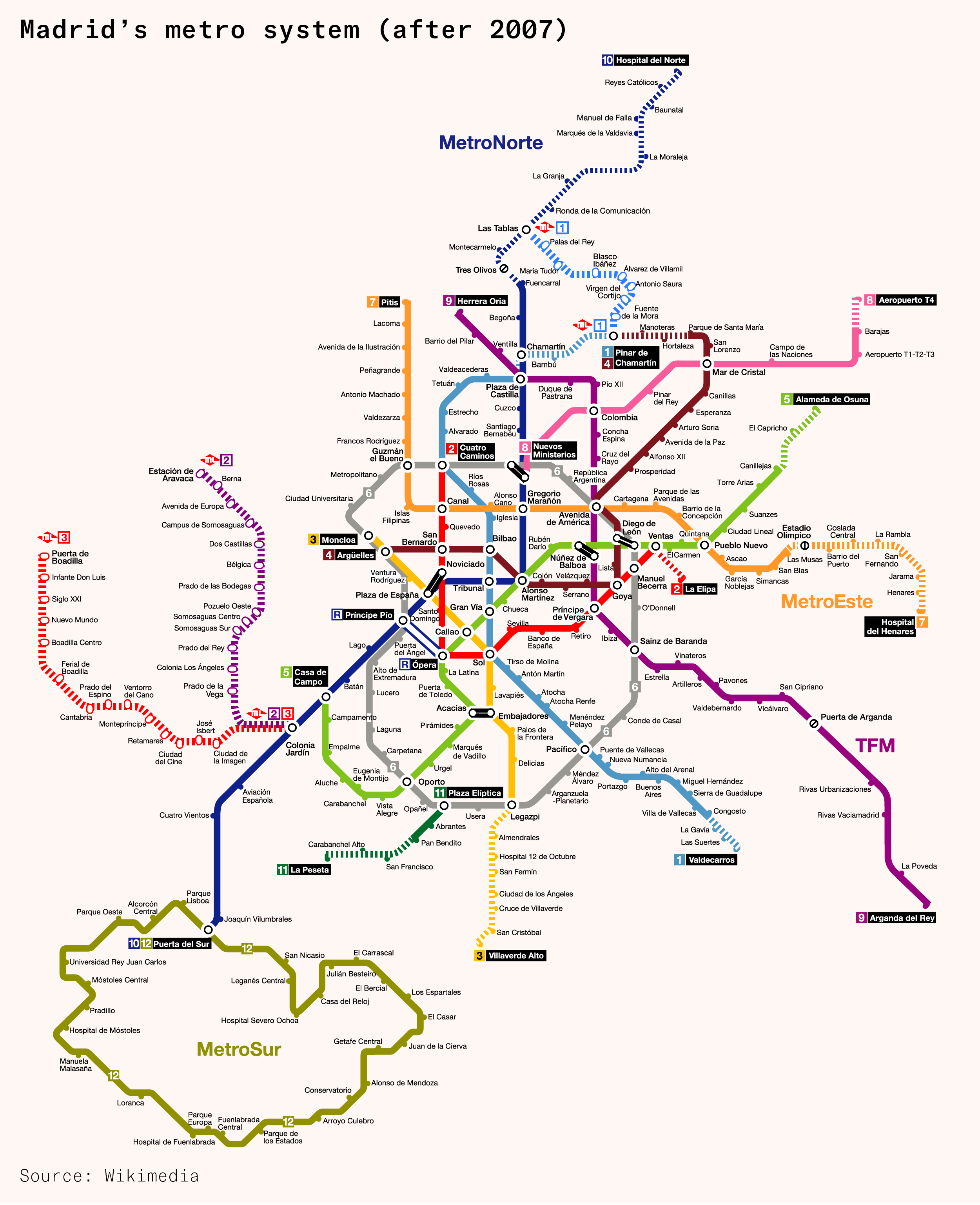
1995년, 마드리드 메트로는 71마일(114km)이었습니다. 오늘날 기준으로 이는 세계에서 51번째로 긴 메트로이며, 마드리드는 인구 기준 전 세계 57번째로 큰 도시이므로 타당합니다. 그러나 1995년은 혁명적인 건설 열풍의 시작이었습니다. 다음 12년간 메트로는 126마일(203km) 늘어났으며 거의 3배가 되었습니다. 이 확장은 베이징과 상하이에 버금가는 세계에서 가장 빠르게 성장하는 메트로 중 하나가 만들었습니다. 현재 마드리드는 중국을 제외한 세계에서 6번째로 긴 메트로이며, 런던과 모스크바에 이어 유럽에서는 3번째로 길다.
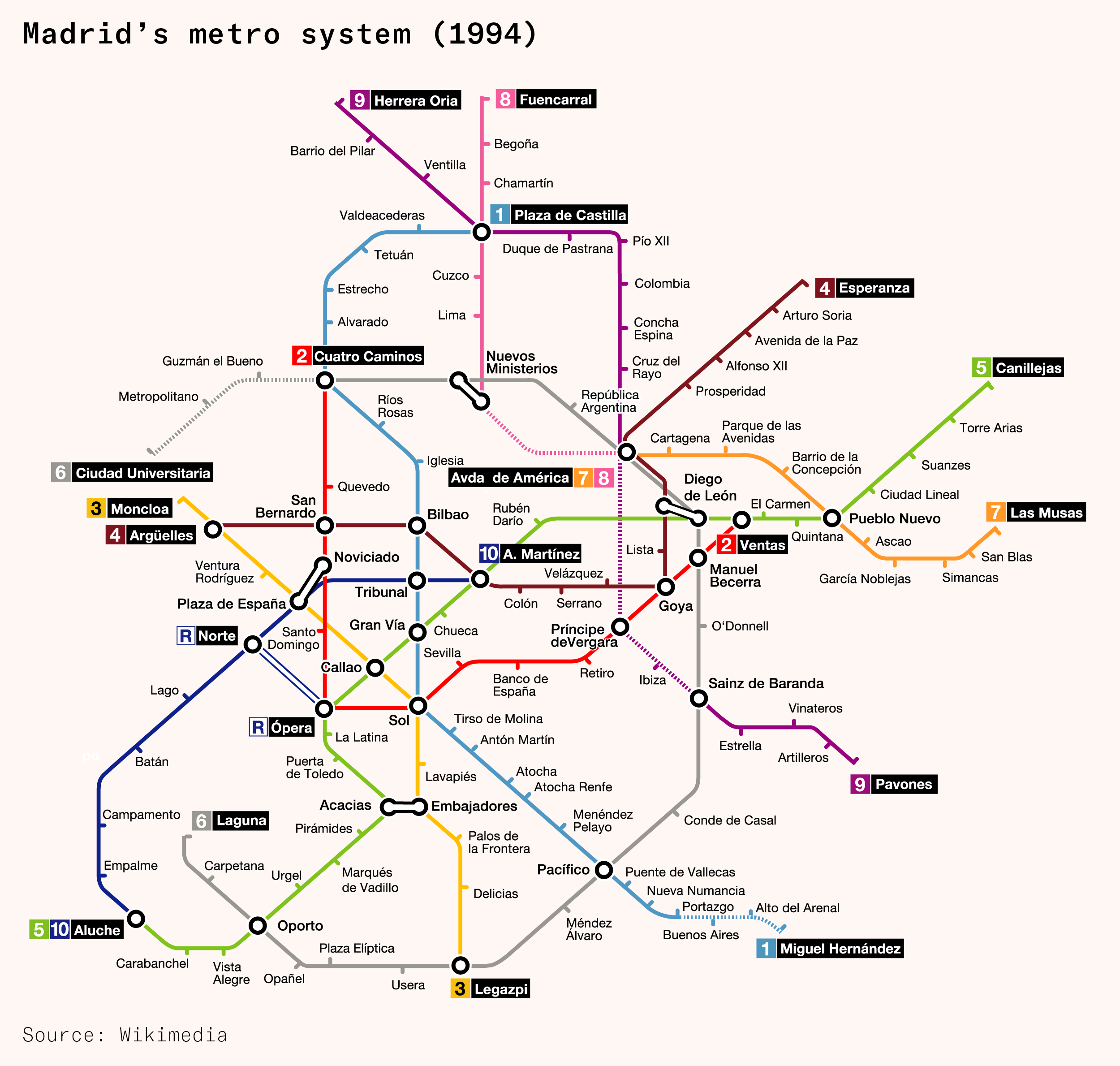
새 노선들은 마드리드 공동체(마드리드 시가 있는 지역)로 퍼져 나갔습니다. 이에는 마드리드 공항 연결, 도심 주변을 돌리는 새로운 원형선, 교외로의 연장(신규 주택과 함께), 그리고 도시 간 새로운 라인이 포함되었습니다. 또한 수도 마드리드의 남서쪽에 위치한 다섯 개의 다른 마을을 연결하는 원형선인 메트로수르(MetroSur, 남부 메트로)도 있었습니다.
Get the print magazine
Subscribe for $100 to receive six beautiful issues per year.
Subscribe
마드리드가 이렇게 많이 건설할 수 있었던 이유는 하나뿐이었습니다: 저비용입니다. 1995년부터 1999년까지 진행된 35마일(56km) 규모의 확장 프로그램은 2024년 기준 약 28억 달러(달러) 정도 비용이 들었습니다. 뉴욕의 7호선 허드슨 야드 연장(1.5마일)은 인플레이션을 고려했을 때 비슷한 비용이 듔니다. 런던의 제빌리 라인 연장은 마드리드 확장이 진행되는 동안 건설되었으며, 마드리드 프로그램보다 마일당 거의 10배 더 비쌌습니다. 세계은행은 마드리드의 비용을 ‘국제적으로 가능한 수준보다 상당히 낮다’고 설명했습니다. 1990년대 이후 마드리드와 스페인 전체는 유럽에서 가장 낮은 비용으로 인프라를 계속 건설해 왔습니다.
Madrid’s success provides four key lessons for policymakers and engineers in places that struggle to cheaply build new transit.
- City-level powers rewarded fast, inexpensive delivery. The structure of the Community of Madrid concentrated the planning, funding, and construction powers at the right level to deliver the project. This enabled political entrepreneurs to make electoral promises about delivering new infrastructure and have their political fortunes dependent on success.
- Time is money. The regional government streamlined environmental and planning processes and the company that oversaw construction expedited the building by tunneling 24/7.
- Trade-offs matter and need to be explicitly considered. The metro planners recognized the trade‑offs that exist between station design and cost, signaling complexity and how much testing is required, and tried‑and‑tested technology versus innovation.
- A pipeline of projects enables investment in state capacity. Madrid built the necessary state capacity to deliver the project, with experienced engineers and managers working in‑house to deliver the technical design and oversee construction. The public company tasked with construction could pay extra to hire experts and procured based on cost and quality instead of just the lowest‑cost bid.
Lesson 1: City-level powers rewarded fast, inexpensive delivery
Following the restoration of democracy in Spain after decades under Francisco Franco, the 1978 constitution created 17 autonomous communities. These function like an American or Canadian federal state, and include the Basque Country, Catalonia, Andalusia, Madrid, and so on. Each of them has an elected parliament, which in turn chooses the President of the Community (a bit like the UK Parliament in Westminster). The Community of Madrid includes the city of Madrid and other outlying cities and towns and is a little larger in size than the US state of Delaware and a little smaller than Île-de-France, the French region including Paris.
Some countries, like Britain, have a centralized system, where the approval of new local transport projects is at the discretion of national ministers and Parliament, and funding for construction mostly comes from the Treasury and national taxes. This system creates friction as local authorities have to continually ask the central government for permission to build and for funding. Once they’ve been given funding, there are limited incentives to keep costs down as local leaders are spending someone else’s money on construction.
The Community of Madrid demonstrates a more successful structure. Madrid’s regional assembly has high flexibility in levying taxes, including income and VAT, approves a roughly €25 billion budget (68 percent higher than London’s budget per capita), and is in control of the Regional Consortium of Transportation for Madrid, much as the state of New York controls the Metropolitan Transit Authority (MTA). The regional consortium, in turn, funds and oversees the Madrid Metro, light rail, and urban buses.
The winner of regional assembly elections has all of the levers of control over a project at their disposal. They can approve new projects, fund those projects by borrowing, and oversee the construction to deliver the project. Enterprising politicians at the regional level of government could claim that they are going to build metro extensions, and then have the power to build; in turn their political fortunes would be tied to successfully delivering the project.
When there are multiple levels of government at work or the size of the area that the government is responsible for is much larger or smaller than the area the project affects, as in Britain and America, it is harder for one politician to take ownership over the construction of a project. This limits the accountability of those in charge if something goes wrong, weakening the incentives and ability of politicians to take full responsibility for successfully delivering the project.
The beginning of the metro’s rapid growth happened in the run-up to the 1995 regional assembly election. The election pitted the incumbent left-leaning Spanish Socialist Workers’ Party (PSOE) against the center-right People’s Party (PP). Instead of debating whether or not to expand the metro, the two parties competed on how much they could feasibly build within the next four-year term.
The PP candidate for Assembly President, Alberto Ruiz-Gallardón, promised to deliver 30 new miles (48 kilometers) of metro by the next election, compared to the 14 miles (23 kilometers) the PSOE had delivered during their previous 15 years in government. With this pledge, the PP won a majority and Ruiz-Gallardón was duly elected president.
Madrid’s four-year electoral cycles gave tight timelines for projects being done. Yet with strong political commitment and the knowledge that fulfilling headline electoral promises would be rewarded by voters, extensions were delivered within four-year windows.
Throughout construction, community engagement remained limited and top-down. The metro planners held public meetings, but they were informational rather than consultative. Some feedback was solicited, but this generally involved the location of entrances of stations, not whether the line should go ahead or where it should run to. If a majority of the residents affected by some sub-element of the program, such as the location of an entrance,