
Your next phone needs this new tech to stop it ruining your sunset photos
Source: Android Authority
Overview

Hadlee Simons / Android Authority
Whether you’re snapping a family portrait or capturing the city at night, today’s best smartphone cameras are undoubtedly brilliant. Computational photography, multi‑lens systems, and ever‑larger sensors have pushed image quality to levels that would’ve seemed impossible at the start of the decade. But while most of the attention goes to new software tricks and megapixel counts, some of the most meaningful improvements are happening deeper in the camera stack, helping smaller mobile sensors catch up with larger mirrorless cameras.
If you’ve been reading through camera spec sheets lately, you might have spotted the term LOFIC appear next to some of the industry’s latest high‑end camera sensors—namely, on the Xiaomi 17 Ultra and the HUAWEI Pura 80 Ultra, two powerhouse mobile camera setups. These phones already boast serious camera credentials, but LOFIC isn’t about flashy features or AI processing. Instead, it’s a fundamental change in how sensors handle light.
The acronym might not mean much at first glance, but LOFIC represents a clever hardware solution to one of photography’s oldest problems: capturing both bright highlights and deep shadows in a single exposure. To understand why that matters — and why it’s such a big deal for mobile cameras — we need to start with how an image sensor actually captures light.
What is LOFIC?
LOFIC stands for Lateral Overflow Integration Capacitor. The name hints at what the technology does, but first let’s review how a typical image sensor captures light.
A quick primer on image‑sensor operation
- Pixels – Each pixel contains a color filter and a photodiode.
- Charge collection – When photons hit the photodiode they generate charge that is stored in a capacitor (sometimes called a well).
- Read‑out – After the shutter closes, the voltage on the capacitor is measured as an analog signal.
- Amplification (ISO) – A predetermined gain (ISO) is applied to map the raw voltage into a usable digital range, balancing highlights and shadows.
The problem is that a single gain value can’t simultaneously optimise both very bright and very dark regions:
- Low gain → highlights stay unclipped, but shadows become noisy or under‑exposed.
- High gain → shadows are bright enough, but highlights saturate (clip).
Because of this limitation, many phone cameras rely on tricks such as multi‑exposure HDR or on‑sensor dual‑ISO techniques to extend dynamic range.
How LOFIC works
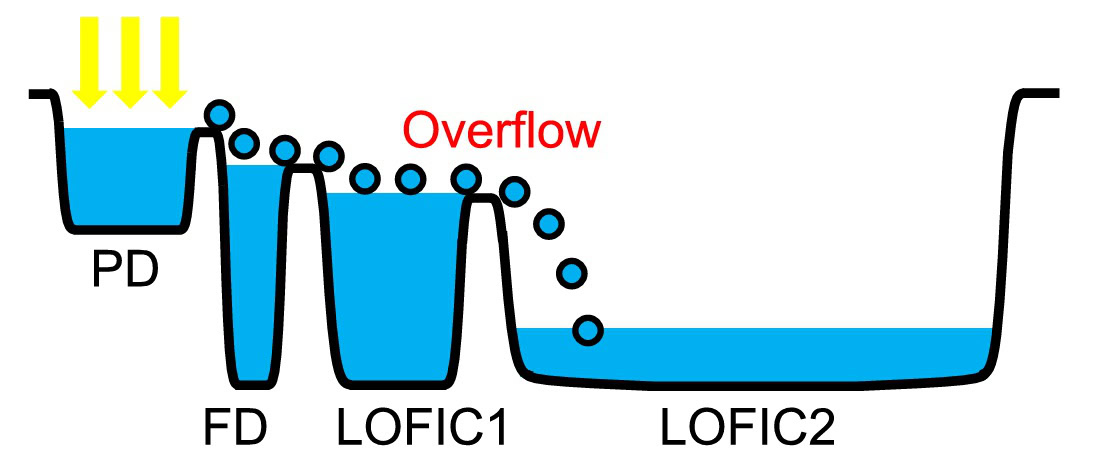
LOFIC concept diagram (illustration)
LOFIC adds extra overflow‑capacitor wells to each pixel:
- The first (small) well is highly sensitive and captures low‑light charge.
- When this well fills, excess charge overflows into a second, larger well that can handle brighter illumination.
During read‑out the sensor can apply different gains to each well (e.g., high gain for the “shadow” well and lower gain for the “highlight” well). The result is:
- Accurate detail in both shadows and highlights.
- An extended dynamic range from a single exposure, without relying on software HDR.
Caveats
- Modern sensors also use multiple capacitor wells for other functions such as phase‑detection autofocus and dynamic gain selection.
- Real‑world performance depends on many additional factors (noise reduction, lens quality, processing pipeline, etc.).
Nevertheless, the core idea is sound: by splitting raw light‑capture information into multiple levels, LOFIC lets the camera optimise signal gain for each level, delivering a wider dynamic range in a single shot.
How LOFIC Actually Improves Your Photos
Paul Jones / Android Authority
Even if the inner workings of LOFIC feel a bit abstract, its goal is simple: capture more of a scene’s real‑world contrast in a single shot. That means preserving bright highlights without sacrificing shadow detail—something that’s especially challenging for smaller smartphone sensors.
Traditional HDR vs. Dual‑ISO vs. LOFIC
| Feature | Software HDR | Dual‑ISO (Dual Conversion Gain) | LOFIC |
|---|---|---|---|
| Motion handling | Moderate | Excellent | Excellent |
| Highlight retention | Good | Good | Excellent |
| Shadow detail | Moderate | Good | Excellent |
| Noise in dark areas | Moderate | Low | Very low |
| Single exposure? | No | Yes | Yes |
Traditional software HDR stacks multiple exposure frames. While effective, it can suffer from ghosting, halos, or blurred detail when subjects move between frames (high‑end algorithms mitigate this to some extent).
Dual‑ISO (or Dual Conversion Gain – DCG) sensors read the same exposure at two different gain levels and merge the results. This improves sensitivity and dynamic range while avoiding motion artifacts, but the hardware is usually limited to two gain stages and rarely operates per‑pixel.
LOFIC (Low‑Overflow‑Full‑Well‑Integrated‑Circuit) changes the sensor’s ability to measure light. Instead of a single charge well—or just two gain readouts—LOFIC‑equipped pixels use additional overflow capacitors to catch excess charge from bright areas. The result is:
- smoother highlight roll‑off and reduced clipping,
- cleaner shadow detail with lower noise,
- per‑pixel gain optimization without amplifying noise, and
- fewer HDR artifacts because the sensor captures the full dynamic range in a single exposure.
The trade‑off is more complex (and therefore more expensive) sensor manufacturing.
Dynamic‑Range Numbers (Illustrative)
- Conventional HDR approaches: ~60–90 dB effective dynamic range (varies with sensor and algorithm).
- OmniVision 1‑inch OV50X (DCG + LOFIC): Specified at ~110 dB at the sensor level.
Note: Exact numbers depend on sensor design, processor support, and real‑world implementation, so treat these figures as a general guide rather than absolute benchmarks.
Visual Example
OmniVision
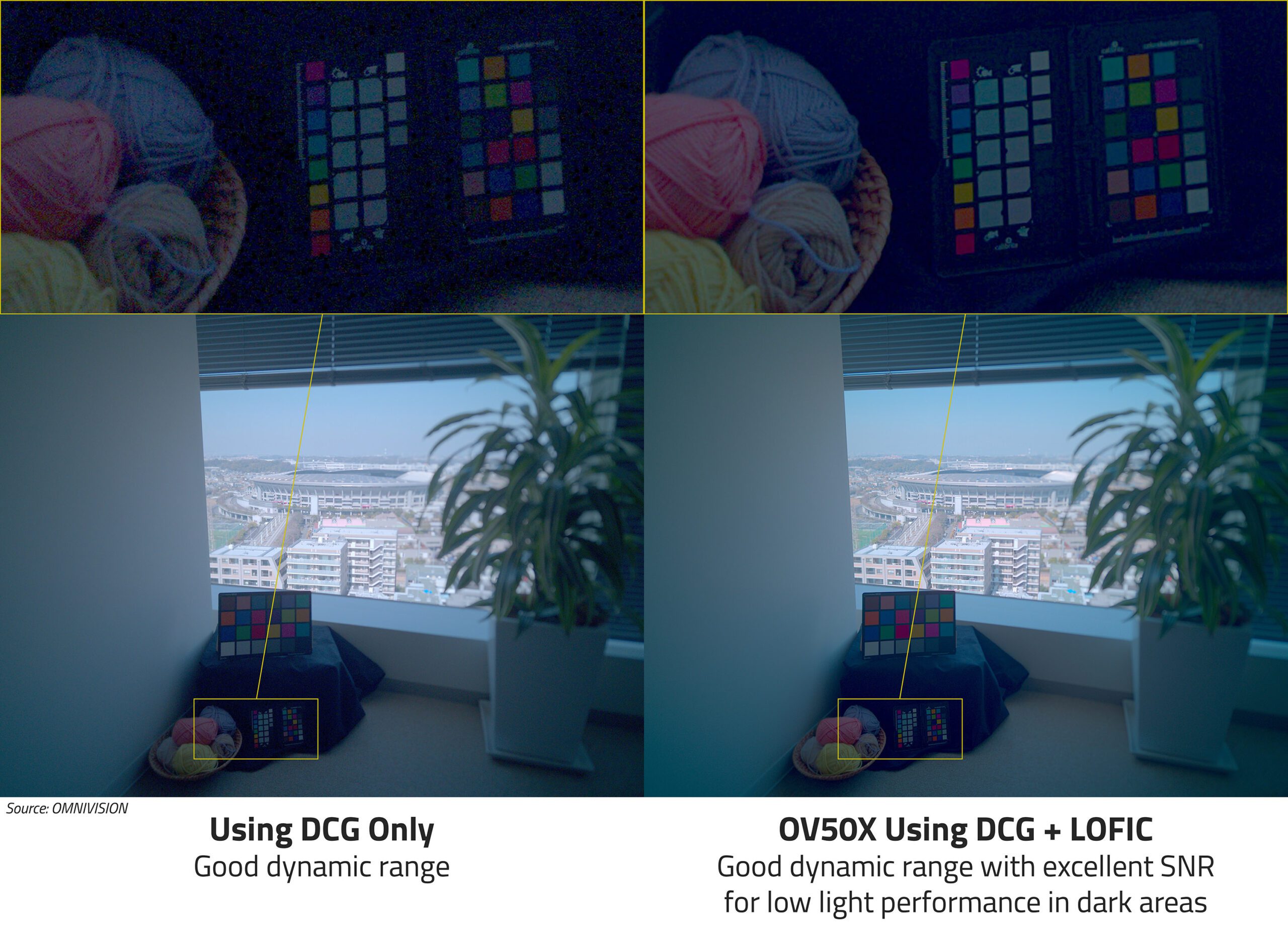
Imagine shooting a silhouetted cityscape against a bright sunset. A conventional or even a dual‑gain sensor may render the sun and clouds as flat, blown‑out white shapes, while crushing shadow detail. With LOFIC, the sensor retains color and gradient in the brightest sky regions and still lifts detail from the shadows below. The same principle applies to night cityscapes, where bright streetlights and deep‑shadowed alleys coexist without one overwhelming the other.
Benefits for Video
Because LOFIC operates entirely in hardware on a per‑frame basis, its advantages extend to video:
- each frame captures a wider dynamic range,
- natural colors are preserved,
- highlights stay un‑blown, and
- shadow detail remains visible—all without multi‑frame processing.
In short, LOFIC provides a hardware‑level solution to dynamic‑range challenges, delivering cleaner highlights, richer shadows, and lower noise across both photos and video.
Next‑Gen Imaging Is Here – But Not for the Masses Yet

Photo credit: Joe Maring / Android Authority
While the LOFIC (Low‑Frequency Capacitor) concept isn’t brand‑new, it represents an exciting step forward for mobile photography. As with many cutting‑edge sensor technologies, LOFIC is currently limited to a handful of Chinese flagship phones and may remain that way for a while. It’s unclear when the traditionally slower Western players—Apple, Google, and Samsung—will adopt the tech for their future flagships.
Limitations to Consider
- Increased sensor complexity – Adding overflow capacitors can raise cost, power draw, and heat output.
- Space constraints – LOFIC’s capacitors require extra real‑estate, so they’re presently used only in larger sensors that already deliver high image quality.
- HDR & AI remain relevant – Even with LOFIC, extreme high‑contrast scenes can still benefit from multi‑frame HDR, computational techniques, and object‑segmentation processing. These software improvements are complementary rather than replaceable.
Because of the size requirement, LOFIC is less useful for the tiny, light‑starved sensors found in selfie cameras and long‑range zoom modules. Hopefully, future miniaturisation will bring the benefits to those use‑cases as well.
Looking Ahead
If hardware continues to evolve and LOFIC‑style sensors become more common, smartphones could capture a dynamic range that rivals larger cameras—not just in stills but also in video. Coupled with ongoing software innovations, the next generation of mobile imaging may finally close the gap between small sensors and professional‑grade photography.
Bottom line: Keep an eye on LOFIC technology when evaluating your next high‑end camera phone.
Thank you for being part of our community. Please read our Comment Policy before posting.