
The Tanegashima Shift: The Tragedy and the Ascension of the Samurai Coder
Source: Dev.to
📊 Visual Summary
Want a quick overview? Check out our Tanegashima Shift infographic that illustrates the historical parallel between the gunpowder revolution and AI’s disruption of software development.
The year is 1575. The plains of Nagashino, Japan.
- On one side stands the Takeda clan, legendary for their cavalry—the terrifying “Red Devils.” These men had spent decades mastering the way of the horse and the spear. They were the “10× Engineers” of feudal warfare.
- On the other side stands Oda Nobunaga’s army. They were not elite; many were ashigaru (foot soldiers)—peasants plucked from rice fields. In their hands, however, they held a piece of technology that had arrived on a Portuguese ship just thirty years prior: the Tanegashima (match‑lock musket).
When the smoke cleared, the Takeda cavalry was decimated. The age of individual martial prowess as the decisive factor was over. The age of the machine had begun.

We are currently standing on the plains of our own Nagashino. Artificial Intelligence is the Tanegashima. As we look at this revolution, we must not only look forward with excitement but also look back with a heavy heart. For the samurai who loved the blade, this new era is a tragedy.
I. The Arrival of the Black Ships: The Disruption
In 1543, when the Portuguese first demonstrated the arquebus, the samurai were unimpressed. It was clumsy, slow, and lacked the “soul” of the katana.
When GPT‑3 and Copilot arrived, senior developers scoffed: “It hallucinates,” they said. “It writes insecure code.” They were right. Yet Oda Nobunaga won at Nagashino not because the musket was elegant, but because it allowed him to scale. He could take a peasant (ashigaru), train him for a week, and have a functional soldier.

Right now, a single junior developer (ashigaru), equipped with AI, can ship full‑stack features that previously required a dedicated backend and frontend team. The code may not be artisan, but the scope of what one person can deliver has fundamentally changed.
II. The Tragedy of Resistance: The Satsuma Rebellion of Code
This is the part that saddens me the most.
History tells us of the Satsuma Rebellion in 1877—the uprising of the last samurai. These were not evil men; they were men of honor who refused to let go of the “old way.” They believed the spirit of the warrior was found in the discipline of the sword, not in the cold mechanism of the gun. They charged into rifle fire and died for their beliefs.

We see this today in our own community. Brilliant senior engineers—true masters of the craft—are resisting this change with every fiber of their being because they love the art of hand‑crafted code.
It is heartbreaking because they are right; there is beauty in the craft. But the market is the Meiji government. It does not care about the “art.” It cares about the outcome. And sadly, the samurai who cling only to the sword—who refuse to touch the gun out of pride—will find themselves fighting an industrial war with artisanal weapons.
III. The Transformation: From Swordsman to Daimyo
The “Fall of the Samurai” does not have to mean death. It means the transformation of the role.
The smart samurai—the ones who saw the future—did not stay in the trenches swinging swords. They realized that their deep discipline, education, and strategy were too valuable to be wasted as foot soldiers. They ascended.
1. The General (Solution Architect & Tech Lead)
The ashigaru (AI‑augmented junior) can shoot, but they cannot aim. They do not know where to position the troops. The senior developer must become the General. You have deep knowledge of the “terrain” (system architecture). In an AI‑driven world, responsibility shifts upward: the person who defines the constraints owns the failures. Your job is no longer to fight in the mud; it is to command the AI legions and accept accountability for the outcome.
2. The Hatamoto (Elite Specialist)
Some become the Hatamoto—the shogun’s direct bannermen. These are elite individual contributors (ICs). They use AI, but they know when to shut it off. When a critical bug threatens the entire system, or performance needs optimization, they intervene with their expertise, ensuring the AI’s output aligns with the highest standards.
3. The Lord of the Realm (Product Owner & Project Manager)
The highest evolution is the Daimyo—the Lord. This is the Technical Product Owner or Project Manager. Because you understand the true cost of war (coding effort), you move from how to build to what to build (strategy) and when to strike (schedule).
4. The Entrepreneur (The Empire Builder)
Yataro Iwasaki was a samurai who traded his sword for a ledger and founded Mitsubishi.
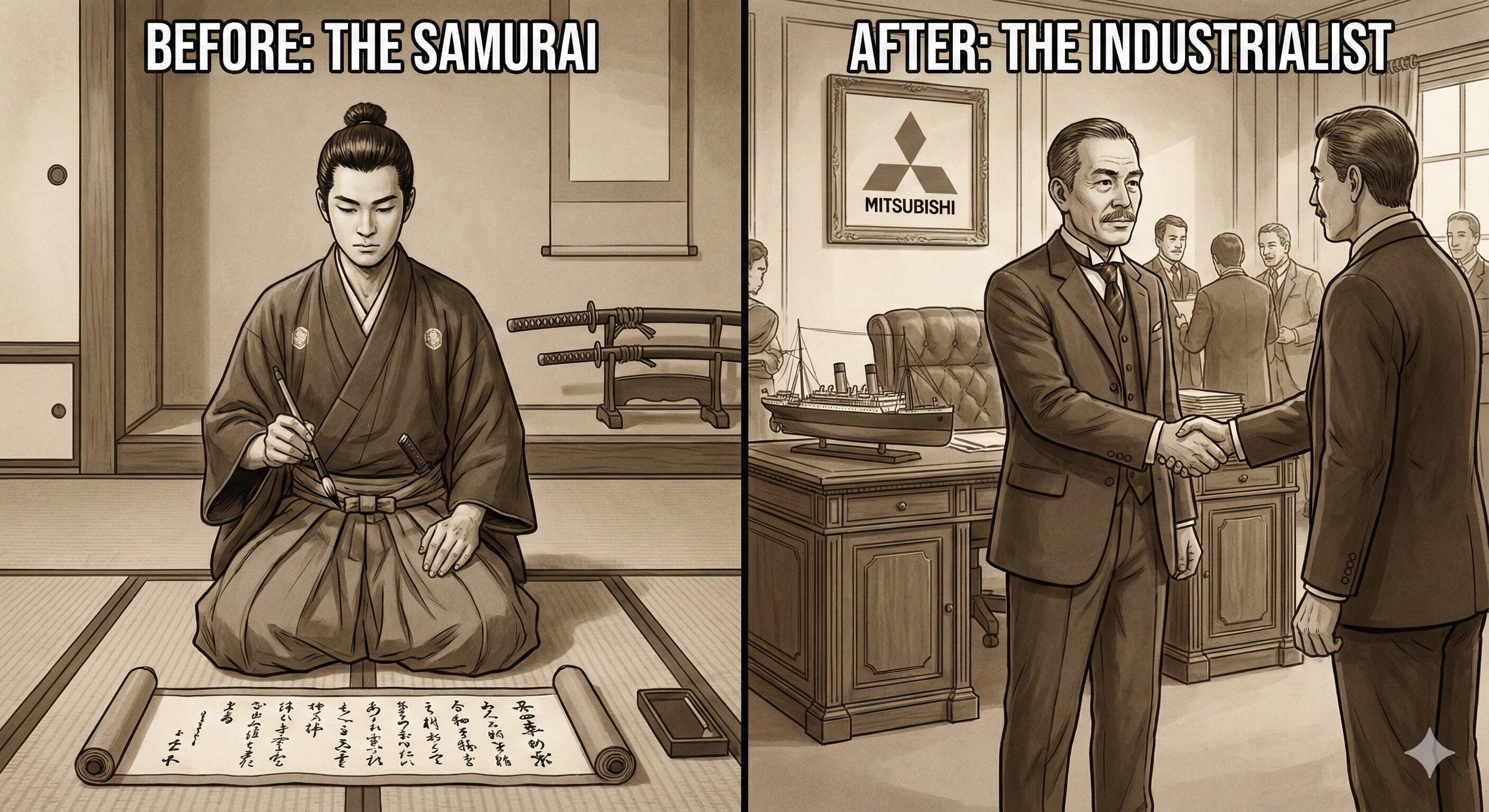
The Samurai is uniquely positioned to become the Entrepreneur because they have the discipline to execute and the deep knowledge to direct the AI‑built product.
IV. The Ashigaru Trap and The Hideyoshi Path
Here lies the warning—and the greatest opportunity—for the new generation.
The gun/AI has democratized coding. It has opened the path for “Conscript Coders”—people entering the industry with only surface‑level prompting skills. They feel powerful. They are shipping apps.
The Trap: When the Ammunition Runs Out
AI is probabilistic. It hallucinates. It runs out of training‑data “ammunition” on edge cases.
- When the server crashes with an obscure memory leak…
- When the AI generates code that introduces a race condition…
- When the “gun” stops firing…
The illusion shatters.
In that moment of chaos, the Conscript Coder (Ashigaru) who relies 100 % on the tool is left exposed. They stare at the error log like a peasant holding a broken musket—vulnerable.
The Opportunity: The Path of Toyotomi Hideyoshi
History provides a counter‑narrative to the “slaughtered peasant”: the story of Toyotomi Hideyoshi.
Hideyoshi was born a peasant with no surname—the lowest of Ashigaru. He joined Oda Nobunaga as a lowly sandal‑bearer. In a rigid feudal society, he should have remained a servant forever.
But Hideyoshi did not just carry sandals. He observed, studied strategy, understood logistics, and embraced the new ways of warfare with fervor. Through sheer intelligence, competence, and discipline, he rose to become Nobunaga’s greatest General, and eventually the Taikō—the supreme ruler of all Japan.
This path is open today. A Junior Dev (Ashigaru) without a traditional CS degree now has access to the “Gun” (AI) that levels the playing field. If they stop there, they remain a foot soldier.
If that Ashigaru uses the time saved by AI to obsessively study the “blade”—to learn distributed systems, data structures, and business architecture with the same discipline as the Samurai of old—they will become unstoppably powerful. They will possess the speed of the new world and the depth of the old.
The complacent Samurai who rests on their laurels will not just be replaced by AI; they will be ruled by the Ashigaru who out‑learned them.
V. The Outlook
The feudal class system of coding is ending. The rigid barriers that kept outsiders from building software have crumbled.
This shift is not automatic; it depends on how we choose to wield the tools.
- To the Resistors: We mourn the loss of the “Pure Craft.” But do not let your pride be your end.
- To the Samurai (Senior Devs): Do not fear the gun. Pick it up. Combine it with your years of discipline. Ascend to become the Generals and Daimyos the world needs.
- To the Ashigaru (New Devs): The gun gives you a start, but it does not give you mastery. Relying solely on the tool will break you when it jams. Study the blade while wielding the gun, and the path of Hideyoshi opens to you. You may just surpass us all.
The Samurai is not dead, but he must take off his armor and learn to lead. The Peasant is no longer helpless, but he must discipline his mind to become a Lord.
What path will you choose? Share your thoughts in the comments or connect with me on LinkedIn. The future belongs to those who see the shift coming and adapt before the smoke clears.