
The rise of the fruit that tastes like custard
Source: BBC Technology
The rise of the fruit that tastes like custard
12 hours ago
Priti Gupta – Technology Reporter, Mumbai

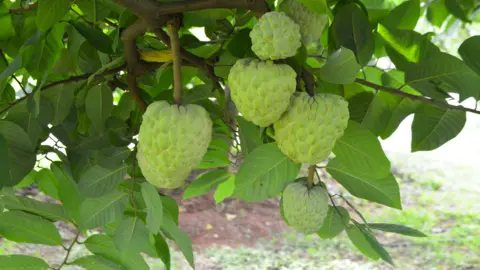
IIHR Bangalore
Custard fruit trees can survive months without watering.
Ashoka Shivareddy comes from a family of farmers, but it was hard to make a living in their drought‑prone district of Kolar in southern India.
“The area receives rainfall of only 60 to 70 centimetres, and farmers dig borewells of up to 1,300 feet – most of their money goes into chasing water,” he says.
Amid mounting losses the family gave up farming and, in 2005, moved to the city – to Bengaluru – and started a vegetable shop.
Shivareddy became an AI software engineer, but he never lost the farming bug.
In 2018 he decided to revive the family farm, but with a more scientific approach.
“I was looking for a crop that could survive with very little water, grow with rainfall, and not depend heavily on pesticides,” he explains.
Custard apple seemed a good fit: a knobbly fruit the size of a large avocado, its creamy, sweet flesh tastes a bit like custard – hence the name.
Custard apple trees grow wild in Shivareddy’s area and locals harvest the fruit and sell it at the market. That seemed promising to him.
Looking to maximise his yield, he planted trees closer together than on typical farms and carefully selected three varieties, each with different benefits. The approach appears to be working.
“Last year I produced around 20 tonnes. This year, it’s about 25 tonnes. There is huge demand for custard apple in India and abroad,” he says.
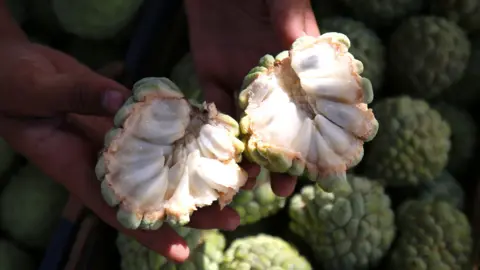
Getty Images
The sweet, creamy flesh of the fruit tastes a bit like custard.
Challenges
While custard apples can survive in dry conditions, there are challenges to growing them.
The traditional variety Balangar has a very short shelf life—sometimes as little as three or four days—limiting the farmer’s selling options. It also contains many seeds, making it less attractive to customers.
“Traditional varieties have excellent flavour, but they suffer from low pulp content, high seed count, and a very poor shelf life,” says Dr Sakthivel T, principal scientist at the Indian Institute of Horticulture Research (IIHR) in Bangalore.
His team developed a hybrid fruit, Arka Sahan, which can survive for a week at room temperature and has fewer seeds and more pulp. Over the past 20 years this variety has spread across southern India.
“The shift from 30 % pulp recovery in wild varieties to 70 % recovery in hybrids like Arka Sahan has effectively doubled the usable harvest for farmers without needing more land,” Sakthivel says.
The team is now looking at better ways to process the fruit and extract the pulp so it can be used in processed foods such as ice‑cream and milkshakes. One problem they are tackling is that custard‑apple pulp turns brown very quickly after extraction. Researchers at IIHR are experimenting with new equipment and techniques to keep the pulp’s milky colour longer.
Regional production
The central Indian state of Maharashtra is the leading producer of custard apples, accounting for almost a third of the national output. It’s where Navnath Malhari Kaspate has been farming the fruit for decades.
He travelled across India collecting seeds and brought them back to his farm where he cross‑pollinated them.
“No one had really paid attention to custard apple or done research, so I decided to keep working on it. It takes 12 to 15 years to develop a new variety. This is not quick work – it’s decades of experimentation,” he says.
His work resulted in the NMK‑01 (named after his initials) variety, known for being high‑yielding. It went on sale in 2014.
“We now grow custard apple on nearly 50 acres, with yields of about 10 tonnes per acre. This improved variety, which does not get spoiled quickly, has created opportunities for export. We started exporting to Gulf countries and even sent it to Europe, something that hadn’t been done before at this scale,” he says.
Kaspate’s development work continues; he is currently working on a variety with an improved appearance and greater disease resistance.
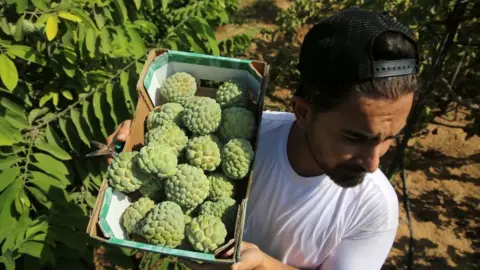
Getty Images
Custard apples have a short shelf life and have to be rushed to market.
Export logistics
Manoj Kumar Barai exports the NMK‑01 variety to the US, UAE, Saudi Arabia and Europe.
“For exports we prefer the NMK‑01 variety because it has better shelf life, thicker skin, more pulp, and a sweeter taste compared to others,” he says.
Nevertheless, exporting such a delicate fruit requires an intricate process.
“We have to plan everything precisely – harvesting time, transport to pack houses, airport transfer, flights, customs clearance – every hour matters.”
Temperature control is critical.
“Custard apple is highly sensitive to heat, and even short exposure can reduce its shelf life,” he says.
Road journeys are often done overnight to avoid the worst of the heat.
“In regions like Maharashtra, temperatures can go up to 40 °C, and even during transit it can reach 30–35 °C, which is not ideal for this fruit.”
The fruit i … (the original text ended abruptly here).
Technology of Business
The fruit is pre‑cooled for five hours before being packed and transported in refrigerated vans, then stored in cold rooms before being air‑freighted.
Special corrugated boxes have been developed to protect the fruit and help keep it cool.
More fruit is being exported as pulp or in a powder form, which is a “revolution” for the export industry, says Barai.
- Pulp is used by overseas ice‑cream makers, bakeries, and “pulp‑shot” cafés.
- It isn’t simple, as the pulp must be stored and transported at ‑18 °C.
- Nevertheless, it is still cheaper than air freight and allows large volumes to be moved over weeks without any fruit going to waste.
Back in Kolar, Shivareddy wants to expand his business by selling pulp as well as whole apples. He plans to set up a pulp‑processing unit that would use the portion of his crop he can’t sell.
Extracting the pulp and chilling it to ‑20 °C involves significant investment in equipment, which, he says, will require a change in mindset for many farmers.
“Custard apple sits in a strange gap. Demand is rising, but the farming hasn’t gone high‑tech as the crop is naturally hardy. It grows in poor soil, needs very little water, and survives on rainfall.