The physics of how Olympic weightlifters exploit barbell's 'whip'
Source: Ars Technica
Olympic Weightlifting and the “Whip”
Olympic weightlifting consists of three basic movements performed on a barbell: the snatch, the clean, and the jerk (the latter two are executed in combination). At the elite level, athletes seek to exploit every possible advantage, including how a barbell bends and recoils in response to loaded weight and applied force—a property known in physics as flexural bending and dubbed the “whip” by Olympic athletes.
Scientists are learning more about the underlying mechanisms of the whip, according to a presentation at this week’s meeting of the Acoustical Society of America in Philadelphia.
“They told me how they use the whip. When they dip down, they can feel when the bar flexes back up and use that to accelerate the movement upward to increase the amount they can lift.”
— Joshua Langloist, graduate student at Pennsylvania State University
The Study
Joshua Langloist, who competes in Strongman competitions as a hobby, decided to conduct a modal analysis (i.e., how an object moves or vibrates) to quantify the whip and better understand the mechanics of a good barbell at the elite level.
- Setup – He suspended four 20‑kg men’s barbells (women use 15‑kg barbells) with 50 kg loaded on each end from elastic resistance bands so that each bar was essentially floating in space.
- Instrumentation – Accelerometers were attached to each end of the bar where vibrational mode patterns occur.
- Excitation – He tapped set locations across the bar with a small hammer, measuring the acceleration at the endpoints.
- Analysis – The data allowed him to map out how the bars moved in response, comparing the vibrations of different barbells and a single barbell loaded with varying weights.
The findings shed light on how bar flex and recoil can be harnessed to improve lift performance, offering both athletes and equipment designers valuable insights.
For more background on Olympic weightlifting, see the Wikipedia article on Olympic weightlifting.
Sleeves or No Sleeves?
Langloist found that the standard motion of a bar floating freely in space has a higher frequency without sleeves—i.e., the outer, thicker area of the bar that holds the plates and can rotate independently of the central shaft—than with sleeves. This was an expected result, since adding mass to the ends of a bar typically decreases the rate of oscillation and shifts the nodes (the points where the bar is stationary).
The surprise came when he examined the higher bending (flexural) modes. In that case the frequency increased at higher loads.
“The bar becomes more fixed so the actual wavelength of the bar is less,” Langloist explained. “With a set wave speed, wavelength is inversely proportional to the rate of oscillation, so we get a higher frequency. This is something we did not foresee happening. So the barbell is likely to matter.”
Experimental Setup
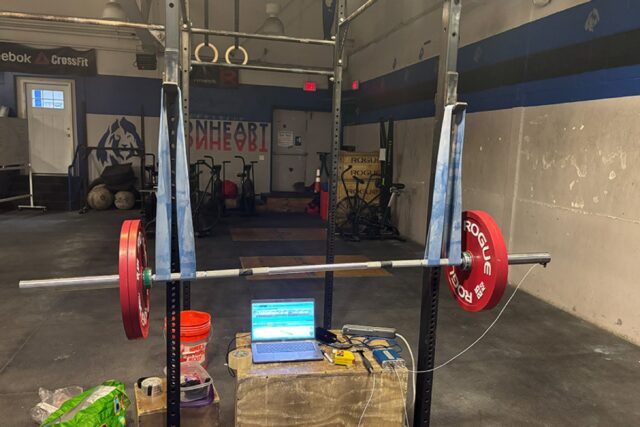
Credit: Joshua Langloist
Granted, the effect is small—about 1 %—but for elite sport that can be decisive.
“I am not an expert Olympic weightlifter. I have a hard time timing the whip; it’s hard for me to feel it exactly. There’s a similar thing with golfers. The best golfers can actually feel how the club bends as they swing and use that to change how the ball flies. I don’t expect casual lifters to exploit this; it’s for the very elite level.” – Langloist
What Makes a “Good” Barbell?
Olympic barbells share the same weight, diameter, and length, but they differ in several ways:
| Feature | Typical Variations | Effect on Whip |
|---|---|---|
| Material | Stainless steel, chrome‑coated steel, etc. | Small differences in stiffness (Young’s modulus) affect vibration. |
| Sleeve coupling | Bushing (solid), bearing (rotating), hybrid, or bare steel | Bearings usually provide the best coupling and are found on expensive bars. |
| Manufacturer transparency | Proprietary designs; exact specs rarely disclosed | Makes it hard to predict performance without testing. |
Manufacturers usually recommend bushing sleeves for slower, heavy lifts and bearing sleeves for fast Olympic lifts.
“Bearings seem to have the best coupling, and that’s what most expensive barbells use.” – Langloist
What’s Next?
“We know that the bar matters. It changes shape, changes frequency, with load. So now we’re going to take data with real Olympic weightlifters—men and women—to see exactly how they use the whip and how the bar matters for them.” – Langloist
About the Author

Jennifer Ouellette is a senior writer at Ars Technica focusing on the intersection of science and culture. She lives in Baltimore with her spouse, physicist Sean M. Carroll, and their two cats, Ariel and Caliban.
Comments: 16
Related image: