Legal fail: Don’t use AI to sue Facebook users for calling you a bad date
Source: Ars Technica
Fake Citations Dashed a Dude’s “Are We Dating the Same Guy” Revenge Lawsuit
An attempt to pressure Meta into removing a critical post from a Chicago Facebook group called “Are We Dating the Same Guy” may end in sanctions for lawyers whose takedown arguments appeared to rely on fabricated AI citations to support doxing claims.
Background
- Plaintiff: Nikko D’Ambrosio
- Allegations: Over two dozen women defamed him; Meta allegedly boosted the post to profit from its “entertainment value.”
- Procedural history: The district court dismissed the case with prejudice, holding that the complaint could not be amended to salvage it.
- Appeal: D’Ambrosio appealed despite the low odds of success.
The AI‑Powered Law Firm
D’Ambrosio hired MarcTrent.AI, a boutique firm that claims to use artificial intelligence to “uncover legal opportunities traditional firms miss” and to “increase legal success rates by 35 % through predictive modeling.”
- Website:
- 2025 blog post:
In that blog, founder Marc Trent wrote that the firm “utilized our tech team to draft the initial complaint” and that its “evolved” practice now uses “everything related to AI,” suggesting that “even Meta can’t beat us.” He argued that the firm’s technological capabilities would level the playing field against Meta’s seasoned Section 230 defense team.
Appeal Outcome
During the appellate review, judges found the case so weak that Section 230 was irrelevant. The firm’s reliance on AI‑generated arguments did not rescue the appeal.
Judicial Opinion
In an opinion released on May 15, 2026, Senior Circuit Judge David Hamilton (U.S. Court of Appeals for the Seventh Circuit) wrote:
“This is a relatively rare appeal in which sanctions appear to be appropriate.”
“The appeal is frivolous for failing to advance D’Ambrosio’s arguments and is littered with ‘mistakes and fictitious quotations’ that ‘bear the hallmarks of the misuse of generative artificial intelligence.’”
He added:
“Briefs and other court submissions that include fictitious quotations—inaccuracies discoverable with elementary professional care—are unacceptable.”
The opinion can be read in full here:
Next Steps
- MarcTrent.AI has not responded to requests for comment on whether it will contest the potential sanctions.
- The firm has until June 16 to request a hearing or file statements on whether sanctions are warranted.
This article has been cleaned up for readability while preserving the original facts and sources.
Man fails to scrub menacing text from Facebook
D’Ambrosio’s legal fight began after a brief‑term girlfriend, Abbigail Rajala, blocked his number. He persisted in sending a menacing text using an alternate number.
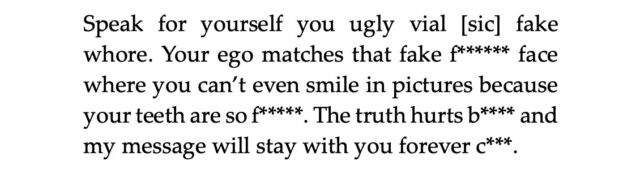
Credit: Judge’s opinion in D’Ambrosio v. Meta
Rajala posted the screenshot in a Facebook thread where more than two dozen women shared photos of D’Ambrosio and criticized him. She did not call for any action—she did not reveal his phone number, request that anyone contact his family or employer, or otherwise identify him beyond the screenshot.
Because the post gained traction, it remained at the top of the group’s feed, which frustrated D’Ambrosio. He claimed Meta was disregarding his safety by allowing the post to stay visible.
Claims D’Ambrosio made
- That Rajala (and, by extension, her parents, since she used their home Internet connection) had doxxed him.
- That Meta profited from his likeness by running ads alongside the post.
- That Rajala was responsible for another woman’s reply linking to a mug‑shot of a convicted rapist; D’Ambros0 claimed this caused defamation, emotional distress, loss of professional opportunities, and damage to his reputation.
- That anyone “remotely associated” with the posts—Rajala, her parents, other commenters, the group operators, and Facebook itself—should be sued for all possible, imaginable claims.
Context provided by Trent (blog)
“These Facebook groups were ostensibly created to help women navigate dating safely, but some women abuse them to trigger harassment campaigns—accusing innocent men of spreading STIs or forcing abortions. ‘They’re facilitating having people contact their bosses, their employers, to take the harm even further,’” – Trent.
Why the case failed
- D’Ambrosio never alleged concrete harm caused by the post, nor was there evidence of real‑world contact or threats.
- He did not argue that any statements about him were false.
- Only at the last minute did his lawyers suggest the screenshot might have been doctored, a claim the panel rejected because D’Ambrosio had ample opportunity to dispute authenticity earlier in the litigation.
Expert commentary
Eric Goldman explained that D’Ambrosio’s suit is similar to other lawsuits where men have tried—and failed—to remove critical posts from “Spill the Tea”‑style Facebook groups (e.g., Chicago’s “Are We Dating the Same Guy”). Courts repeatedly hold that such posts are opinions protected by the First Amendment and do not constitute defamation under Illinois law.
Fake Citations a “Serious” Problem
After pushing the “frivolous” appeal, D’Ambrosio’s lawyers now face potential sanctions on three fronts:
- Misleading the court over the authenticity of a screenshot.
- Using AI to introduce fake and deceptive citations.
- Filing a frivolous appeal.
Sanctions could include fines covering the costs for the Rajalas to fight the appeal, as well as possible penalties for Trent and another attorney at his firm, Aaron Walner.
“In short, D’Ambrosio and his attorneys failed to advance any conceivable reason for this court to reverse the dismissal of any of his claims against any of the Rajalas,” the appeals‑court panel ruled.
The Fake‑Citation Issue
The panel focused its analysis on a section of the filing that “seemed to have the highest density of them,” emphasizing that such “sloppy” work is a serious problem. In addition to misquoting statutes and misrepresenting legal standards, the filing made broad claims about what constitutes doxing without citing a single case to support its stance.
In a footnote, the panel expressed particular frustration that Walner not only failed to review the fake citations but also neglected to sign the filing—a signature that serves as a lawyer’s certification of review.
Context
In some cases, lawyers have offered pretty wild excuses for relying too much on AI (see Ars Technica article), but it’s increasingly rare for the court to forgive and forget. Occasionally, a sincere apology can help lower fines, but whether D’Ambrosio’s lawyers admit to using AI or not, the panel can still impose sanctions.
“Submitting fictitious quotations to a court, regardless of how they are generated, is obviously inconsistent with the standards of conduct this court expects from attorneys practicing in this court,” — Hamilton
About the Author

Ashley Belanger is a senior policy reporter for Ars Technica, dedicated to tracking the social impacts of emerging policies and new technologies. She is a Chicago‑based journalist with 20 years of experience.
Comments
36 Comments