
Tesla registrations crash 17% in Europe as BEV market surges 14%
Source: Hacker News
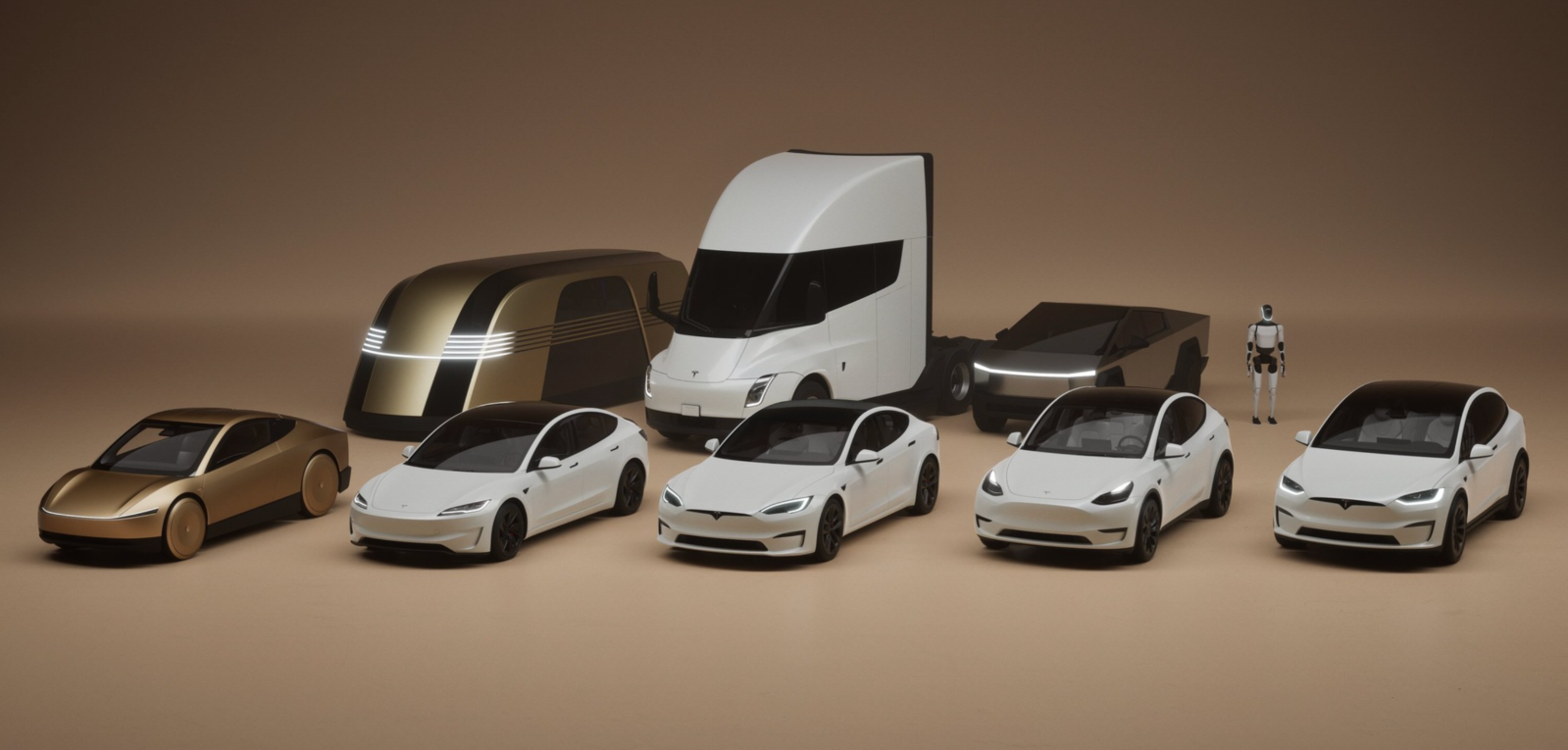
Tesla registrations in Europe – January 2026
New data from the European Automobile Manufacturers’ Association (ACEA) confirms that Tesla registered just 8,075 vehicles across the EU, EFTA, and UK in January 2026, a 17 % decline from the same month last year. The drop is especially damaging because January 2025 was already a weak month for Tesla during the production transition to the refreshed Model Y. Meanwhile, the broader battery‑electric vehicle (BEV) market grew 13.9 %, making Tesla’s slump harder to explain as a simple timing issue.
BEV market grows despite Tesla dragging it down
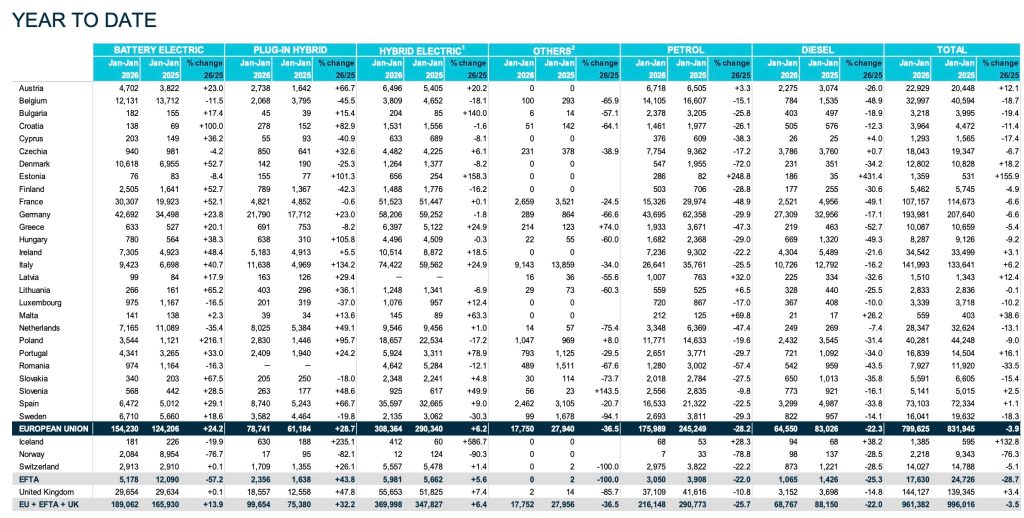
Across the EU, EFTA, and UK, 189,062 battery‑electric cars were registered in January 2026, up from 165,930 a year ago — a 13.9 % increase. BEV market share in the EU reached 19.3 %, up from 14.9 % in January 2025, according to ACEA data.
- France: +52.1 %
- Germany: +23.8 %
- Denmark: +52.7 %
The overall car market contracted 3.5 %.
When Tesla’s numbers are excluded, BEV registrations across the EU, EFTA, and UK were up 15.9 % year‑over‑year — 180,987 units in January 2026 versus 156,197 a year earlier. Tesla is not only failing to contribute to the EV transition in Europe; it is actively dragging down the growth rate.
- BYD registered 18,242 vehicles in January 2026, 165 % year‑over‑year growth, more than doubling Tesla’s volume in the region. BYD now holds a 1.9 % market share in the EU+EFTA+UK, compared to Tesla’s 0.8 %.
Tesla’s problem runs deeper than the Model Y refresh
In Q1 2025, Tesla’s European sales collapsed roughly 37 % year‑over‑year. The company and its supporters blamed the production changeover to the refreshed Model Y “Juniper.” January 2025 was presented as a temporary dip caused by the transition.
That excuse no longer holds. January 2026 is a full year after the Model Y refresh launched; the new model is in full production, widely available across Europe, and has been on the market for months. Yet Tesla’s registrations still fell 17 % compared to already poor numbers.
- EU only: 7,187 vehicles in January 2026 vs. 7,305 a year earlier (‑1.6 %).
- The steeper 17 % drop in the EU+EFTA+UK figure is driven by EFTA markets, especially Norway, where total new car registrations plummeted 76.3 % after the end of tax exemptions.
The rest of the market tells a different story
-
Petrol cars in the EU crashed 28.2 % year‑over‑year (France ‑48.9 %, Germany ‑29.9 %).
-
Diesel continued its decline at ‑22.3 %.
-
Combined share of petrol and diesel fell to 30.1 % in the EU, down from 39.5 % in January 2025.
-
Plug‑in hybrids surged 32.2 % across the EU+EFTA+UK, reaching 99,654 units. Italy (+134.2 %) and Spain (+66.7 %) led the charge. Hybrid‑electric vehicles remain the most popular powertrain choice at 38.6 % EU market share.
Manufacturer performance
- Stellantis: +6.7 % to 164,436 units (Fiat +24.6 %, Opel/Vauxhall +12.7 %).
- Volkswagen Group: ‑3.8 % but still holds a dominant 26.7 % market share.
- Mercedes‑Benz: +2.8 %.
- BMW Group: ‑5.7 % (see source).
Electrek’s Take
We thought Tesla’s January 2025 numbers in Europe were bad, attributing the dip to a Model Y production transition. A year later, with the new Model Y widely available, Tesla’s European registrations are down another 17 %. The problem is clearly not the Model Y refresh.
The European EV transition is accelerating—just not for Tesla. BYD registered more than twice as many vehicles as Tesla in January, and the gap is widening each month.
The boycott movement that gained momentum across Europe in 2025 appears to have locked Tesla out of a significant part of the market, and the end of subsidies in some markets is compounding Tesla’s demand slump.
Tesla needs to find the bottom in Europe soon, or it risks becoming irrelevant in one of the world’s largest EV markets while competitors like BYD, Volkswagen, and Stellantis fill the void.
FTC: We use income‑earning auto affiliate links. More.