
Sideways on the ice, in a supercar: Stability control is getting very good
Source: Ars Technica
brrr so cold
To test stability control, it helps to have a wide‑open space with very low grip.
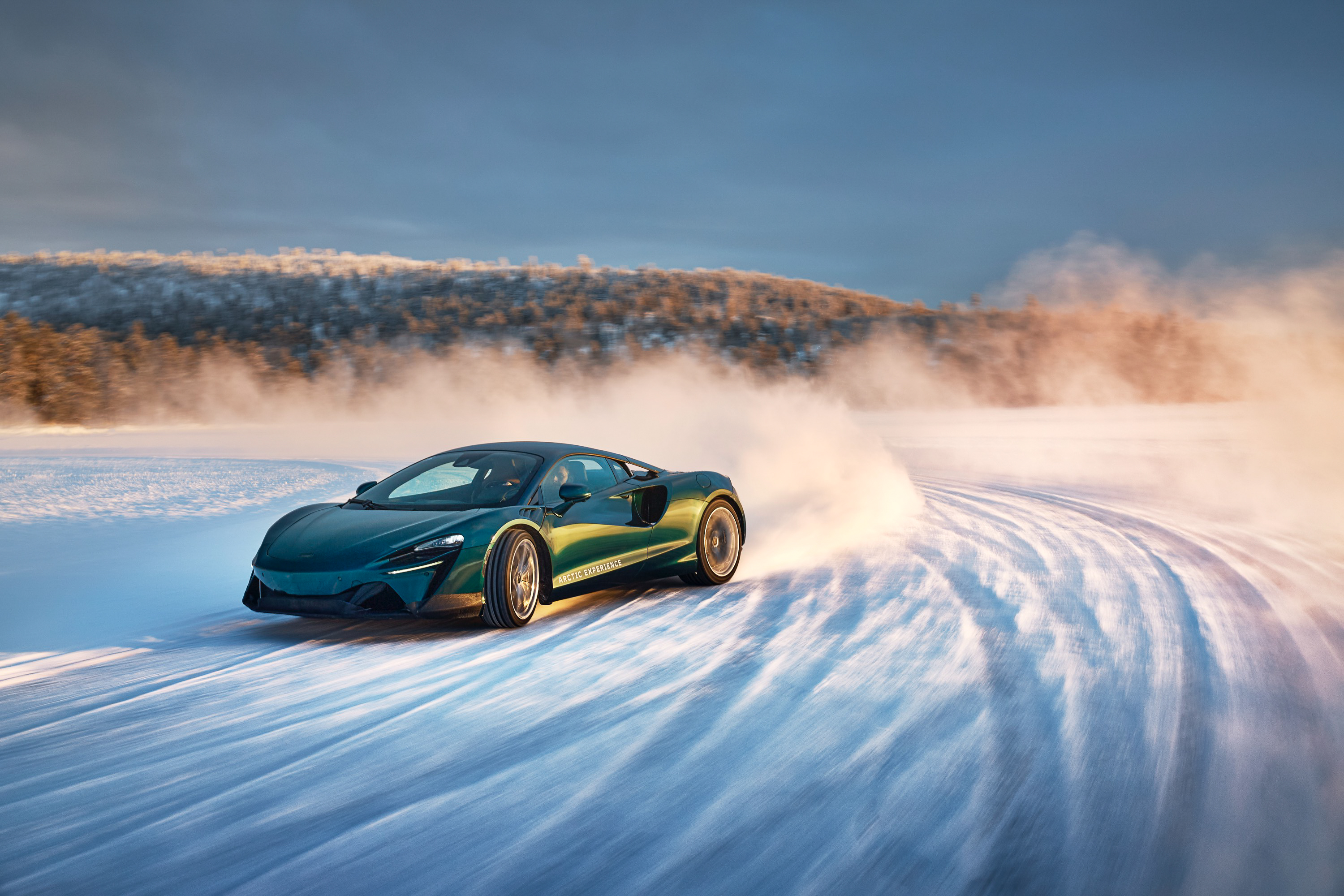
Credit: McLaren
Saariselkä, Finland
If you’re expecting it, the feeling in the pit of your stomach when the rear of your car breaks traction and begins to slide is rather pleasant. It’s the same exhilaration we get from roller coasters, but when you’re in the driver’s seat, you’re in charge of the ride.
When you’re not expecting it, however, anxiety replaces excitement, and if the slide ends with a crunch you’ll feel a lot more negative emotions.
Thankfully, fewer and fewer drivers will have to experience that kind of scare thanks to the proliferation and sophistication of modern electronic stability and traction‑control systems. For more than 30 years, these electronic safety nets have grown in capability and became mandatory in the early 2010s, saving countless crashes in the process.
Through a combination of cutting engine power and individually braking each wheel, the computers that keep a watchful eye on things like lateral acceleration and wheel spin gather it all together with the idea that the car goes where the driver wants it rather than sideways or backward into whatever solid object lies along the new path of motion.
Obviously, the quickest way to find out whether this all works is to turn it off—and then find a slippery road, or just drive like an oaf. Yet even when automakers let journalists loose on racetracks, they invariably require that we keep some of the electronic safety net turned on. Even on track, you can hit things that will crumple a car—or worse—and with modern tire technology being what it is, the speeds involved when cars do let go tend to be quite high, particularly if it’s dry.
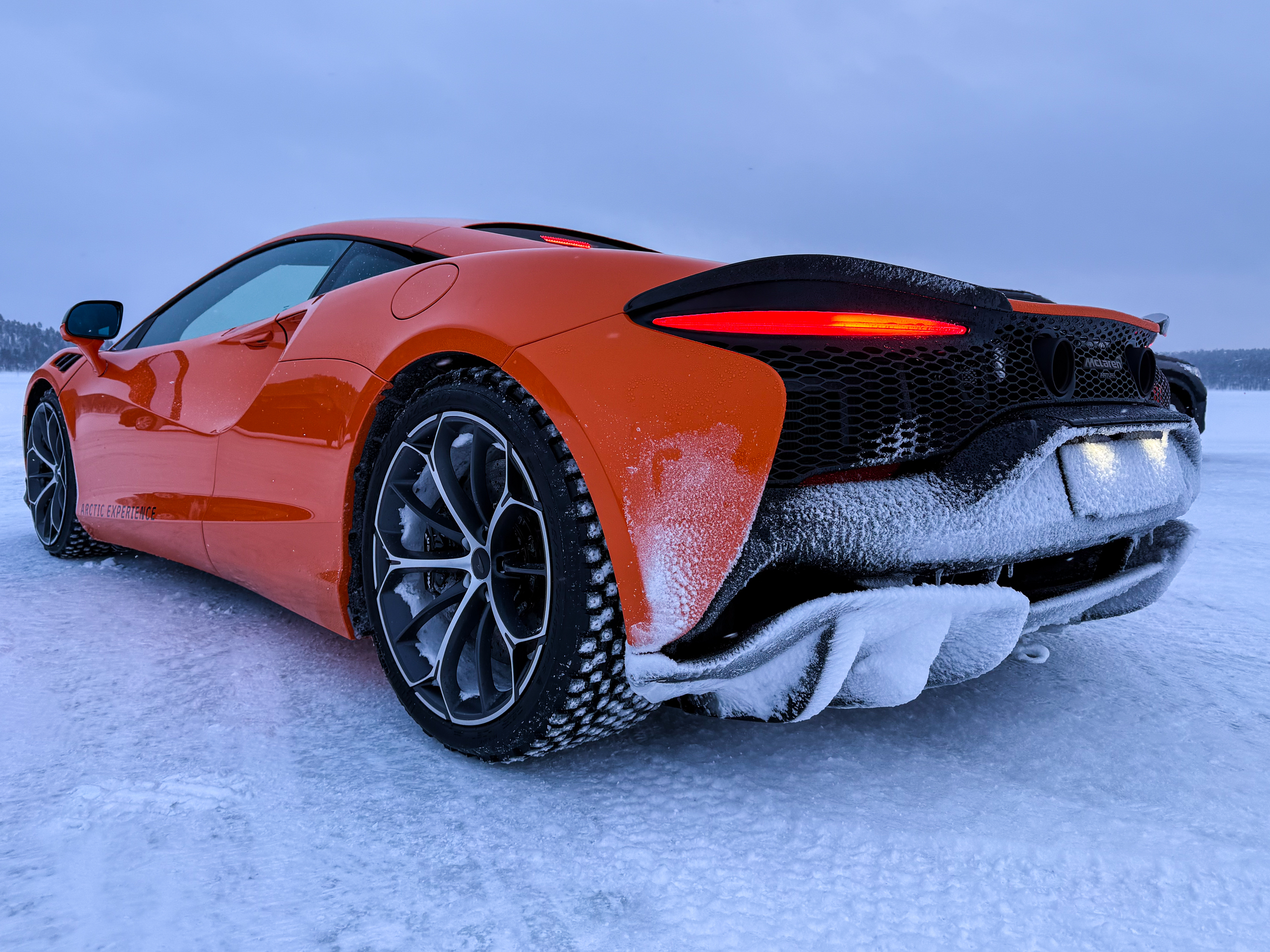
The Artura is probably my favorite McLaren, as it’s smaller and more versatile than the more expensive, more powerful machines in the range.
Credit: Jonathan Gitlin
There are few environments that are more conducive to exploring the limits and capabilities of electronic chassis control. Ideally, you want a lot of wide‑open space free of wildlife and people and a smooth, low‑grip surface. A giant sand dune would work. Or a frozen lake. Which is why you can sometimes find automotive engineers hanging out in these remote, often extreme locations, braving the desert’s heat or an Arctic chill as they work on a prototype or fine‑tune the next model.
And it’s no secret that sliding a car on the ice is a lot of fun. So it’s not surprising that a cottage‑tourism industry exists that—for a suitable fee—will bring you north of the Arctic Circle where you can work on your car control and get some insight into just how hard those electronics are capable of working.
That explains why I left an extremely cold Washington, DC, to travel to an even colder Saariselkä in Finland, where McLaren operates its Arctic Experience program on a frozen lake in nearby Ivalo. The company does some development work here, though more of it happens across the border in Sweden. But for a few weeks each winter, it welcomes customers to its minimalist lodge to work on their car control. Earlier this month, Ars was among a group of journalists who got an abbreviated version of the experience.
Our car for the day was a Ventura‑orange McLaren Artura, the brand’s plug‑in hybrid supercar, wearing Pirelli’s Sottozero winter tires, each augmented by a few hundred metal spikes. Its total power and torque output is 671 hp (500 kW) and 531 lb‑ft (720 Nm) combined from a 3.0 L twin‑turbo V6 that generates 577 hp (430 kW) and 431 lb‑ft (584 Nm), plus an axial‑flux electric motor that contributes an additional 94 hp (70 kW) and 166 lb‑ft (225 Nm). All of that is sent to the rear wheels via an eight‑speed dual‑clutch transmission.
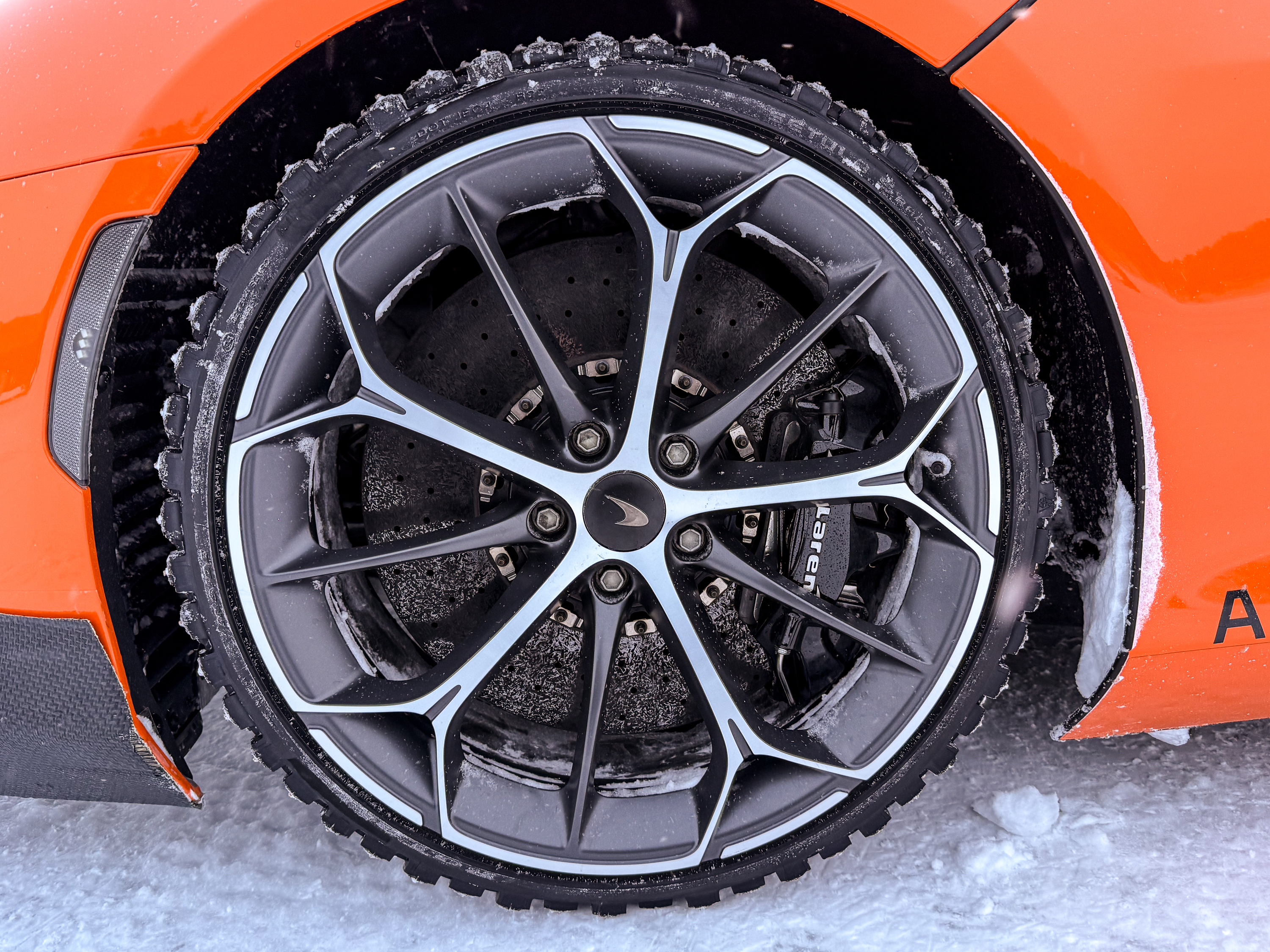
Winter tires work well on snow, but for ice you really need studs.
ed studs.

> **Credit:** Jonathan Gitlin

Winter tires work well on snow, but for ice, you really need studs.

> **Credit:** Jonathan Gitlin

Where most hybrids use the electric motor to boost efficiency, McLaren mostly uses it to boost performance, providing an immediate shove and filling gaps in the torque band where necessary. In electric‑only mode, it will do just that, right up to the 81 mph (130 km/h) speed limit of the mode. Being the sort of curious nerd I am, I took the opportunity to try all the different modes.

Once I got control of my stomach, that is.
Are you sure you should drink that?
Our first exercise was, paradoxically, the hardest: driving sideways around a plain‑old circle. A couple of these had been scribed into the ice—which freezes from November until April and was 28 inches (70 cm) thick, we learned—along with more than a dozen other, more involved courses. Even under the best of conditions, the Sun spends barely six hours a day on its shallow curve from horizon to horizon at this time of year. On the day of our visit, the horizon was an indistinct thing as heavy gray skies blended with the snow‑covered ice.
The lack of a visual reference, mixed with 15 minutes of steady lateral G‑forces, turned out to be unkind to my vestibular system, and about 10 minutes later I found myself in shirtsleeves at ‑11 °F (‑23 °C), saying goodbye to a cup of Earl Grey tea I’d previously—and perhaps unwisely—drunk a little earlier. At least I remembered to face downwind—given the sideways gale, it could have ended worse.

These are just some of the circuits that McLaren has carved into the ice in Ivalo. Beware of the innocent‑looking circles—they’re deceptively hard and may turn your stomach.
Credit: McLaren
Fortified with an anti‑emetic and some extremely fresh air, I returned to the ice and can happily report that as long as you slide both left and right, you’re unlikely to get nauseous.
Getting an Artura sideways on a frozen lake isn’t especially complicated. With the powertrain set to Track (which prioritises performance and keeps the V6 running the whole time) and with stability and traction control off, you apply enough power to break traction at the rear. A dab of brake can do the job, too, followed by some power. You steer more with your right foot than your hands, adding or subtracting power to reign in or amplify the slip angle. Your eyes are crucial; if you look through the corner down the track, that’s probably where you’ll end up. Fixate on the next apex and you may quickly find yourself off‑course.
Most of the mid‑engined Artura’s 3,303 lb (1,498 kg) live between its axles, and it’s a relatively easy car to catch once it begins to slide, with plenty of travel for the well‑mapped throttle pedal.
It turns out that holds true even when you’re using only the electric motor. 166 lb‑ft is more than enough to spin the rear wheels on ice, but with just 94 hp there isn’t enough power to get the car properly sideways. You can therefore control a lazy slide around one of the handling courses in near silence. Turning the electronic aids back on makes things much less dramatic; even with my foot to the floor, the Artura measured out minute amounts of power, keeping the car pointed where I steered it rather than requiring any opposite lock.
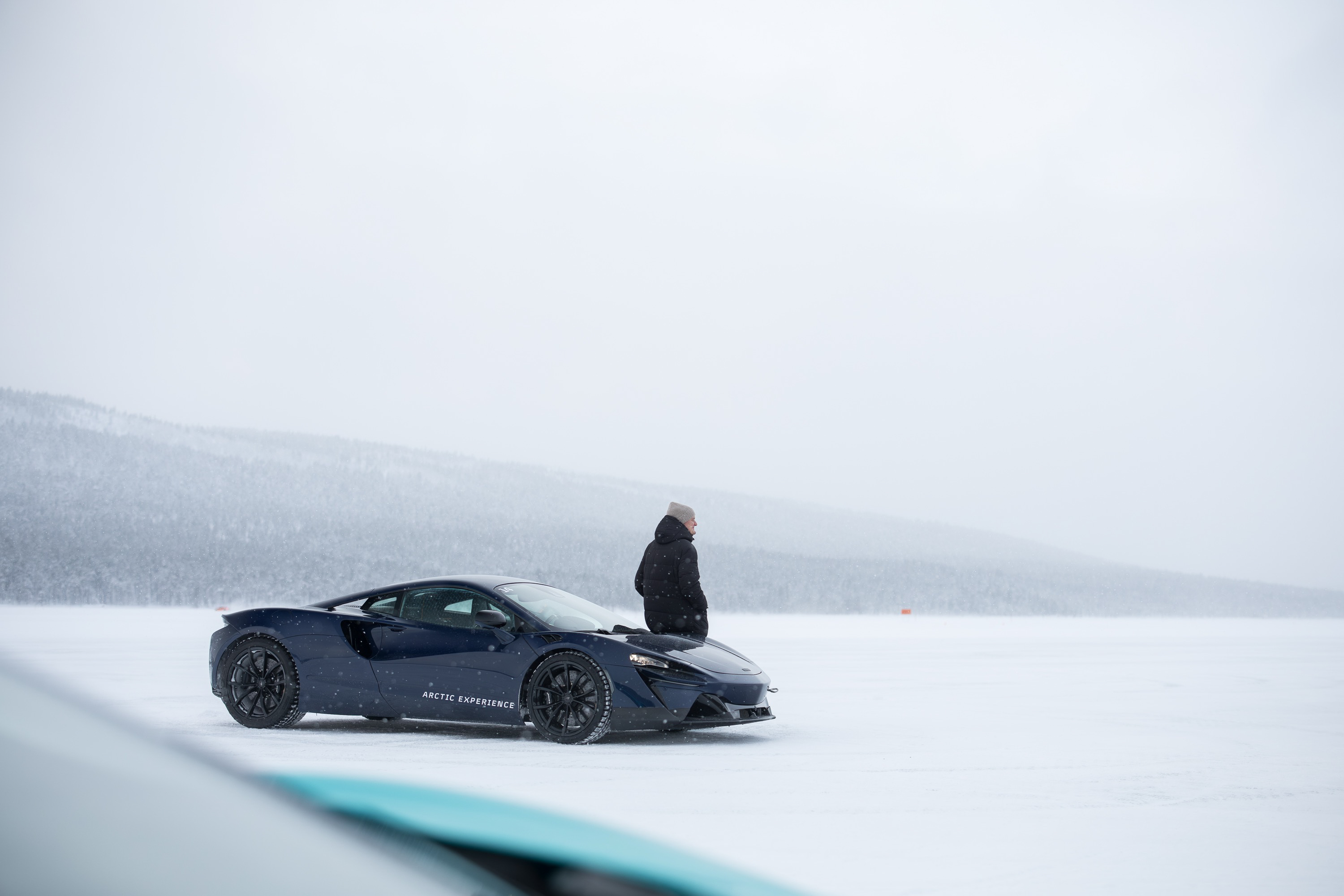
It feels like the edge of the world out here.
Credit: McLaren
Turn it on, turn it off
Back in track mode, with all 671 hp at my disposal, there was far more power than needed to spin the wheels. With the safety net re‑enabled, driving around the handling course was barely any more dramatic than with a fraction of that power. The car’s electronic chassis‑control algorithms only sent as much torque to the rear wheels as they could safely deploy, no matter how much throttle I applied. As each wheel lost grip and began to spin, the brakes intervened, and we circled the course slowly but safely. As a demonstration of modern electronic safety systems, it was very reassuring.
As I mentioned earlier, even when journalists are let loose in supercars on track, some degree of electronic assist is always enabled. For the sportier cars you’ll often find a “halfway house” between full‑on aids and everything turned off. The idea is to loosen the safety net just enough to let the car move around, but only a little. Instead of using the electronics solely to keep things safe, they also flatter the driver — see the article on BMW’s upcoming electric M‑car here.
In McLaren’s case, that mode is called Variable Drift Control (VDC), which is a fairly literal name. In this mode you set a maximum slip angle (from 1° to 15°), and the car will never exceed it. A slug of power will get the rear wheels spinning and the rear sliding, but only up to the set degree; at that point the brakes and powertrain intervene as necessary.
It’s surprisingly flattering to hold what feels like a lurid slide between turns with ease, without worrying that a lapse in concentration will leave the car stranded on a few inches of snow. Even when your right foot is pinned to the firewall, the silicon brains running the show apply only as much torque as needed, and a little icon on the dash flashes to let you know it’s intervening.
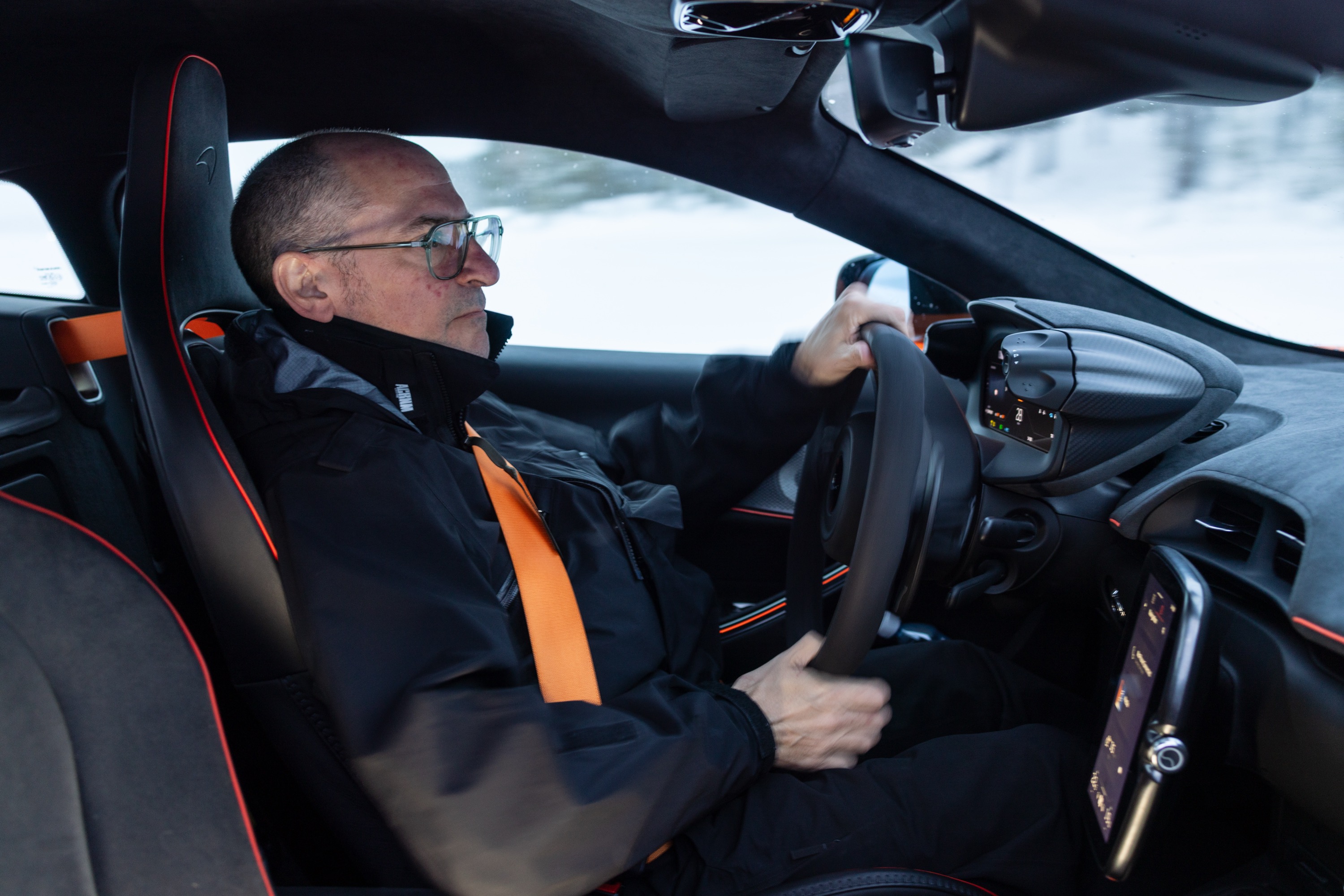
If you have the space, there’s little more fun than drifting a car on ice. But it’s good to know that electronic stability control and traction control will help you out when you’re not trying to have fun.
Credit: McLaren
I can certainly see why OEMs tout modes like VDC as the “spiciest” setting they let us try. They’re permissive enough to break the rear loose and fire off a burst of adrenaline, yet soft enough that the ride almost certainly won’t end in tears. Fun as VDC is, it does feel artificial once you get your eye in—especially compared with the thrill of balancing an Artura on the throttle through a series of corners or the satisfaction of catching and recovering a spin before it becomes too late.
Outside of a frozen lake, I’ll be content to keep some degree of driver aids running.
About the author

Jonathan M. Gitlin – Automotive Editor at Ars Technica. He holds a BSc and PhD in Pharmacology. In 2014 he left the National Human Genome Research Institute to pursue his lifelong passion for cars, launching Ars Technica’s automotive coverage. He lives in Washington, DC.
53 Comments