
Pick up exactly where you left off with Session Management in Gemini CLI
Source: Google Developers Blog
DEC. 10, 2025
Editor’s Note: This new feature was made possible by Christopher Beeson, an outstanding open‑source contributor in the Gemini CLI community. His meticulous work across nine‑plus well‑crafted pull requests was instrumental in bringing this to fruition.
Context is everything when working with Gemini CLI. Whether you are refactoring a complex codebase or debugging a tricky error, your conversation history contains valuable reasoning, tool outputs, and decisions.
Previously, closing your terminal meant losing that context. Starting over required re‑explaining the problem to the model. This is no longer the case—Gemini CLI now automatically saves your sessions and lets you search through your session history to resume right where you left off!
Automatic Saving: Peace of mind
Every time you interact with Gemini CLI, your session is now automatically saved in the background. You don’t need to remember to save or export your chat; we handle it for you with our new Session Management system.
We capture the complete state of your work, including:
- Your prompts and the model’s responses.
- All tool executions (inputs and outputs).
- Token usage statistics.
- Assistant thoughts and reasoning summaries.
Crucially, these sessions are project‑specific. If you switch directories to a different project, Gemini CLI automatically switches context to that project’s session history, ensuring Gemini CLI is always on the same page as you.
Resuming Sessions
We have made it incredibly easy to jump back into a previous workflow, whether you prefer command‑line flags or our interactive UI.
The Interactive Session Browser
Within Gemini CLI, type /resume to open the new Session Browser.
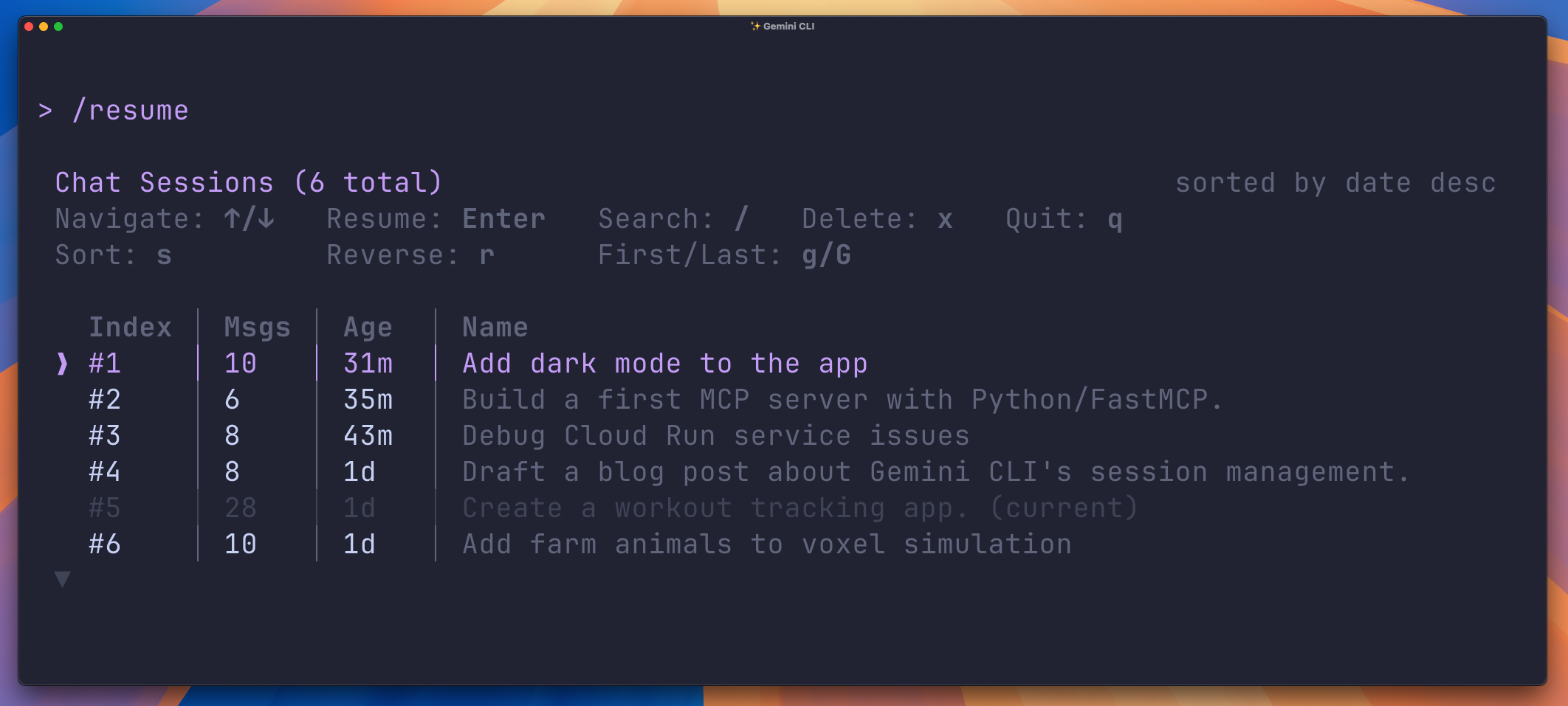
This interactive interface allows you to:
- Browse: Scroll through a chronologically sorted list of your past sessions.
- Preview: See details like message counts and a one‑line summary to identify the right chat.
- Search: Press
/to filter sessions by ID or content keywords. - Select: Press Enter to instantly restore the full context of that conversation.
Command Line Power
For those who prefer flags, you can resume sessions right from the start when you launch Gemini CLI.
- Resume latest:
gemini --resumewill immediately load your most recent session. - Resume specific session:
gemini --resume 5(by index) orgemini --resume <session-id>(by session ID).
You can list all available sessions for your current project as well:
gemini --list-sessionsOutput example
Available sessions for this project (3):

  1. Fix bug in auth (2 days ago) [a1b2c3d4]
  2. Refactor database schema (5 hours ago) [e5f67890]
  3. Update documentation (Just now) [abcd1234]
Managing your History
With great power comes great responsibility… or, in this case, a lot of history files! We’ve added tools to help you keep your environment clean.
To prevent your history from growing indefinitely, enable automatic cleanup policies in your settings.json configuration file:
{
  "general": {
    "sessionRetention": {
      "enabled": true,
      "maxAge": "30d",   // Keep sessions for 30 days
      "maxCount": 50     // Keep the 50 most recent sessions
    }
  }
}
Tracking your Gemini CLI usage
Detailed message, thought, tool‑call, and token usage information is recorded automatically, allowing you to analyze your Gemini CLI usage. You can use community‑developed tools like Splitrail or develop your own.
Get started today
Session management is available in Gemini CLI and is on by default as of v0.20.0+.
Update to the latest version to take advantage of the new feature:
npm install -g @google/gemini-cli@latestFor further details, see the official documentation on session management.
You can also follow Gemini CLI on X to stay up to date with the latest news and announcements.