
NVIDIA Rubin Platform, Open Models, Autonomous Driving: NVIDIA Presents Blueprint for the Future at CES
Source: NVIDIA AI Blog
NVIDIA founder and CEO Jensen Huang took the stage at the Fontainebleau Las Vegas today to open CES 2026, declaring that AI is scaling into every domain and every device.
“Computing has been fundamentally reshaped as a result of accelerated computing, as a result of artificial intelligence. What that means is some $10 trillion or so of the last decade of computing is now being modernized to this new way of doing computing.” – Jensen Huang
Key Announcements
| Announcement | Description | Link |
|---|---|---|
| Rubin | NVIDIA’s first extreme‑codesigned, six‑chip AI platform, now in full production. Aims to push AI to the next frontier while cutting token‑generation cost to roughly one‑tenth of the previous platform. | Rubin Platform AI Supercomputer |
| Alpamayo | An open‑reasoning model family for autonomous‑vehicle development, part of NVIDIA’s push to embed AI across all domains. | Alpamayo Autonomous Vehicle Development |
| Open Models | NVIDIA’s open‑model ecosystem, trained on NVIDIA supercomputers, enables developers and enterprises to build on a global intelligence platform. | Open Models, Data & Tools Accelerate AI |
“Every single six months, a new model is emerging, and these models are getting smarter and smarter. Because of that, you could see the number of downloads has exploded.” – Jensen Huang
Additional Resources
- Online Press Kit: Find all NVIDIA news from CES 2026 in the online press kit.
A New Engine for Intelligence: The Rubin Platform
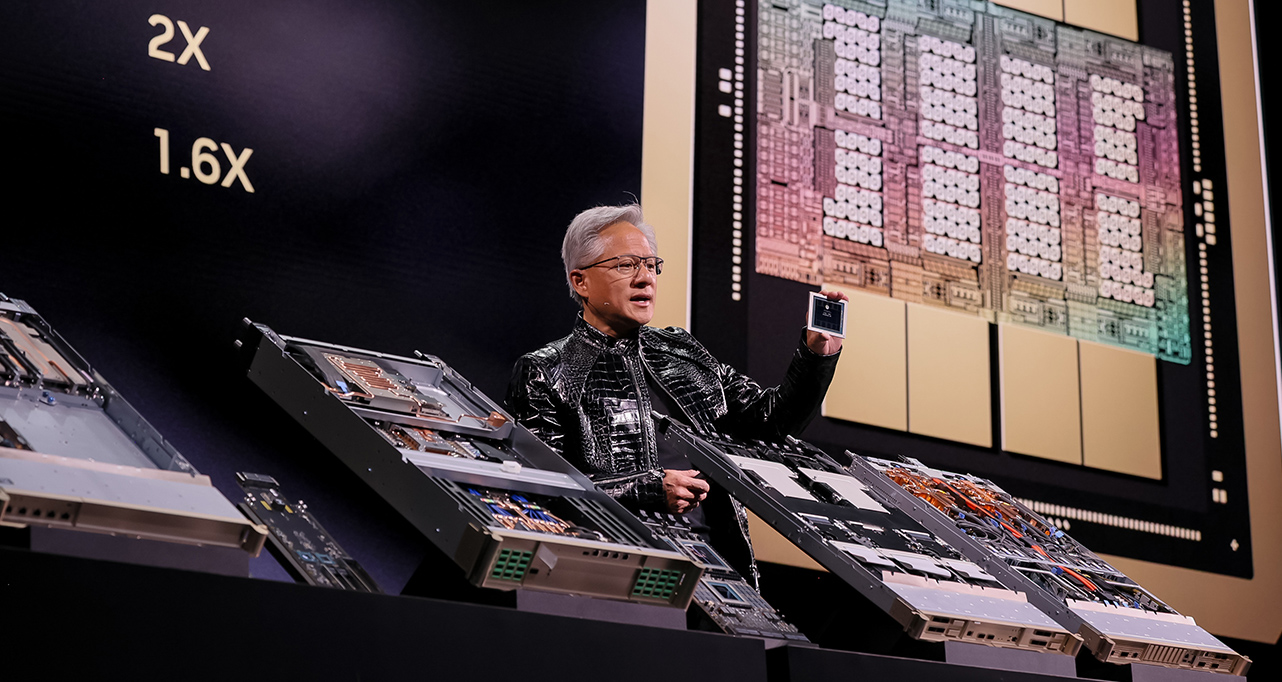
NVIDIA CEO Jensen Huang introduced the NVIDIA Rubin platform, named after pioneering American astronomer Vera Rubin. The platform succeeds the record‑breaking Blackwell architecture and is NVIDIA’s first extreme‑codesigned, six‑chip AI system, now in full production.
Core Components
Built from the data‑center outward, Rubin platform components span:
- Rubin GPUs – 50 PFLOPS of NVFP4 inference
- Vera CPUs – engineered for data movement and agentic processing
- NVLink 6 – scale‑up networking
- Spectrum‑X Ethernet Photonics – scale‑out networking
- ConnectX‑9 SuperNICs
- BlueField‑4 DPUs
Extreme codesign—designing all of these pieces together—is essential for gigascale AI. Tight integration across chips, trays, racks, networking, storage, and software eliminates bottlenecks and dramatically reduces the cost of training and inference.
AI‑Native Storage
Huang also unveiled the NVIDIA Inference Context Memory Storage Platform, an AI‑native KV‑cache tier that:
- Boosts long‑context inference by 5× higher tokens‑per‑second
- Delivers 5× better performance per TCO dollar
- Achieves 5× better power efficiency
Learn more about the storage platform →
Impact
When combined, these innovations promise to accelerate AI development dramatically, delivering tokens at one‑tenth the cost of prior solutions. As Huang put it:
“The faster you train AI models, the faster you can get the next frontier out to the world. This is your time‑to‑market. This is technology leadership.”

Open Models
NVIDIA’s open models—trained on its own supercomputers—are powering breakthroughs in:
- Healthcare (Clara)
- Climate science (Earth‑2)
- Reasoning & multimodal AI (Nemotron)
- Robotics & simulation (Cosmos)
- Embodied intelligence (GR00T)
- Autonomous driving (Alpamayo)
“Now on top of this platform, NVIDIA is a frontier AI model builder, and we build it in a very special way—completely in the open—so that every company, every industry, and every country can be part of this AI revolution,” Huang said.
These models are openly available, allowing developers to create, evaluate, guardrail, and deploy world‑class AI that consistently tops leaderboards.
AI on Every Desk: RTX, DGX Spark, and Personal Agents
NVIDIA CEO Jensen Huang emphasized that the future of AI isn’t limited to massive super‑computers—it’s becoming personal.
Demo Highlights
- Personal AI agent running locally on an NVIDIA DGX Spark desktop supercomputer.
- The agent embodied through a Reachy Mini robot using models from Hugging Face.
- Demonstrated how open models, model routing, and local execution turn agents into responsive, physical collaborators.
“The amazing thing is that it is utterly trivial now, but a couple of years ago that would have been impossible—absolutely unimaginable.” – Jensen Huang
Enterprise Adoption
Huang listed several leading enterprises that are integrating NVIDIA AI to power their products:
- Palantir
- ServiceNow
- Snowflake
- CodeRabbit
- CrowdStrike
- NetApp
- Symantec
“Whether it’s Palantir, ServiceNow, Snowflake—or many other companies we’re working with—the agentic system is the interface.”
CES Announcement
At CES, NVIDIA announced that DGX Spark delivers up to 2.6× performance for large models, with new support for:
- Lightricks LTX‑2 image model
- FLUX image model
The enhancements will be available through NVIDIA AI Enterprise in an upcoming release.
Read the full DGX Spark announcement
Physical AI

AI is now grounded in the physical world through NVIDIA’s technologies for training, inference, and edge computing. These systems can be trained on synthetic data in virtual worlds long before they interact with the real world.
NVIDIA Cosmos
Huang showcased NVIDIA Cosmos—open‑world foundation models trained on videos, robotics data, and simulation. Cosmos can:
- Generate realistic videos from a single image
- Synthesize multi‑camera driving scenarios
- Model edge‑case environments from scenario prompts
- Perform physical reasoning and trajectory prediction
- Drive interactive, closed‑loop simulation
Alpamayo
Advancing the story, Huang announced Alpamayo—an open portfolio of reasoning vision‑language‑action models, simulation blueprints, and datasets that enable level‑4‑capable autonomy. The release includes:
- Alpamayo R1 – the first open, reasoning VLA model for autonomous driving
- AlpaSim – a fully open simulation blueprint for high‑fidelity AV testing
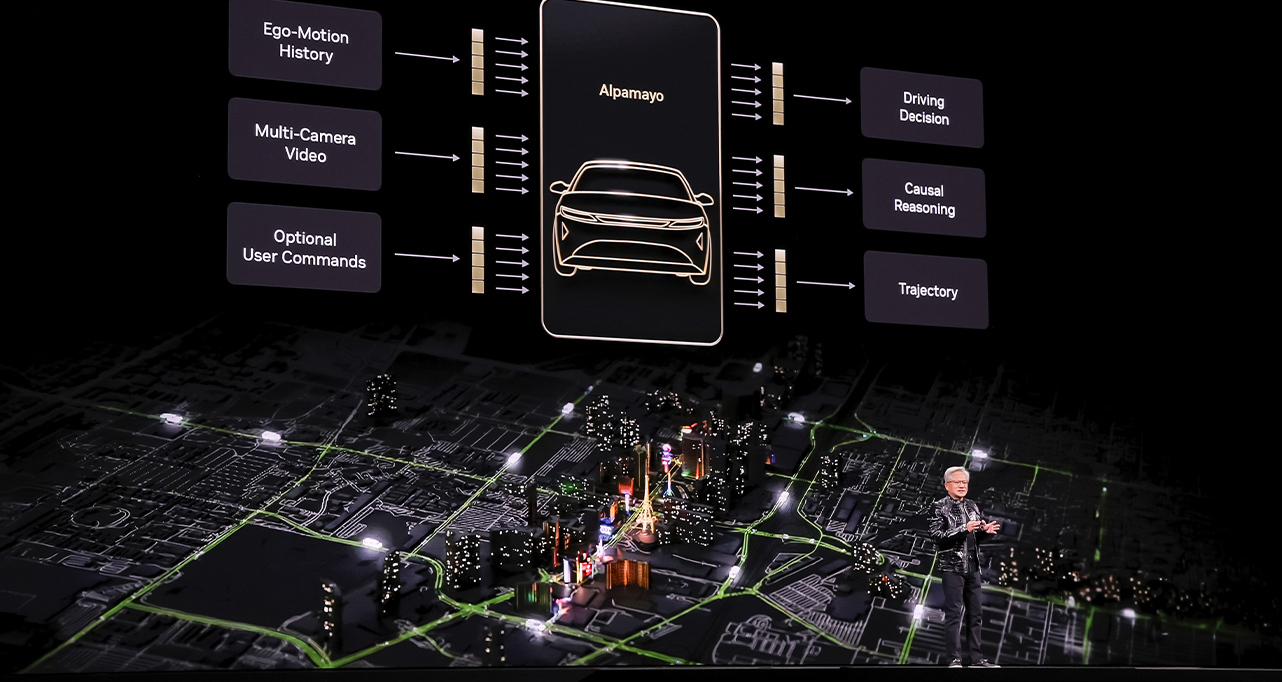
“Not only does it take sensor input and activate the steering wheel, brakes, and acceleration, it also reasons about what action it is about to take,” Huang said, introducing a video of a vehicle smoothly navigating busy San Francisco traffic.
Huang also announced that the first passenger car featuring Alpamayo will be built on the NVIDIA DRIVE full‑stack autonomous‑vehicle platform and will soon be on the roads in the all‑new Mercedes‑Benz CLA. AI‑defined driving is slated to arrive in the U.S. this year, following the CLA’s recent EuroNCAP five‑star safety rating.
DRIVE Hyperion
Huang highlighted the growing momentum behind DRIVE Hyperion—an open, modular, level‑4‑ready platform adopted by leading automakers, suppliers, and robotaxi providers worldwide.
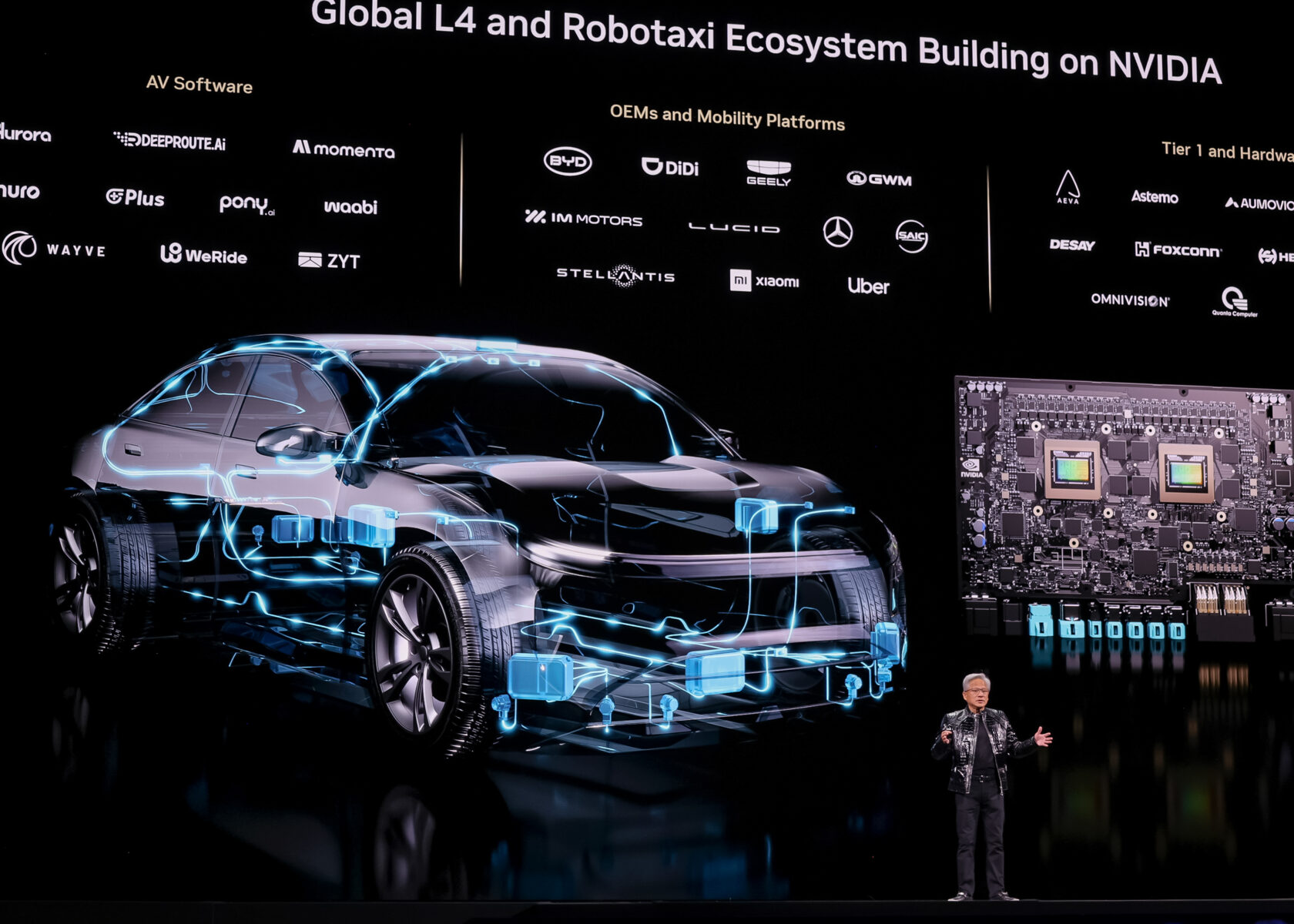
“Our vision is that, someday, every single car, every single truck will be autonomous, and we’re working toward that future,” Huang said.
Global Physical‑AI Ecosystem
On stage, Huang was joined by a pair of tiny, beeping, hopping robots while explaining how NVIDIA’s full‑stack approach fuels a global physical‑AI ecosystem.
He showed a video of robots being trained in NVIDIA Isaac Sim and Isaac Lab within photorealistic simulated worlds, then highlighted partner contributions across the industry—including Synopsys, Cadence, Boston Dynamics, Franka, and others.
An expanded partnership with Siemens was also announced. A montage demonstrated how NVIDIA’s stack integrates with Siemens’ industrial software, enabling physical AI from design and simulation through production.
“These manufacturing plants are going to be essentially giant robots,” Huang concluded.
Building the Future, Together
Huang explained that NVIDIA now builds entire systems because a fully optimized stack is required to deliver AI breakthroughs.
“Our job is to create the entire stack so that all of you can create incredible applications for the rest of the world,” he said.