
NVIDIA DGX Spark Powers Big Projects in Higher Education
Source: NVIDIA AI Blog
NVIDIA DGX Spark: Desktop Supercomputer for AI Research
At leading institutions worldwide, the NVIDIA DGX Spark desktop supercomputer is bringing data‑center‑class AI to lab benches, faculty offices, and students’ workstations. A DGX Spark unit is even deployed at the South Pole for the IceCube Neutrino Observatory (University of Wisconsin‑Madison).
Why DGX Spark Matters
- Petaflop‑class performance on a compact desktop form factor.
- Enables local deployment of large AI workloads (e.g., clinical‑report evaluators, robotics perception) while keeping sensitive data on‑site.
- Shortens iteration cycles for researchers, educators, and learners.
Core Technology
- GPU: NVIDIA GB10 superchip.
- Software stack: NVIDIA DGX Operating System.
- Model capacity: Supports AI models up to 200 billion parameters.
Seamless Integration with NVIDIA AI Platforms
| Platform | Use‑case | Link |
|---|---|---|
| NVIDIA NeMo | Conversational AI, speech, and language models | |
| NVIDIA Metropolis | Intelligent video analytics and surveillance | |
| NVIDIA Holoscan | Real‑time multimodal AI at the edge (e.g., medical imaging, robotics) | |
| NVIDIA Isaac | Robotics simulation and deployment |
These integrations give students and researchers access to the same professional‑grade tools used across the broader DGX ecosystem.
Read on to discover how DGX Spark powers groundbreaking AI work at leading institutions worldwide.
IceCube Neutrino Observatory: Studying Particles at the South Pole
At the University of Wisconsin‑Madison’s IceCube Neutrino Observatory in Antarctica, researchers are using DGX Spark to run AI models for experiments that study the universe’s most cataclysmic events through subatomic particles called neutrinos.
Traditional astronomy—based on detecting light waves—allows us to observe about 80 % of the known universe, according to Benedikt Riedel, Computing Director at the Wisconsin IceCube Particle Astrophysics Center. A new approach that incorporates gravitational waves and particles like neutrinos opens a window onto the most extreme cosmic environments, including supernovas and dark matter.

“There’s no hardware store in the South Pole, which is technically a desert, with relative humidity under 5 % and an elevation of 10,000 ft, meaning very limited power,” Riedel said. “DGX Spark allows us to deploy AI in a compartmentalized and easy fashion, at low cost and in such an extremely remote environment, to run AI analyses locally on our neutrino observation data.”
NYU: Using Agentic AI for Radiology Reports
At NYU’s Global AI Frontier Lab, the ICARE (Interpretable and Clinically‑Grounded Agent‑Based Report Evaluation) project runs end‑to‑end on a DGX Spark in the lab. ICARE uses collaborating AI agents and multiple‑choice question generation to evaluate how closely AI‑generated radiology reports align with expert sources, enabling real‑time clinical evaluation and continuous monitoring without sending medical imaging data to the cloud.
“Being able to run powerful LLMs locally on the DGX Spark has completely changed my workflow,” said Lucius Bynum, data‑science assistant professor and faculty fellow at the NYU Center for Data Science. “I have been able to focus my efforts on quickly iterating and improving the research tool I’m developing.”
NYU researchers also use DGX Spark to run LLMs locally as part of interactive causal‑modeling tools that generate and refine semantic causal models—structured, machine‑readable maps of cause‑and‑effect relationships between clinical variables, imaging findings, and potential diagnoses. This setup lets teams rapidly design, test, and iterate on advanced models without waiting for cluster resources, which is especially important for privacy‑ and security‑sensitive applications such as healthcare, where data must stay on‑premises.
Harvard: Decoding Epilepsy With AI
At Harvard’s Kempner Institute for the Study of Natural and Artificial Intelligence, neuroscientists are using DGX Spark to probe how genetic mutations in the brain drive epilepsy. The compact desktop supercomputer lets researchers run complex analyses in real time without waiting for access to large institutional clusters.
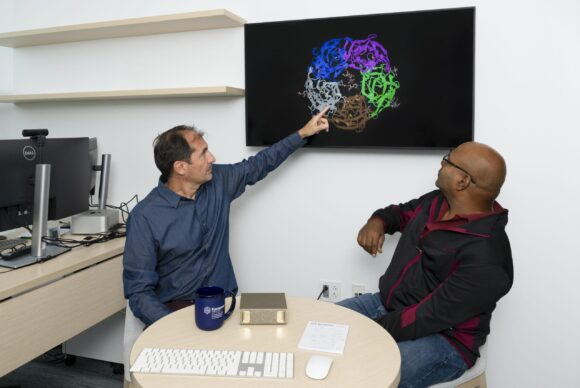
The team, led by Kempner Institute Co‑Director Bernardo Sabatini, is studying about 6,000 mutations in excitatory and inhibitory neurons, building protein‑structure and neuronal‑function prediction maps that guide which variants to test next in the lab.
DGX Spark acts as a bridge between benchtop and cluster‑scale computing at Harvard. Researchers first validate workflows and timing on a single DGX Spark, then scale successful pipelines to large GPU clusters for massive protein screens.
ASU: Enabling Campus‑Scale Innovation
Arizona State University was among the first universities to receive multiple DGX Spark systems, which now support AI research across the campus—spanning initiatives for memory care, transportation safety, and sustainable energy.
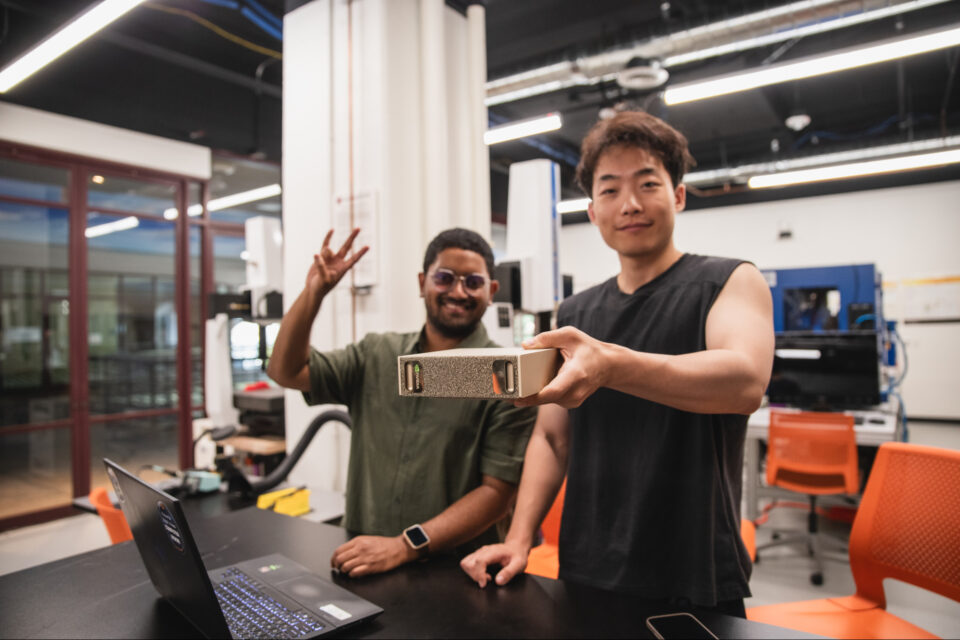
One ASU team led by Yezhou “YZ” Yang, associate professor in the School of Computing and Augmented Intelligence, is using DGX Spark to power advanced perception and robotics research, including applications such as AI‑enabled, search‑and‑rescue robotic dogs and assistance tools for visually impaired users.
Mississippi State: Empowering Computer Science and Engineering Students
In the Computer Science and Engineering department at Mississippi State University, DGX Spark serves as a hands‑on learning platform for the next generation of AI engineers.
The enthusiasm around DGX Spark at Mississippi State is captured through lab‑driven outreach, including an unboxing video created by a lab working to advance applied AI, foster AI workforce development, and drive real‑world AI experimentation across the state.
University of Delaware: Transforming Research Across Disciplines
When ASUS delivered the school’s first Ascent GX10—powered by DGX Spark—Sunita Chandrasekaran, professor of Computer and Information Sciences and director of the First State AI Institute, called it “transformative for research.” The system enables teams across disciplines—such as sports analytics and coastal science—to run large AI models directly on campus instead of relying on costly cloud resources.
Through the ASUS Virtual Lab program, schools can test GX10 performance remotely before deployment.
ISTA: Training Big LLMs on a Small Desktop
Researchers at the Institute of Science and Technology Austria (ISTA) are using an HP ZGX Nano AI Station—a compact system built on the NVIDIA DGX Spark architecture—to train and fine‑tune large language models (LLMs) directly on a desktop workstation.
Key Highlights
- Open‑source LLMQ software – The team’s LLMQ repository supports models up to 7 billion parameters, bringing advanced LLM training within reach of students and researchers.
- Unified memory – The ZGX Nano ships with 128 GB of unified memory, allowing the entire model and its training data to reside on‑device. This eliminates the complex memory‑management tricks often required on consumer GPUs.
- Data privacy & speed – Keeping everything on‑premises speeds up experimentation and ensures sensitive data never leaves the institution.
For a deeper dive, see the accompanying research paper on ISTA’s LLMQ software.
Stanford: A Pipeline for Prototyping
Researchers at Stanford University are using DGX Spark to prototype complete training and evaluation pipelines for their Biomni biological‑agent workflows. By running these pipelines locally, they can:
- Iterate quickly on model development and benchmarking.
- Automate complex analysis and experimental planning directly in the lab.
- Achieve performance comparable to large cloud GPU instances (≈ 80 tokens / s on a 120 B‑parameter gpt‑oss model at MXFP4 via Ollama) while keeping the entire workload on a desktop.
Student Hackathon – Treehacks
College students worldwide are invited to join Treehacks, a massive student hackathon taking place Feb 13‑15 at Stanford. The event will feature DGX Spark units from ASUS.
- Live demo: Watch DGX Spark in action by joining the livestream on Friday, Feb 13, 9 a.m. PT – watch here.
Get Started
- Explore DGX Spark:
- Purchase options:
Empowering higher education and student innovation with on‑premise AI supercomputing.