
NASA successfully deflected a small asteroid with its DART rocket, kinetic strike ejected a significant amount of debris from the asteroid — impact nudges the orbit of the small astronomical body, affecting the larger cosmic object as well
Source: Tom’s Hardware
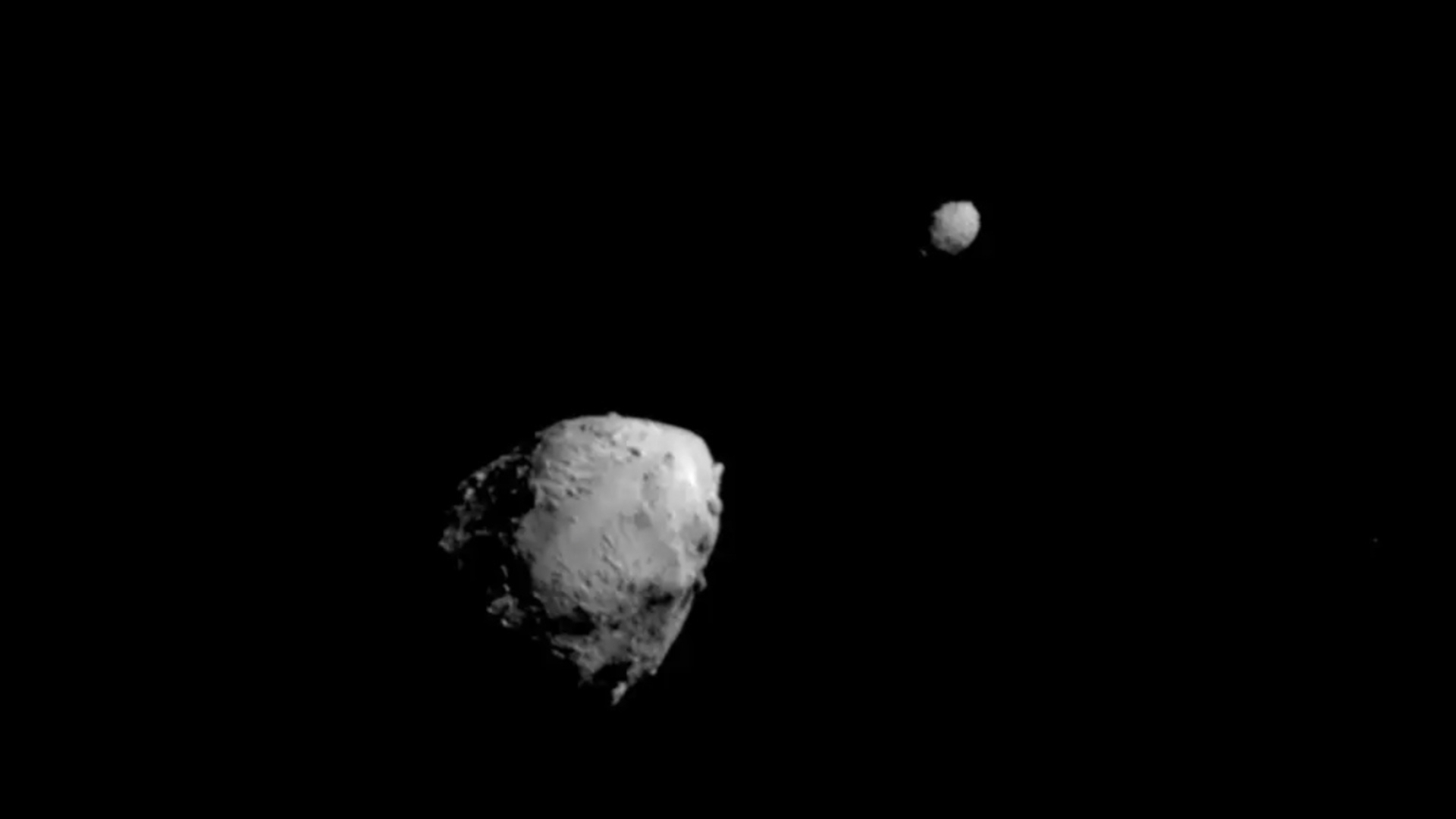
Image credit: NASA
NASA just reported that the Double Asteroid Redirection Test (DART) was successful in altering the orbit of the smaller body in a binary asteroid system. The space agency launched the DART probe in November 2021, taking nearly nine months before it hit the 560‑foot (170‑meter) wide Dimorphos in September 2022. According to NASA, the agency, alongside several volunteer astronomers, observed the pair over several months, noting that Dimorphos’s 12‑hour orbit around its larger sibling, the 880‑yard (805‑meter) wide Didymos, was reduced by around 33 minutes. More importantly, it also affected the system’s orbit around the Sun by 0.15 seconds.
The numbers mentioned might seem minuscule, especially when compared to the size of these celestial bodies, but NASA is banking on detecting any collision hazards to our home planet early on. By affecting an asteroid’s trajectory as soon as it’s detected, even a small change can make a huge impact over the massive distances involved in space.
DART can make the difference
“The change in the binary system’s orbital speed was about 11.7 microns per second, or 1.7 inches per hour,” Rahil Makadia of the University of Illinois Urbana‑Champaign, the lead author of the study on the DART mission, told NASA. “Over time, such a small change in an asteroid’s motion can make the difference between a hazardous object hitting or missing our planet.”
Although DART’s target is small and won’t destroy an entire planet, it still has the potential to wipe out an area the size of London and its surroundings. Its larger companion, however, poses a bigger threat, with the capability of destroying the entirety of Southern England.
NASA is concerned that there might be several other smaller rocks floating in space that could pose a danger to the planet. Because of this, the agency is now building an orbit‑ing telescope designed to detect incoming threats like asteroids and comets—the first such satellite dedicated to planetary defense. Early detection would allow NASA to send a kinetic impact vehicle to change an object’s direction before it could threaten Earth.