
Leak reveals the science behind Galaxy S26 Ultra’s Privacy Display
Source: Android Authority
TL;DR
- The Galaxy S26 Ultra seemingly introduces a Privacy Display that narrows viewing angles to thwart shoulder surfing.
- The feature uses microscopic gratings and prism‑like optics within the screen layers to diffract and reflect off‑angle light away from viewers.
- Technical details come from a new leak by Ice Universe, presented in an AI‑generated graphic, so the specific mechanics should be treated as unconfirmed.
One of the biggest and most important features of the Galaxy S26 Ultra is the new Privacy Display. We’ve already seen the Privacy Display in action thanks to an early hands‑on, and leaks suggest the feature is set to expand to next‑generation Android flagships releasing later this year. If you’re yearning for more details on how exactly this feature works, a new leak showcases the technology behind the Privacy Display.
On X, leaker Ice Universe shared a deep dive on the Galaxy S26 Ultra’s Privacy Display technology.
How the Privacy Display Works
During ordinary use—when the Privacy Display feature is not engaged—the refractive indices of all layers of the display assembly are the same, allowing all light to pass through freely. Unfortunately, this also lets people around you peek at your screen.
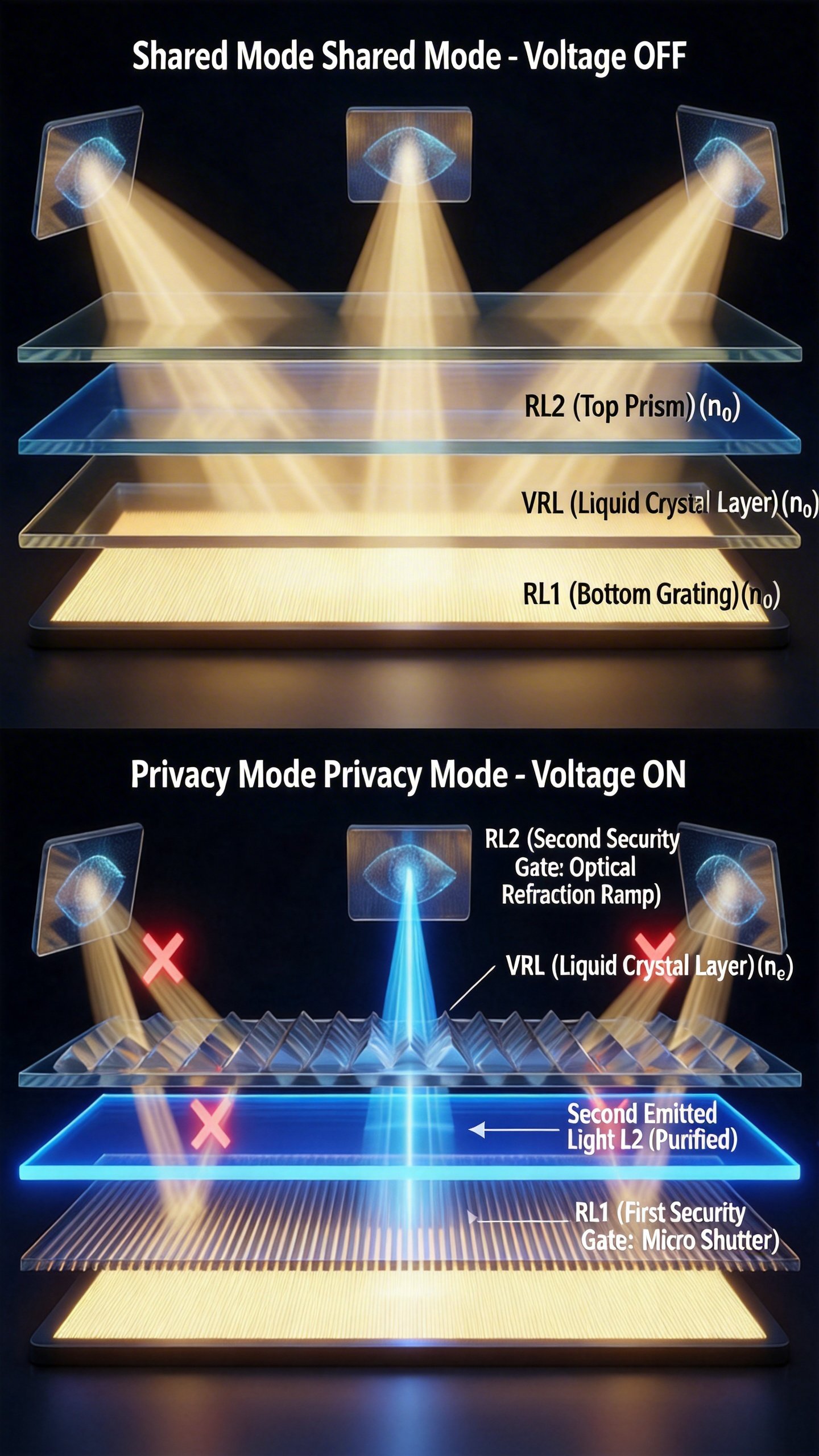
When the Privacy Display feature is enabled, voltage is applied to the various layers of the display. The bottom‑most layer reveals a diffraction structure in the form of a microscopic grating carved into its surface. These gratings act like louvers on window blinds: light rays that try to pass through at wide angles (anything beyond a straight‑on trajectory) undergo diffraction, altering their paths.
The diffracted light rays then encounter a prism‑like optical structure on the top layer. Because they hit the prism slopes at extreme angles and there is a refractive‑index difference, they become severely distorted or are totally internally reflected, bouncing back into the screen.
As a result, viewers at extreme angles see a blank display, while the primary user looking straight on sees the content normally. The effect is a narrower viewing angle on demand, useful for protecting privacy.
Caveats
- Samsung has not officially shared these technical details, and the leaker has not disclosed their source.
- The graphics accompanying the leak appear to have been generated with AI, so the explanation should be taken with a healthy pinch of salt.
- We hope Samsung will publish a technical deep dive to confirm exactly how the Privacy Display works.