
Intel mobile CPUs have achieved up to 95x performance uplift over the past two decades — benchmarking the gains from 45nm Penryn to 18A Panther Lake
Source: Tom’s Hardware
Image credit: Getty Images
Intel has consistently pushed the boundaries of processor technology, delivering some of the best CPUs on the market. Leading Linux publication Phoronix tested 15 mobile Intel processors spanning 18 years to illustrate the evolution from the Penryn architecture to the cutting‑edge Panther Lake. In specific workloads, Panther Lake delivers up to 95× higher performance than Penryn.
Processor lineup
| Codename | Processor | Cores / Threads | Max Turbo Boost (GHz) | Launch Date |
|---|---|---|---|---|
| Panther Lake | Core Ultra X7 358H | 16 / 16 | 4.8 | 2026 |
| Lunar Lake | Core Ultra 7 256V | 8 / 8 | 4.8 | 2024 |
| Meteor Lake | Core Ultra 7 155H | 16 / 22 | 4.8 | 2023 |
| Raptor Lake | Core i5-1334U | 10 / 12 | 4.6 | 2023 |
| Alder Lake | Core i7-1280P | 14 / 20 | 4.8 | 2022 |
| Tiger Lake | Core i7-1165G7 | 4 / 8 | 4.7 | 2022 |
| Ice Lake | Core i7-1065G7 | 4 / 8 | 3.9 | 2019 |
| Whiskey Lake | Core i7-8565U | 4 / 8 | 4.6 | 2018 |
| Kaby Lake | Core i7-8550U | 4 / 8 | 4.0 | 2017 |
| Broadwell | Core i7-5600U | 2 / 4 | 3.2 | 2015 |
| Haswell | Core i7-4558U | 2 / 4 | 3.3 | 2013 |
| Ivy Bridge | Core i7-3517U | 2 / 4 | 3.0 | 2012 |
| Sandy Bridge | Core i5-2520M | 2 / 4 | 3.2 | 2011 |
| Clarksfield | Core i7-720QM | 4 / 8 | 2.8 | 2009 |
| Penryn | Core 2 Duo T9300 | 2 / 2 | 2.5 | 2008 |
Benchmark methodology
Phoronix ran 150 benchmarks on each processor under Ubuntu 26.04, covering:
- Daily workloads – web browsing, media encoding
- Specialized workloads – database management, AI inference, HPC
The benchmark suite is documented in Phoronix’s benchmark tag.
Performance results
- The Core Ultra X7 358H (Panther Lake) was up to 95× faster than the Core 2 Duo T9300 (Penryn) in OpenSSL and 93.9× faster in OpenVINO AI.
- The geometric mean across all tests shows the Panther Lake chip outperformed Penryn by 21.5×.
- Typical productivity tasks (web browsing, photo manipulation) saw improvements of up to 10×.
For a more recent baseline, the Panther Lake processor was on average 9.7× faster than the Core i5-2520M (Sandy Bridge). The most notable generation‑over‑generation jump was the Core i7-720QM (Clarksfield), delivering 1.9× more performance than Penryn, thanks to double the core count and Hyper‑Threading.
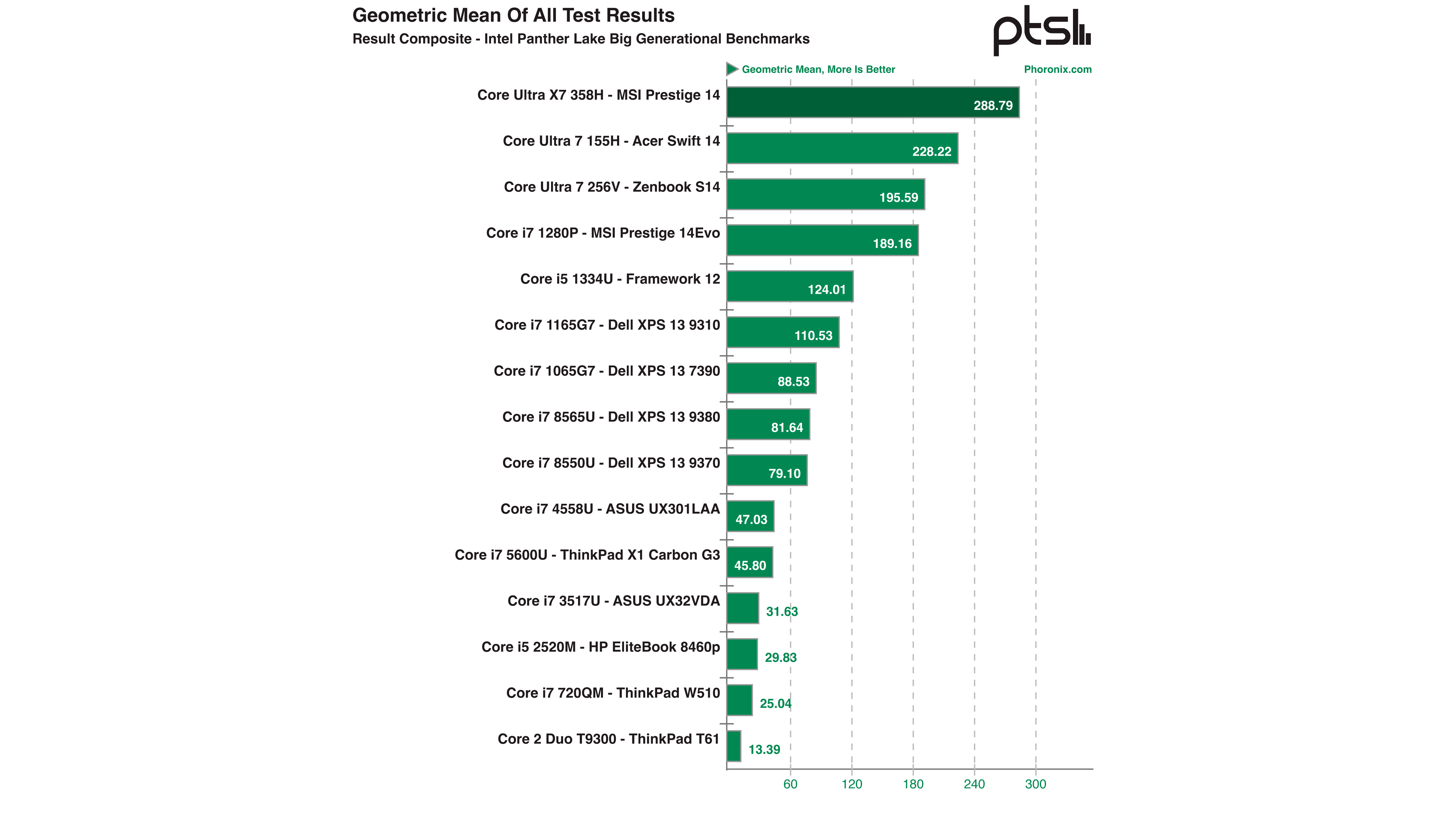
Image credit: Phoronix
Power efficiency
Phoronix noted that early chips (Penryn, Clarksfield) lacked power‑sensor support, so power‑efficiency data is unavailable for them. However, newer generations reveal clear trends:
- Panther Lake consumes 7.8 % less power on average than Sandy Bridge, despite having 8× more cores.
- The Core i7-3517U (Ivy Bridge) recorded the lowest average power consumption among the 15 tested processors.
- Compared to Ivy Bridge, Panther Lake uses 1.92× more power but delivers 9.1× more performance.
Conclusion
The quantitative gains in Intel’s mobile CPUs over the past two decades are striking, with up to 95× performance uplift in specific workloads. Equally impressive is Linux’s continued support for legacy hardware, allowing even a 2008‑era processor to run modern Ubuntu releases and benchmark suites. This combination of hardware evolution and software compatibility ensures that older devices can still find relevance in today’s computing landscape.