
Google quietly kills Project Mariner as the AI agent race shifts gears
Source: Android Authority

Edgar Cervantes / Android Authority
TL;DR
- Google is shutting down its experimental AI browser agent that could browse the web, fill forms, search listings, and book trips for you.
- The tool relied on screenshots and visual recognition to interact with websites like a human.
- Google isn’t abandoning the tech entirely; many of the tool’s features are being folded into the Gemini API and Gemini Agent.
Project Mariner Overview
Project Mariner was introduced at I/O 2025 as Google DeepMind’s effort to create an AI that could use the internet much like a person. The agent could navigate Chrome, fill out forms, look up job listings, and even book travel on sites such as Expedia. It achieved this by taking frequent screenshots of the browser, recognizing buttons and text, and then clicking or typing on the user’s behalf.
Shutdown Details
In March, reports surfaced that Google was moving staff off the Project Mariner team. Wired’s Maxwell Zeff covered the shake‑up, noting that the project was likely to be discontinued.
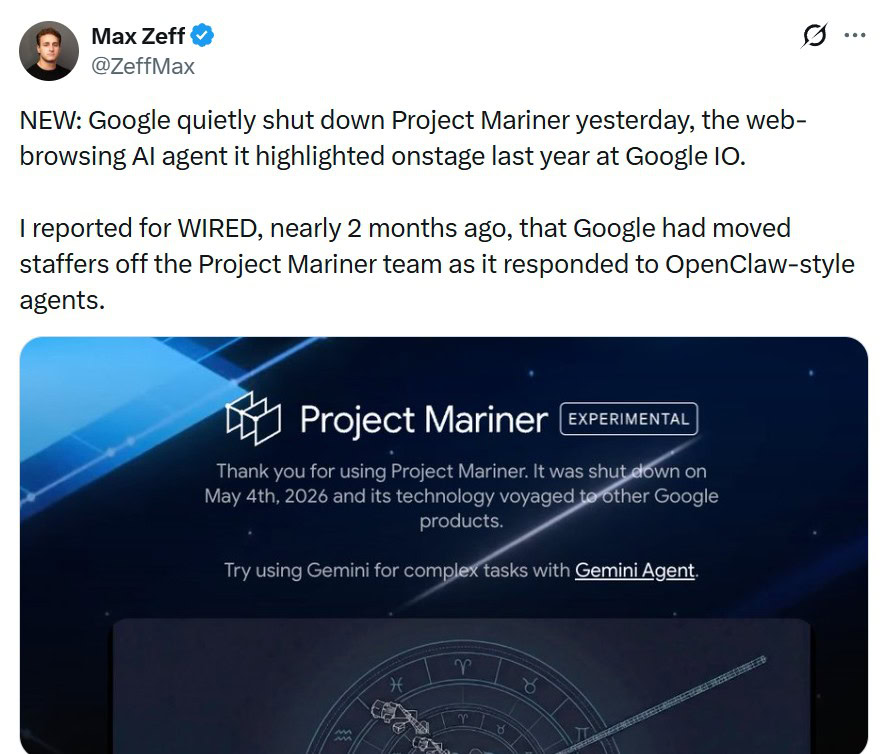
X user BoughtMilkMan first spotted the project’s shutdown, as indicated by its landing page’s message.
Technical Challenges
While the concept of an AI assistant that can browse the web is appealing, the technology is resource‑intensive. Agents that process visual data in real time require significant computing power, which can lead to:
- Slow performance
- Occasional errors, such as selecting incorrect options
Industry Shift
The AI agent landscape has evolved rapidly. Newer agentic tools like OpenClaw and Claude Code (see the Claude AI chatbot overview) have gained popularity. These tools go beyond simple clicking; they can modify files, write complex code, and act as digital coworkers.
Future of the Technology
Google has indicated that the core technology behind Mariner will live on in other products. Most of its capabilities are being integrated into:
- The Gemini API
- The new Gemini Agent
These integrations aim to bring the browsing and automation strengths of Mariner to a broader set of Google AI services.