
Galaxy S26 Ultra’s Privacy Display just passed an independent test, and the numbers are wild!
Source: Android Authority
TL;DR
- Samsung Display’s Flex Magic Pixel OLED, now featured on the Galaxy S26 Ultra, has been independently verified to sharply reduce screen visibility from side angles.
- Testing shows brightness drops to just 3.5 % at 45° and below 0.9 % at 60°, far lower than conventional smartphone displays.
Samsung’s Privacy Display just got a big credibility boost. The headline isn’t about how to use it on the Galaxy S26 Ultra.
Samsung Display says its Flex Magic Pixel (FMP) OLED technology has now been independently verified by UL Solutions, a globally recognized testing and certification body. UL Solutions confirms that the new OLED panel delivers strong viewing‑angle privacy across all off‑axis angles.
Test Results
- 45° off‑axis: retains 3.5 % of original brightness.
- 60° off‑axis: retains 0.9 % or less of original brightness.
This translates to roughly 1/30th of the brightness at 45° and less than 1/100th at steeper angles—a stark contrast to conventional smartphone displays, which typically maintain around 40 % brightness when viewed from the side.
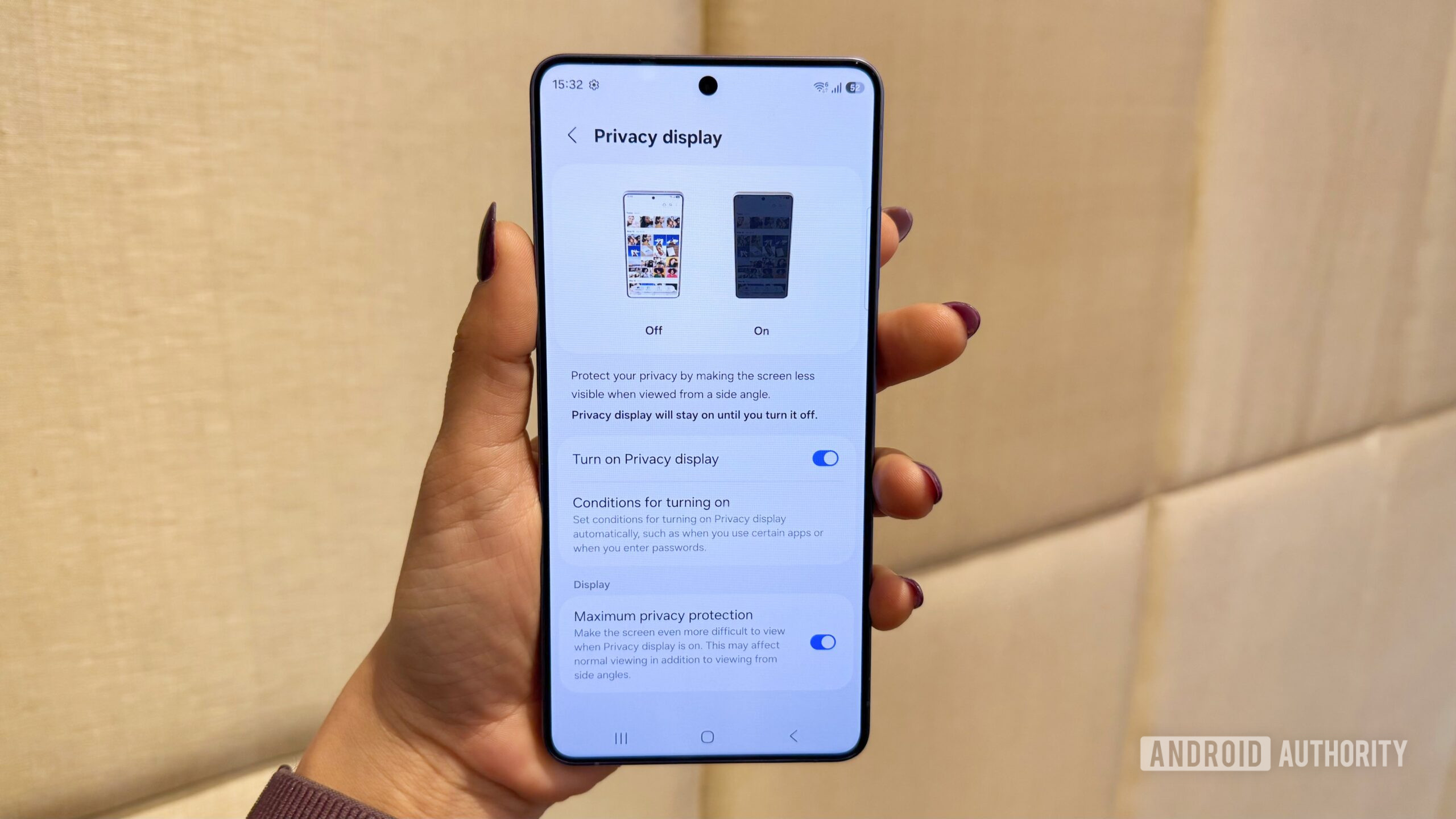
Adamya Sharma / Android Authority
How It Works
Samsung Display re‑engineered a key OLED structure—the Black Matrix—which separates red, green, and blue subpixels. Instead of a single layer, the company developed a multi‑layer light‑blocking structure that precisely controls light spread from each subpixel (each only a few micrometers wide).
This is paired with Samsung Display’s polarizer‑free OLED platform, LEAD, which already boosts brightness and reduces power consumption. The combined system is now branded LEAD 2.0, integrating Flex Magic Pixel privacy control while also improving power efficiency.
- Around 150 patents have been filed since 2020 related to these technologies.
Implications
While Samsung isn’t naming other devices, the independent verification adds weight to claims that more Android phones will get privacy displays in the near future. Industry sources suggest Chinese smartphone OEMs are also testing the technology for flagship releases around September. For now, the Samsung Galaxy S26 Ultra enjoys a clear first‑mover advantage.