Ford is focusing on efficiency to make its 2027 $30,000 EV pickup affordable
Source: Ars Technica
Ford’s New Universal EV Platform – A $30 k Midsize Truck

Credit: Ford
The electric‑car transition isn’t going great for America’s domestic automakers, but it’s far from over. Ford may have ended production of the full‑size F‑150 Lightning — see the Ars Technica report — but next year it will debut a new “Universal EV Platform,” starting with a midsize truck that the company says will start at a much more reasonable $30,000 (if everything goes to plan).
The company seems serious about the idea, having created an internal “skunkworks” several years ago to design this affordable platform from first principles. See the earlier coverage of that effort: Ford rethinks EV strategy, works on a smaller, cheaper EV platform.
Doing More with Less
Fewer components, less energy, same distance.
Ford’s new approach focuses on:
- Smaller battery packs → lower cost, lighter vehicle.
- Simplified architecture → fewer parts, easier manufacturing.
- Optimised software → better energy‑management and range.
Why the Full‑Size EV Trucks Struggled
A few years ago, Ford and its crosstown rival bet that full‑size pickup buyers would overlook the range penalty of heavy towing in exchange for instant torque and low operating costs. The trucks shipped with useful features such as:
- Power sockets for job sites.
- Ability to power a home during an outage.
However, most buyers weren’t willing to accept the trade‑offs. Two major factors drove the disappointment:
-
Sticker shock – supply‑chain chaos and dealer mark‑ups pushed prices far beyond the original expectations.
-
Range anxiety – towing heavily reduced usable range, making the trucks less practical for many work‑site scenarios.
The result: Ford has taken an estimated $20 billion write‑down on its full‑size electric pickup program.
The New Midsize Truck
- Target price: $30,000 (base model).
- Platform: Universal EV Platform – a modular architecture that can underpin trucks, SUVs, and vans.
- Battery size: Significantly smaller than the F‑150 Lightning, but paired with a more efficient drivetrain.
- Launch timeline: First production units expected in 2025.
For more details on the platform announcement, see the Ars Technica story on Ford’s universal EV system and the $30 k truck.
What This Means for the Industry
- Affordability could finally bring EV pickups into the mainstream.
- Modular platforms may become the norm, allowing manufacturers to spread R&D costs across multiple models.
- Supply‑chain lessons learned from the Lightning’s rollout are likely to shape future production strategies.
References
- Ford ends F‑150 Lightning production – Ars Technica (Dec 2025)
- Ford bets big on universal EV production system and $30 k truck – Ars Technica (Aug 2025)
- Ford rethinks EV strategy, is working on a smaller, cheaper EV platform – Ars Technica (Feb 2024)
- No end in sight for chip shortage – Ars Technica (Oct 2021)
- Buying a new car? This database might help save thousands in dealer markups – Ars Technica (Apr 2022)
- Ford kills some F‑150 Lightning trims, raises prices on others – Ars Technica (Jan 2024)
- Here’s what we know about Ford’s electric F‑150 Lightning pickup – Ars Technica (May 2021)
Smaller, cheaper? We got it.
Meanwhile, Ford appears to have been listening. Instead of making a full‑size pickup with a starting price north of $60,000, it’s aiming to produce something more midsized (more interior space than a Toyota RAV4, it says), starting at roughly half that amount. It will only succeed if it can get away with using a smaller battery than you’d find between the frame rails of an F‑150 Lightning—about 40 % of the vehicle cost is battery, Ford says.
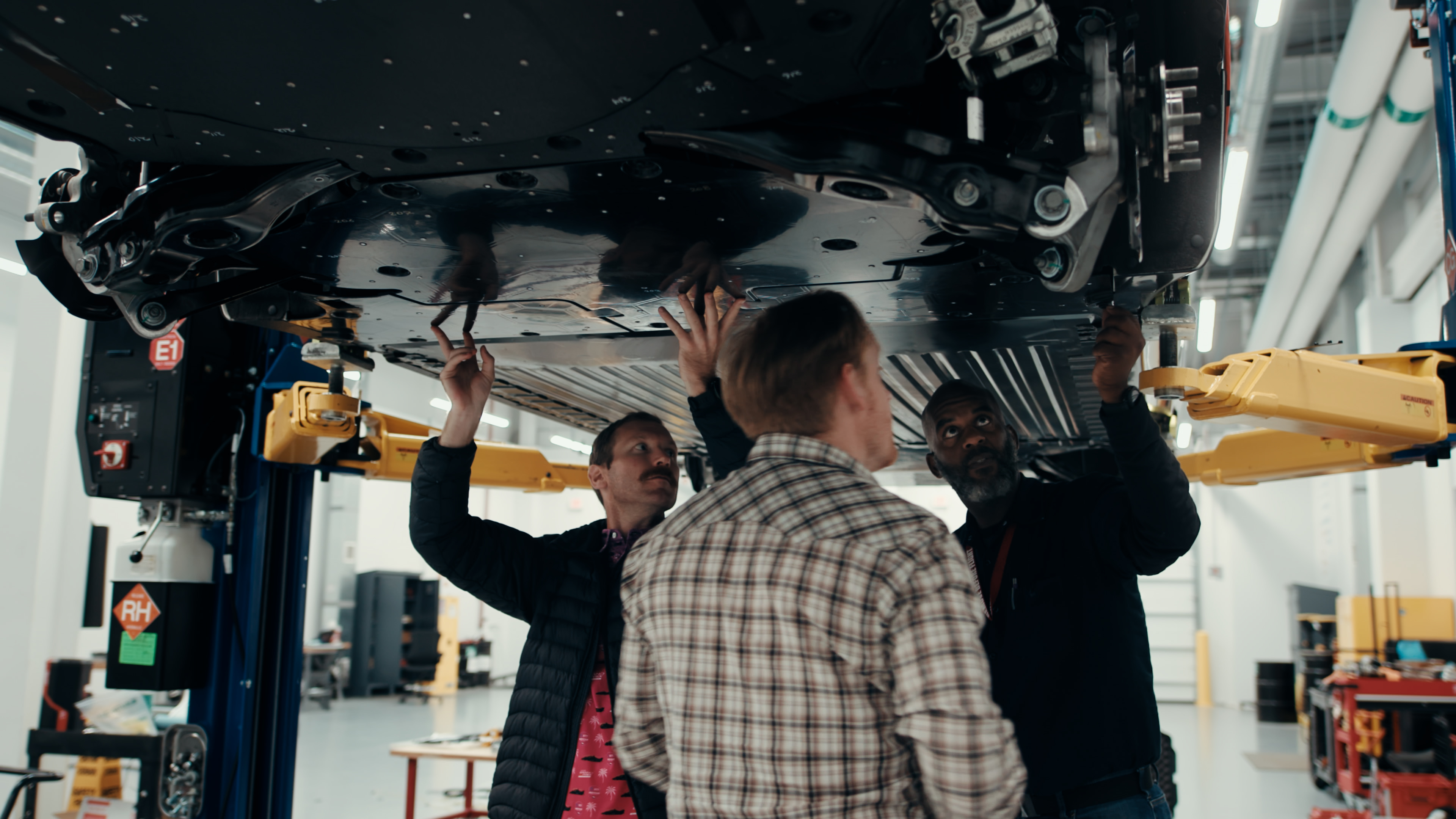
Underbody aerodynamics are extremely important.
Credit: Ford
We’ve known for some time that the plan includes new prismatic lithium‑iron‑phosphate cells made in Michigan. The pickup will be assembled at Ford’s Louisville plant with a new, more efficient process that uses 40 % fewer workstations than a traditional Ford assembly line.
If you want to provide more range with less energy and a smaller battery pack, you need a more efficient vehicle. Too much weight is a liability, and at highway speeds aerodynamic efficiency matters most of all (see the Ars Technica test of an electric Mercedes). Designing a new vehicle—or platform—is not simple; it involves many different departments, each with its own priorities.
“For example, the aerodynamics team always wants a lower roof for less drag; the occupant‑package team wants a higher roof for more headroom, while the interiors team wants to decrease the cabin size to reduce cost,” said Alan Clarke, executive director of Ford’s advanced EV development.
“Usually, these groups negotiate until they find a ‘middle ground,’ one that inevitably ends in a trade‑off led by yet another department tasked with making trade‑offs on behalf of the customer.”
To get everyone on the same page, Ford instituted what it calls “bounties” to help engineers evaluate the trade‑offs involved in design decisions.
“Now, the aerodynamics team and interior team share the same goal, and both understand that adding even 1 mm to the roof height would mean $1.30 in additional battery cost or 0.055 mi (0.089 km) of range loss. With bounties, each team has a common objective to maximize range while decreasing battery cost—a direct linkage to giving our customers more,” Clarke explained.
15 % Better Efficiency
The wake from the front wheels helps prevent the rear wheels from creating additional drag as they rotate. The underside of the drive units has been aero‑optimized, with the driveshafts angled to minimize friction. The traditional pickup‑truck shape isn’t the ideal starting point for an ultra‑low‑drag vehicle, but Ford has reshaped the cab so that airflow continues over the bed in a teardrop form until it meets the top of the tailgate.
“To the air, it’s no longer a truck,” said Saleem Merkt, head of aerodynamics for Ford’s advanced EV development.
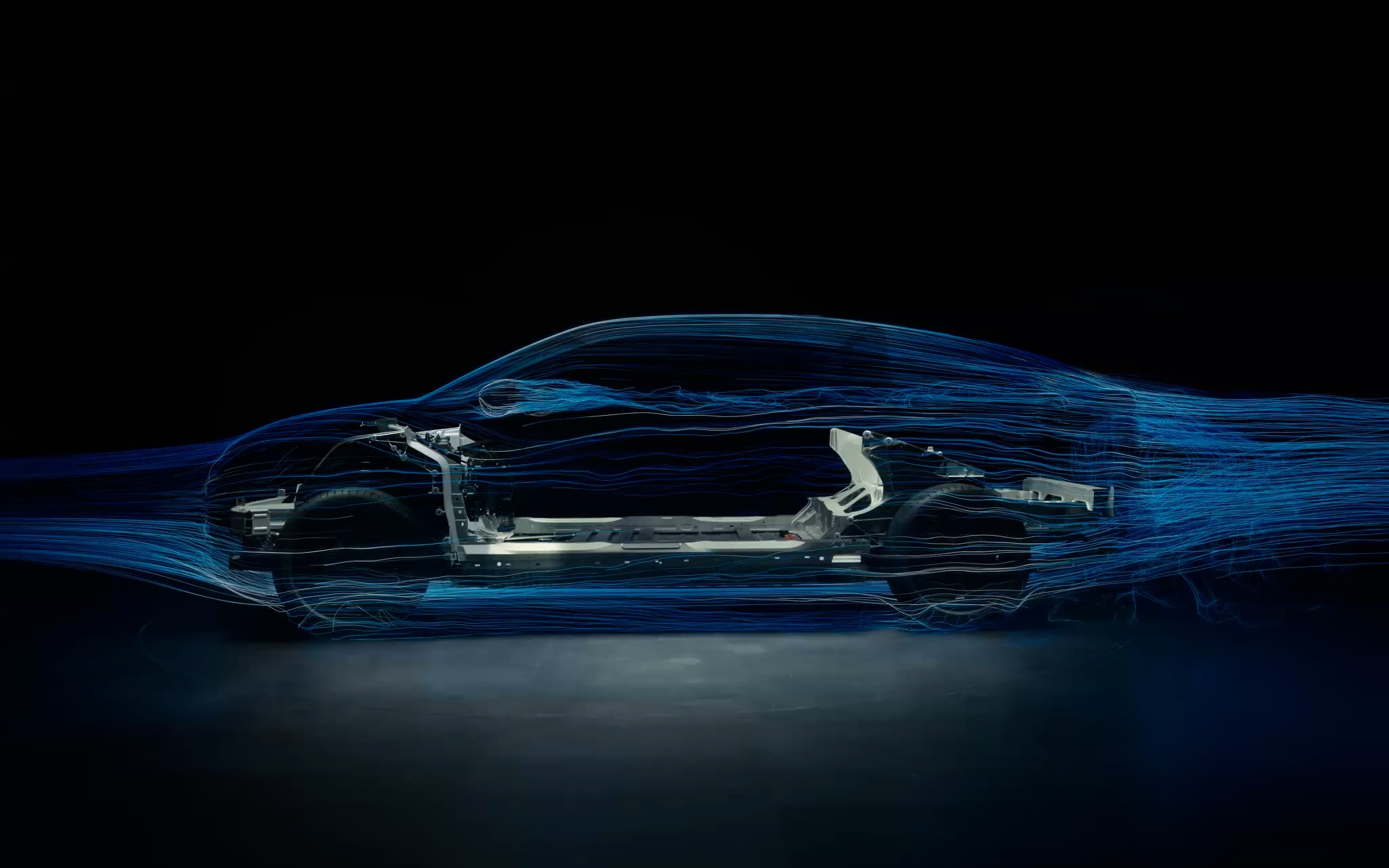
Prototype illustration of the aerodynamic efficiency of Ford’s midsize electric truck.
Credit: Ford
Like Merkt, many of the aerodynamicists working on the EV platform have a background in Formula 1, and Ford says it used their “fail fast, learn faster” mentality to good effect. They introduced the wind tunnel early in the truck’s development, using a modular approach that allowed them to swap 3D‑printed or machined parts in and out to test new configurations quickly.
“From under‑body shields to front fascia to suspension—in as little as minutes. We tested thousands of 3D‑printed components, including versions of the suspension and drive units that didn’t even exist as functional prototypes yet,” Merkt explained. “Since these 3D‑printed parts were accurate within fractions of a millimeter of our simulations, it allowed us to develop a deeper, data‑driven understanding of how every single detail impacts range and efficiency in the real world.”
In addition to the wind‑shaping roof, Merkt’s team redesigned the side mirrors to use a single actuator for both adjusting the glass and folding the mirror.
“Now that the mirror body no longer needs internal ‘wiggle room’ for the glass to move independently, we were able to shrink the entire housing by over 20 %. This reduction in frontal area and mass unlocks a more aerodynamic shape, adding an estimated 1.5 miles of range,” Merkt said.
On their own, each small optimization adds only a little more range. Together, however, they add up to a meaningful improvement over any midsize truck on the market, Ford says.
Large Castings, Fewer Wires, Smarter Electronics
Large castings are a hot trend in the automotive industry right now. As long as you have good quality control, using single castings instead of assemblies made from dozens or hundreds of components can save time and weight.
- For the 2027 electric pickup, Ford is using just two front‑ and rear‑structural parts, each a single aluminum casting.
- By contrast, the Ford Maverick pickup uses 146 structural parts in the front and rear, according to Ford.
- Because unicastings require fewer fasteners and adhesives, Ford needs fewer robots on the assembly line.
The battery uses a cell‑to‑structure architecture, meaning more of the pack’s volume is taken up by cells, increasing energy density. A flexible one‑piece circuit board sits on top, and a shorter (therefore lighter) wiring harness is made possible by switching to 48 V for the low‑voltage system.
Ford has designed the new platform’s charging system entirely in‑house, creating a single high‑ and low‑voltage power‑electronics unit for the entire EV. This includes bidirectional charging, although the company has stuck with 400 V for the high‑voltage system rather than moving to 800 V or greater.
The pickup will be an entirely software‑defined vehicle. Instead of dozens of discrete electronic control units, the EV will use a zonal architecture with five powerful computers—one overseeing each zone.
Details such as the exact price, EPA range estimate, and sale date will be released later, the company told us.
Author

Jonathan M. Gitlin – Automotive Editor, Ars Technica
BSc & PhD in Pharmacology
In 2014 he left the National Human Genome Research Institute to launch Ars Technica’s automotive coverage. He lives in Washington, D.C.
30 Comments