
Engineering Research Beyond Surveys (Part II)
Source: Dev.to
Source: Dev.to
When Surveys Are the Right Method in Engineering Teams
Engineers are data‑driven, practical, and skeptical of anything that feels vague or time‑consuming, which makes research a tricky thing to get right. Surveys are often the go‑to tool, but they only tell part of the story. Used the right way, research can help teams understand not just what is happening, but why.
This guide walks through:
- How to use surveys effectively
- When to go beyond surveys
- How to present findings in a way that engineers trust and act on
Step 1: Use Surveys for Measurement, Not Discovery
Surveys work best as a measurement tool, not an exploration tool. They’re most useful once you already understand the problem space, the workflows, and the main pain points—in other words, when you know what questions to ask.
Examples of good survey use
- Tracking how developer satisfaction changes over time.
- Measuring whether onboarding improvements actually made a difference.
- Helping teams prioritize a known list of feature requests.
- Checking how a new release landed with users.
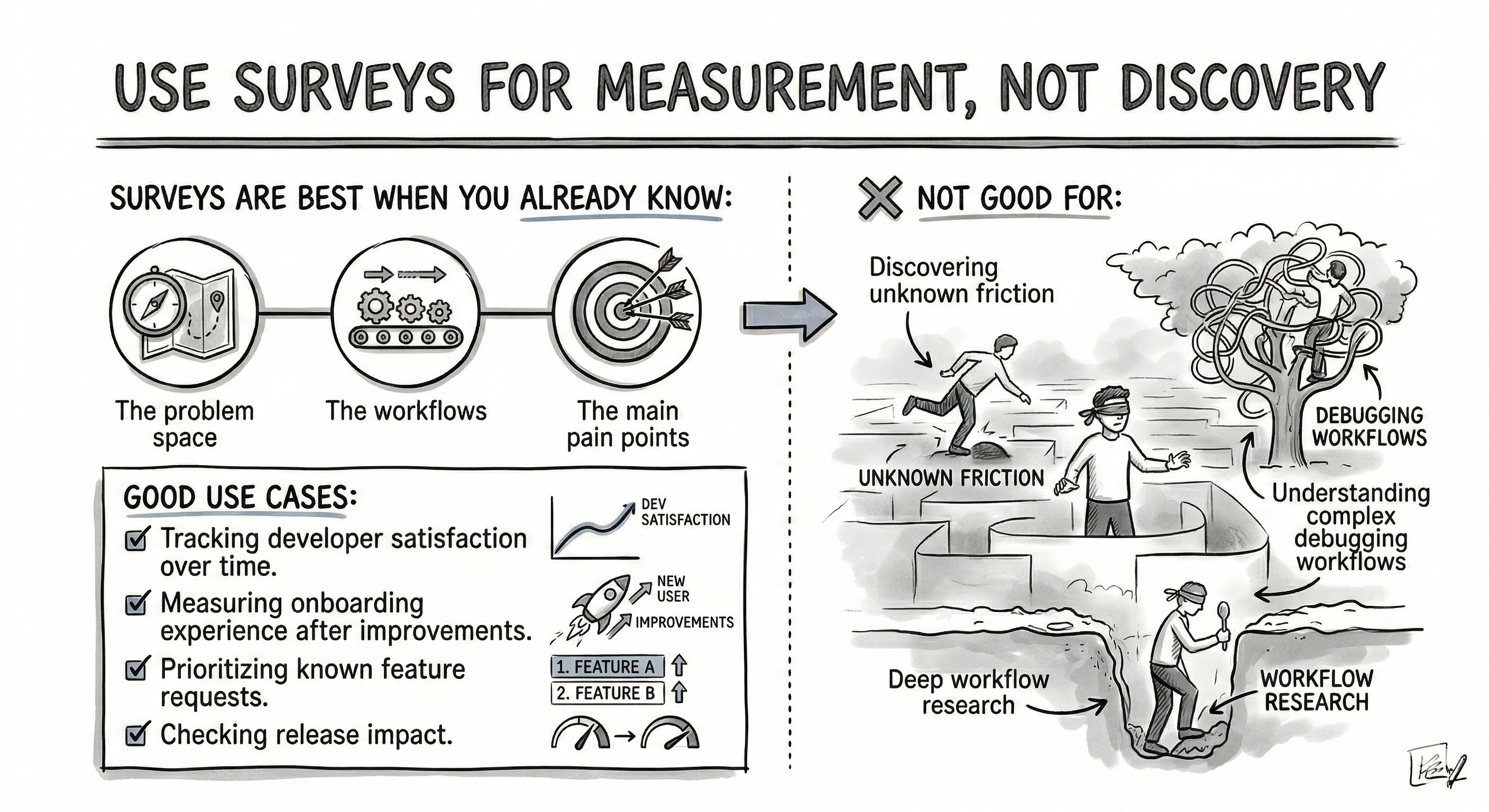
When surveys fall short
If you need to:
- Uncover friction you don’t yet know about,
- Understand how developers work through complex debugging scenarios, or
- Do deep research into how people actually use a tool day‑to‑day,
then interviews, observation, or other qualitative methods are more appropriate.
Takeaway: Surveys are powerful—when used intentionally.
Step 2: Define a Clear Outcome Metric
Before launching any survey, be crystal‑clear about what decision the data will influence. This outcome metric should guide every question you write.
Typical outcome metrics
- CLI performance – Should it move up the roadmap?
- CI pipeline – Did a recent change make onboarding easier?
- Documentation – Is it usable enough for new hires?
Without a decision target, the survey becomes a collection of “useful” responses that point nowhere. The data turns into noise rather than direction.
Step 3 – Keep It Focused (Engineers Hate Long Surveys)
- Target: 10 – 20 questions total.
- Mix: Likert‑scale (rating) items plus one or two open‑ended prompts.
- Focus: Ask about real behaviors and actual experiences, not vague opinions.
Bad vs. Good Question Examples
| ❌ Bad | ✅ Good |
|---|---|
| “Do you like the platform?” | “How many times did the build fail last week?” |
| — | “What was the last frustrating moment you experienced?” |
Behavior‑based questions generate more honest and actionable answers.
Step 4: Pair Surveys With Usage Data
Surveys reveal what developers think and feel, but engineers trust logs, metrics, and performance data. Pairing survey findings with actual usage data gives your research credibility.
- Perception + behavior = a picture that’s hard to dismiss.
- Example: Developers report slow onboarding and metrics show a drop‑off at the same stage.
- Example: Satisfaction scores dip while error rates spike.
This combination speaks the language engineers already trust.
How to Convince Engineering Teams to Go Beyond Surveys
Getting engineering teams to embrace research beyond surveys is really a question of framing. Telling a room of engineers that you need more qualitative research sounds like a methodological preference—easy to brush off.
What gets their attention is framing it as a gap in the signal. Engineers already think in terms of failures, blind spots, and missing data. So, instead of leading with the research method, lead with what’s being missed.
“We’re not catching failure signals early enough.”
That lands differently. It connects to reliability, visibility, and avoiding surprises. Once you speak that language, the case for richer research methods makes itself.
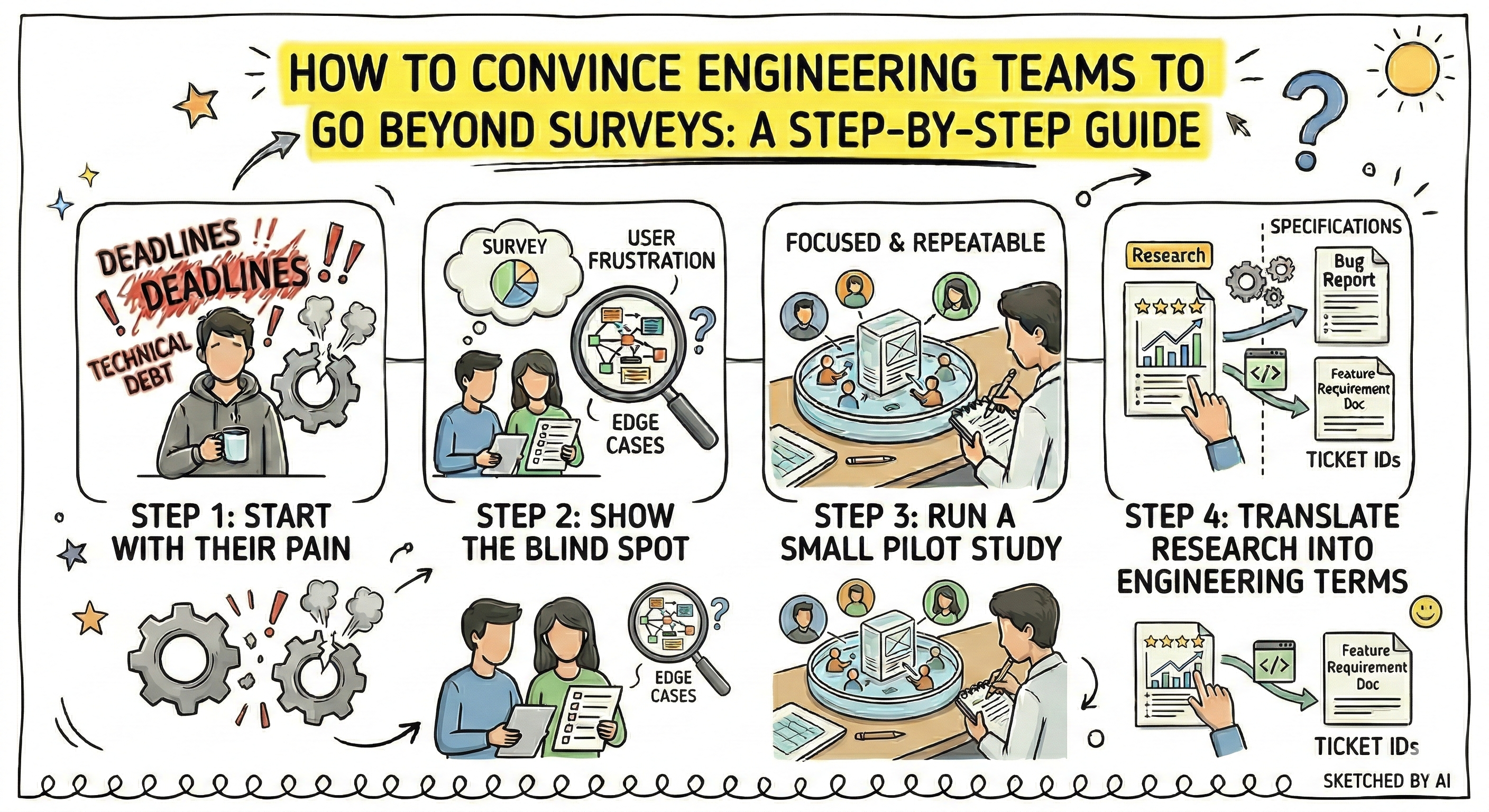
Step 1 – Start With Their Pain
Begin the conversation with a problem the engineering team is already feeling. Rather than asking for interviews or more research time outright, anchor the discussion in an existing friction point.
Step 2 – Show the Blind Spot
Illustrate the missing data or hidden failure signals that current metrics don’t capture. Use a concrete example to make the gap tangible.
Step 3 – Run a Small Pilot Study
Propose a low‑effort, high‑impact pilot that combines a short survey with a slice of usage data. Show how quickly you can surface actionable insights.
Step 4 – Translate Research Into Engineering Terms
When presenting findings, speak in the language engineers use: error rates, latency, throughput, failure modes, etc. Map qualitative insights to the quantitative signals they already monitor.
Visual Summary
Why This Works
- Treat surveys as measurement tools – define clear outcome metrics, keep them short, and always pair them with real usage data.
- Speak the engineers’ language – error rates, latency, throughput, failure modes.
- Frame requests as “closing a blind spot” – the team sees immediate value.
Typical questions that reveal blind spots
- Why are support tickets going up?
- Why are developers building workarounds instead of using the platform as intended?
- Why do satisfaction scores look healthy while adoption numbers lag?
These are questions surveys alone can’t answer. By surfacing the gaps, you’re not pitching a research method—you’re pointing at a real problem that needs deeper investigation. That shift in framing makes it much easier for engineering teams to see the value, because you’re speaking directly to something already on their radar.
Step 2: Show the Blind Spot
Sometimes the data you have tells one story while reality tells another. Imagine your survey shows 75 % of developers are satisfied—that sounds like a win.
But then you look around and notice people are quietly building workarounds, Slack is full of complaints, and CI timeouts are happening every single day. There’s a clear disconnect, and that gap is your blind spot.
- Surveys are good at telling you what is happening, but they rarely explain why.
- Engineers deeply respect root‑cause analysis—it’s how they think about system failures.
So instead of framing additional research as a soft or optional exercise, position it as debugging user behavior, running a root‑cause investigation, or building “observability for humans” the same way you’d build it for systems. That language clicks with technical teams because it maps directly onto how they already approach problems.
Step 3: Run a Small Pilot Study
Instead of proposing a full research program up front, start small and let the results speak for themselves.
What to Do
- Five developer interviews
- One shadowing session where you follow someone through their actual workflow
- One usability test focused on a specific task (e.g., CLI setup)
These activities are easy for a team to approve because they require minimal investment.
Why It Works
What matters most is what you do with the results.
When you return with concrete findings—such as:
- A precise point in the workflow where things break down
- A pain point that never appeared in surveys
- A quick‑win the team can implement immediately
skepticism begins to fade. Engineers are pragmatic; a small pilot that yields real, actionable insights is far more convincing than any proposal or methodology argument you could make up front.
Step 4: Translate Research Into Engineering Terms
How you communicate findings matters just as much as the findings themselves.
- Bad: “Developers feel confused.”
- Good: “Onboarding has three distinct friction points, two undocumented assumptions that users can’t discover upfront, and one configuration issue that consistently causes 40‑minute delays.”
That level of specificity speaks directly to how engineers think. It turns a feeling into a defect, a complaint into a root cause, and a vague observation into something that can actually be prioritized and fixed. The goal is to make your research feel less like a report and more like a diagnostic—something that tells the team exactly where to look and what to do about it.
Conclusion: Building a Research Practice Engineers Actually Trust
Surveys are a valuable tool for engineering teams, but only when used with intention and paired with the right approach. They work best for measuring what you already know, not for uncovering what you don’t.
- Keep surveys short and focused on real behaviors.
- Back them up with actual usage data.
- Know when to go deeper through interviews or observation.
When bringing engineering teams on board with broader research, speak their language, frame gaps as missing signals, start small with a pilot study, and translate findings into specific, actionable problems they can actually fix. When research is done this way, it stops feeling like an extra step and becomes a natural part of how good engineering decisions are made.
Part (I) of this article