
Don't Become an Engineering Manager
Source: Hacker News
Over drinks a few weeks ago, a friend told me he’d been offered a promotion to an Engineering Manager role. He planned to decline it, but wanted to hear my take first.
Until recently, my answer in such conversations was always “100 % go for it.” My logic was that it’s a super‑valuable experience, even if someone isn’t looking for a management career path. I told every engineer that a couple of years as an EM would teach them valuable skills, and they could always go back afterward.
This time, we had a long discussion about the trade‑offs, and I finally agreed with him that he should not take that step.
Main arguments from our conversation
Thanks Unblocked for supporting today’s article!
AI coding tools are fast, capable, and completely context‑blind. Even with rules, skills, and MCP connections, they generate code that:
- Misses your conventions
- Ignores past decisions
- Breaks patterns
You end up paying for that gap in re‑work and tokens.
Unblocked changes the economics. It builds organizational context from your code, PR history, conversations, docs, and runtime signals. It maps relationships across systems, reconciles conflicting information, respects permissions, and surfaces what matters for the task at hand. Instead of guessing, agents operate with the same understanding as experienced engineers.
You can:
- Generate plans, code, and reviews that reflect how your system actually works
- Reduce costly retrieval loops and tool calls by providing better context up‑front
- Spend less time correcting outputs for code that should have been right in the first place
The broader landscape
WTF is OpenClaw? I’ve been on paternity leave for a few weeks, and another completely new project exploded…
The pace of change in the last year has been crazy, and it’s not stopping. Even if you don’t give in to constant FOMO, it’s impossible to argue that the way we work hasn’t changed. Almost every part of our work looks different, and will continue to evolve.
You’ve probably seen this tweet – the creator of Claude Code asking why Anthropic still needs software engineers.
My friend was afraid that as a manager he’d have less time to experiment and adapt. Especially with a bigger team (he was offered to manage six), you don’t have much time to play around. I could definitely relate: there are so many ideas I want to work on, tech I want to play with, and so little time to actually do it.
The classic EM ladder used to look like:
EM → Senior EM → Director → VPBut companies have been flattening for two years now. Amazon increased its IC‑to‑manager ratio by 15 %, and other companies followed. This means:
- Fewer Director and VP roles to grow into (and far fewer Senior‑EM slots)
- You can be a great EM for years and find yourself stuck
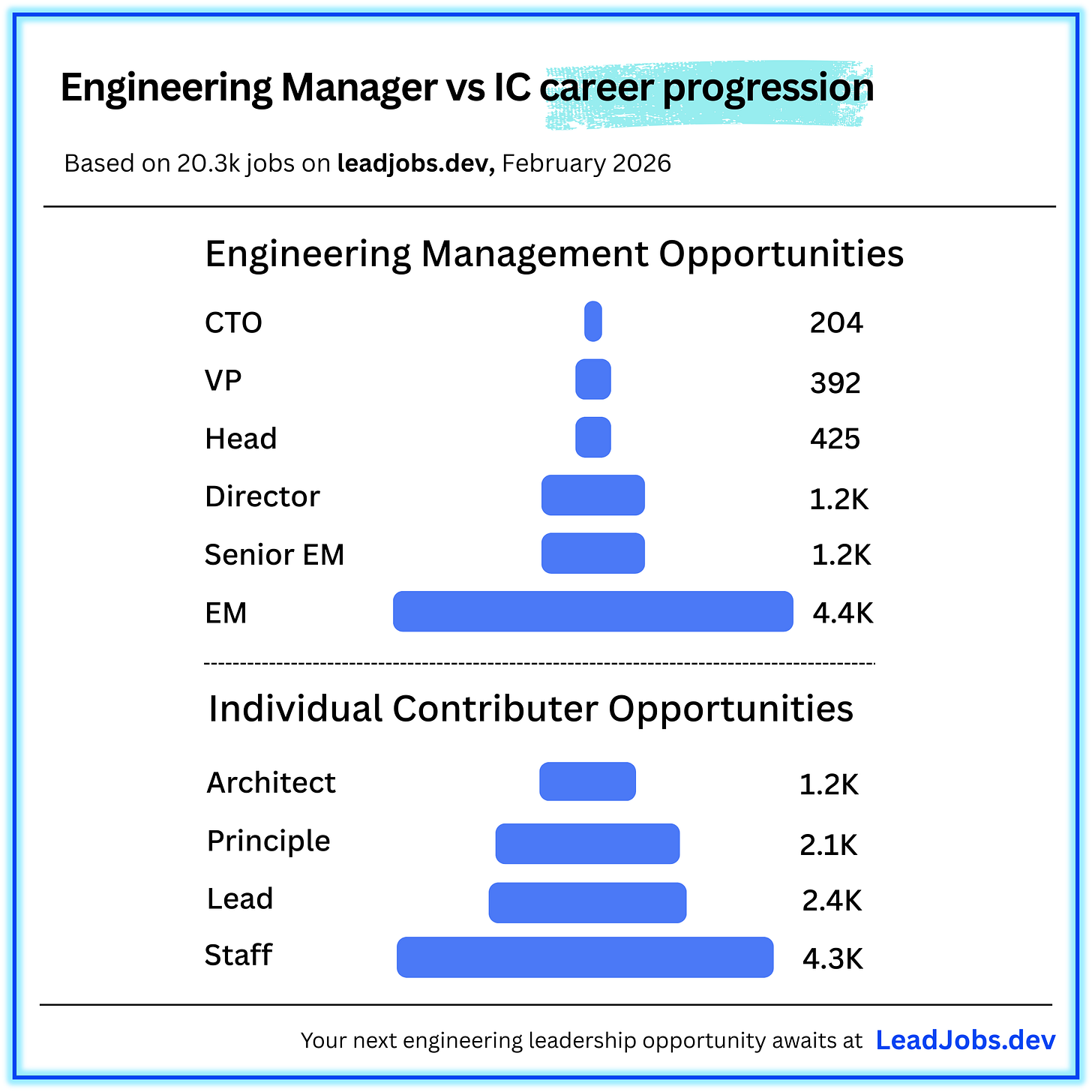
Note: leadjobs.dev is a side project I’m building with Piotr Osiński. I’ve been exploring the engineering‑leadership job market in the last few months through the data we get.
Companies still need someone to run teams, but from Senior EM upward it becomes much more competitive. You’re now competing with experienced leaders who were laid off from those “flattened” companies.
There is also less opportunity for internal growth. As an EM, promotion usually means managing more engineers – something that may not be possible right now. You’re more likely to get a bigger scope with the same team, which isn’t usually a promotion‑worthy achievement.
IC vs. EM compensation
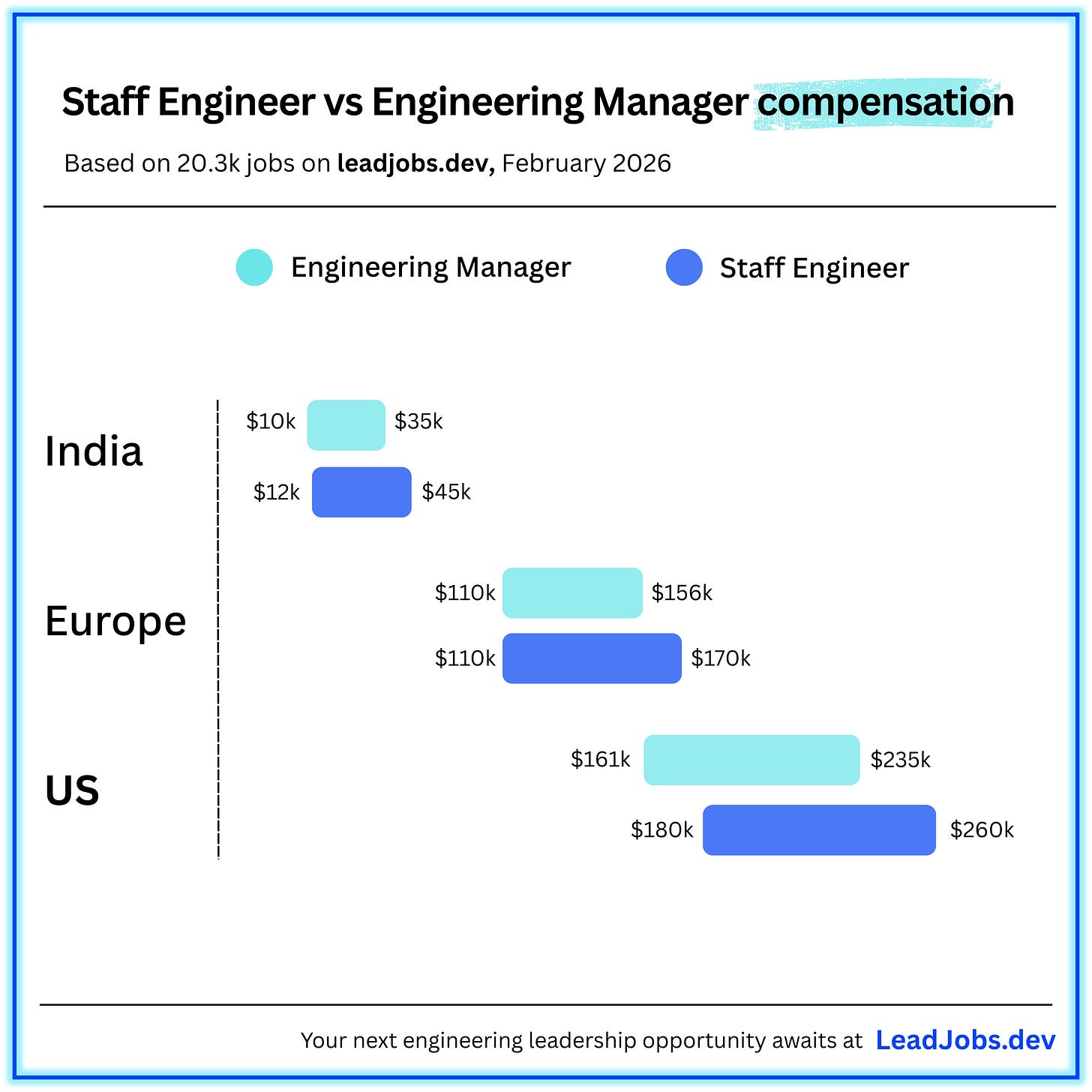
While my friend was offered a bump with the EM promotion, the total compensation was less than the offers he received for Senior/Staff Engineer at other startups.
The assumption has always been that management pays more. It does, if you compare an EM to a Senior Engineer at the same company. But when you compare across the industry, a Staff Engineer is better paid. This is because those engineers are in huge demand (and will continue to be).
For my friend specifically, staying on the IC track, becoming a Staff Engineer, and switching companies would have given him ~20‑30 % more than the EM promotion he was offered.
Two reasons I’m leaning toward staying IC
-
Optimism about experienced Engineering Managers who stay hands‑on. I wrote about this in Engineering Management in the Age of Agents. While we may be less sharp tech‑wise, the many relevant skills the job teaches over the years will still be valuable. And while it’s hard, I think I’ll manage to keep up.
-
I enjoy my job.
Rationally, I believe that being an IC is the smarter choice in 2026, but I know I would enjoy it less.
—
James Stanier | Engineering Management Newsletter | manager.dev | Twitter @jstanier | LinkedIn | Subscribe | Unblocked – Context‑aware AI for engineers | © 2026 | All rights reserved.
Career Advice for Senior Engineers
James Stanier wrote a great article about what to do when the ladder disappears to help you figure out where you should aim. I highly recommend the exercise there!
If you are a senior engineer, the bottom line is that I wouldn’t recommend the jump to management right now. I would wait a couple of years to see how things look.
BUT, and it’s a big but – if your gut tells you to do it (and not your brain), if it’s truly a path you want to pursue – then go for it!
Recommended Reading
-
Even fewer middle managers and more flexible teams? by Gergely Orosz
I love Gergely’s weekly Pulse (I’m a paid subscriber); this one was especially interesting. -
Being an architect isn’t the sum of skills. It’s the product by Gregor Hohpe.
-
The Product Velocity Paradox: When Your Engineers Outrun Your Product Team? by Sahar Carmel – an interesting article on the current reality in many companies.