
Chemical Engineering: A Beginner’s Guide to First-Year Subjects, Skills & Study Strategies
Source: Dev.to
Chemical Engineering – A Dynamic & Versatile Discipline
Chemical Engineering blends chemistry, physics, mathematics, and problem‑solving to create real‑world solutions. From medicines and fuels to eco‑friendly materials, chemical engineers play a vital role in modern society.
Why the First Year Matters
The first year lays the academic and conceptual foundation for advanced topics in later semesters. Knowing what to study, how to study, and which skills to focus on early can make your engineering journey smoother and more successful.
What Is Chemical Engineering All About?
Chemical Engineering focuses on transforming raw materials into valuable products through controlled chemical and physical processes. Unlike pure chemistry, this field emphasizes large‑scale production, safety, efficiency, and sustainability.
Industries Where Chemical Engineers Work
- Pharmaceuticals & biotechnology
- Oil & gas & petrochemicals
- Food processing & FMCG
- Renewable energy & sustainability
- Polymers, materials & nanotechnology
Key traits: strong analytical thinking, numerical ability, and curiosity about how processes work.
First‑Year Chemical Engineering Subjects in India
(While syllabi may vary across universities, the core subjects are generally the same.)
Core Subjects
| Subject | Topics Covered |
|---|---|
| Engineering Chemistry | Atomic structure, bonding, electrochemistry, reaction mechanisms |
| Engineering Mathematics I & II | Calculus, matrices, differential equations, linear algebra |
| Engineering Physics | Mechanics, thermodynamics, waves, material properties |
| Basic Electrical & Electronics Engineering | Circuits, instruments, measurements |
| Introduction to Chemical Engineering | Material balance, energy balance, process basics |
| Computer Programming for Engineers | Fundamentals of C, C++, or Python |
| Environmental Science / Sustainability | Pollution control, green engineering concepts |
Laboratory Work & Practical Learning
Practical exposure is a major part of the curriculum, even in the first year.
- Chemistry Lab: Titration, kinetics, corrosion, thermochemical experiments
- Physics Lab: Optics, oscillations, material testing
- Programming Lab: Basic coding & problem‑solving
- Engineering Drawing: Orthographic projections, isometric views, 3D visualization
These labs help you connect theory with real‑world engineering applications.
Skills You Develop in the First Year
Your first year isn’t just about exams—it’s about building a skill set that will serve you throughout your career.
- Stoichiometry & chemical equation balancing
- Basic thermodynamics & mass‑energy balance concepts
- Logical problem‑solving & analytical thinking
- Introductory programming for engineering applications
- Technical report writing & data interpretation
These abilities become invaluable during internships, research projects, and later semesters.
Common Challenges Faced by Freshers
Many first‑year students encounter similar hurdles:
- Transitioning from school‑level concepts to engineering depth
- Managing theory‑heavy subjects alongside labs
- Grasping abstract topics like thermodynamics
- Time‑management between assignments, labs, and exams
- Writing technical lab reports for the first time
The good news: these challenges are common and completely manageable with the right approach.
Study Tips for Chemical Engineering Beginners
Subject‑Wise Tips
| Subject | Tip |
|---|---|
| Chemistry | Revise physical and organic fundamentals regularly |
| Mathematics | Daily practice is essential; calculus is heavily used later |
| Programming | Start with Python – widely used in simulations & data analysis |
| Engineering Drawing | Practice visualization and projections consistently |
General Study Strategies
- Create short, clear notes after every lecture
- Revise topics weekly instead of cramming before exams
- Practice numerical problems daily
- Use online platforms like NPTEL and MIT OpenCourseWare
- Stay consistent – concept clarity matters more than memorization
Career Scope After Chemical Engineering
Chemical Engineering offers long‑term stability and global opportunities. Typical roles include:
- Process Engineer
- Quality Control Analyst
- R&D Scientist
- Production Engineer
- Sustainability & Environmental Engineer
With experience, you can also move into data analytics, management, consulting, or entrepreneurship. The growing demand for sustainable and green technologies further expands career prospects worldwide.
Useful Resources for First‑Year Students
Recommended Books
- Elements of Chemical Engineering – H. S. Ray
- Introduction to Chemical Engineering – Badger & Banchero
Online Learning Platforms
- NPTEL – Indian university‑level Chemical Engineering courses
- Coursera / edX – Thermodynamics and material‑balance basics
- Khan Academy – Math and chemistry revision
Productivity Tools
- Notion – Notes & task management
- Wolfram Alpha – Solving complex equations
- ChemCollective – Virtual lab simulations
Final Words
The first year of Chemical Engineering is all about building strong fundamentals and developing a mindset of continuous learning. Embrace the challenges, stay curious, and you’ll set a solid foundation for a rewarding engineering career.
Image (optional)
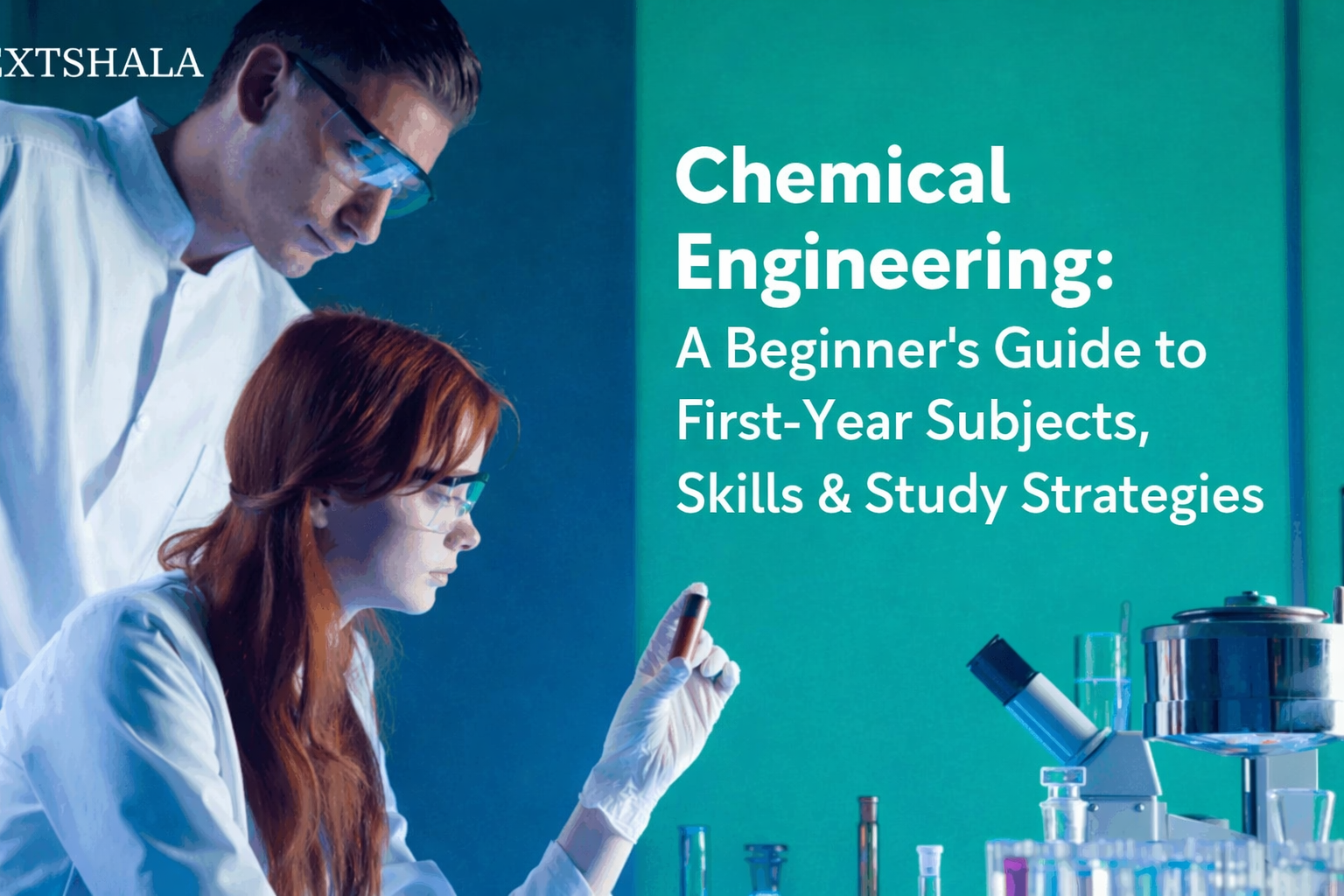
Developing the right mindset. Focus on understanding concepts, practicing regularly, and staying curious about how industrial processes work. The habits you form now will define your success throughout your engineering career.
For curated Chemical Engineering books, first‑year notes, and study materials, platforms like TextShala can help you begin your journey with confidence and clarity.
FAQs
Q1. Is Chemical Engineering difficult in the first year?
It can feel challenging initially, but with consistent study and practice, it becomes manageable.
Q2. What should I study before joining Chemical Engineering?
Revise 11th–12th chemistry, calculus, and basic programming concepts.
Q3. Are labs important in the first year?
Yes, labs help you understand how theoretical concepts apply in real engineering scenarios.
Q4. Which programming language is best for Chemical Engineering students?
Python is highly recommended due to its use in simulations and data analysis.
Q5. Does Chemical Engineering have good future scope?
Absolutely. It offers stable, diverse, and globally relevant career opportunities.
Short Blog Description (≈500 characters)
Chemical Engineering is a versatile and future‑focused field that blends chemistry, physics, mathematics, and problem‑solving to power industries like pharmaceuticals, energy, food, and sustainability. This blog by MAHARANIBYRUNGTAS guides first‑year students through core subjects, essential skills, practical labs, common challenges, and smart study strategies to build strong fundamentals and begin a successful chemical engineering journey with confidence.