
Chaterm Announced at the AWS Summit Keynote
Source: Dev.to
Chaterm, a flagship project from GenAI, was open‑sourced to developers worldwide during the AWS Summit keynote.
Chaterm: Ushering in the Era of Agentic AI for Terminals
In today’s cloud‑native world, operations and cloud‑resource management are becoming exponentially more complex. With hundreds or thousands of servers, multi‑environment Kubernetes clusters, and logs scattered across many systems, the terminal remains the core entry point, yet its interaction model is still stuck in a 20‑year‑old paradigm.
Chaterm was created to address this gap. It is an AI‑Agent‑driven intelligent terminal that upgrades the interaction model from “command‑driven” to “goal‑driven.”
AI‑Agent‑Driven Intelligent Terminal
Current DevOps practices require engineers to manage massive fleets of servers and containers. Low‑level intelligence makes operations cumbersome and reduces efficiency, especially for batch jobs and troubleshooting.
Key Pain Points
| Pain Point | Description |
|---|---|
| Cumbersome Batch Operations | Traditional tools (e.g., Amazon SSM Agent) can run commands across clusters, but they lack large‑scale model support, limiting intelligence for daily work. |
| High Knowledge Barrier | O&M staff must master a wide stack: command‑line tools, scripting, regex, system configuration, from kernel to application layer. Novices need ≥ 6 months of hands‑on experience to handle routine issues. |
| Complex Troubleshooting | In micro‑service architectures, engineers must gather logs from API gateways, order services, payment services, etc., then correlate them with Jaeger tracing IDs—often taking senior engineers several hours. |
To solve these challenges, Chaterm was built around a single principle:
“You no longer need to think about how to type commands; just specify what you want to accomplish.”
Example Goals
- “Check all abnormal background services on this server.”
- “Analyze the anomaly logs from the last hour and provide remediation suggestions.”
The AI Agent understands, plans, executes, and returns results automatically.
The Leap from “Command Generation” to “Task Agent”
Unlike tools that merely generate commands, Chaterm’s design focuses on Agentic AI.
🔹 Goal‑Driven, Not Command‑Driven
The AI interprets the user’s ultimate goal, decomposes it into steps, runs them sequentially, and adapts the plan based on real‑time outcomes. It can handle:
- Multi‑step maintenance tasks
- Cross‑service / cross‑host operations
- Conditional flows and rollback logic
🔹 Two Working Modes
| Mode | Interaction Style | Usage |
|---|---|---|
| Command Mode | Assisted Driving | AI suggests commands; the user confirms and runs them in the current terminal session. |
| Agent Mode | Intelligent Driving | The user provides only the goal; the AI plans, executes, and acts as an autonomous operation agent. |
Command Mode – Assisted Generation
AI assists the user by generating commands that are executed after explicit confirmation.

Agent Mode – Intelligent Generation
The user supplies only the desired outcome; the AI automatically plans, analyzes, and completes the task step‑by‑step, establishing a backend connection and acting as the user’s operation agent.

Get Started
- Install Chaterm via the official repository.
- Choose Command Mode for assisted workflows or Agent Mode for fully autonomous tasks.
- Start describing your goals in natural language and let the AI handle the rest!
Chaterm is open‑source and available on GitHub. Join the community, contribute, and help shape the next generation of terminal interaction.
Agent Capabilities Truly Targeting Operations and Maintenance Scenarios
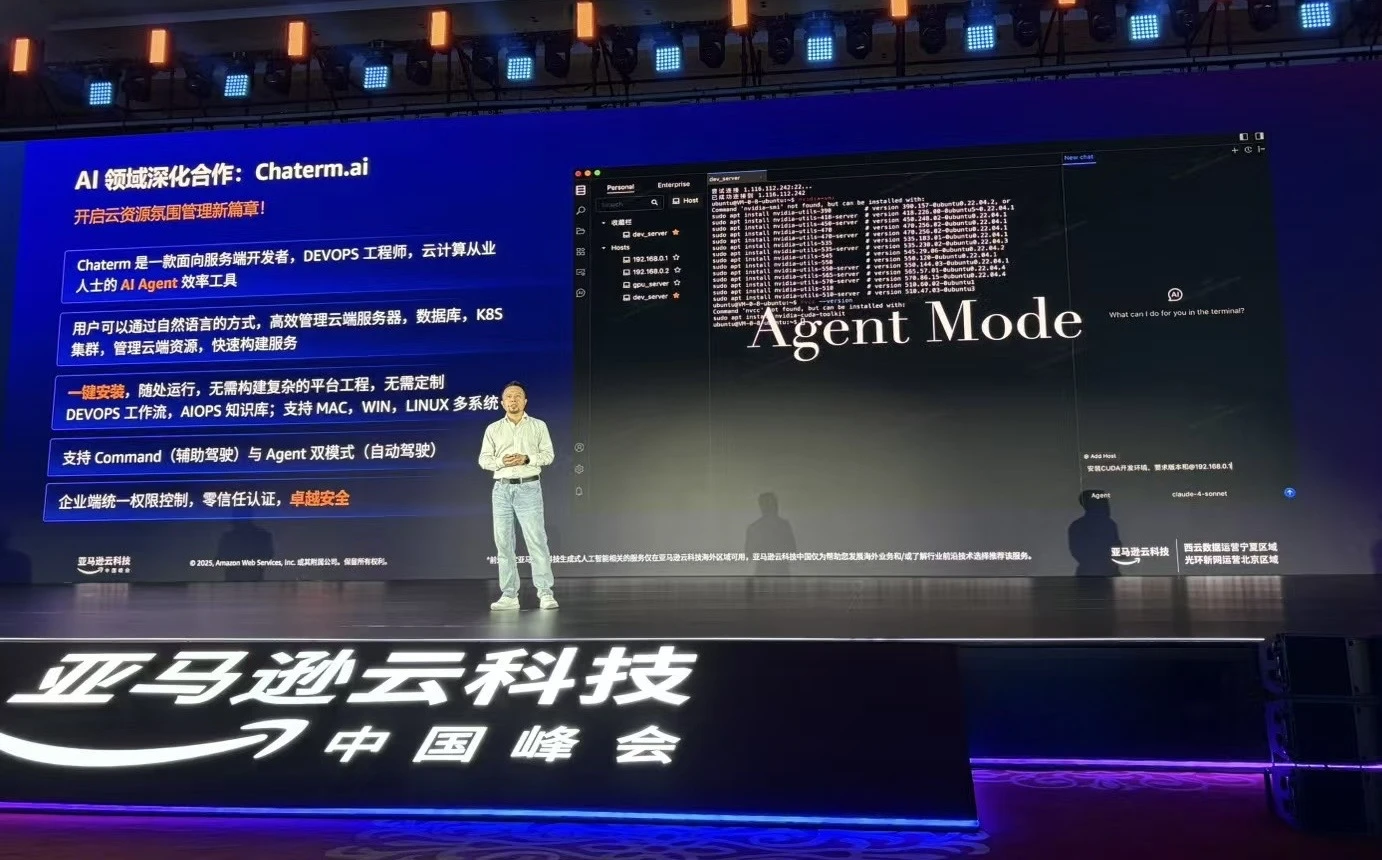
Chaterm elevates AI from a simple command generator to a true operations and maintenance assistant. It not only provides AI dialogue and terminal‑command execution capabilities but also possesses the automation power of Agentic AI. Goals can be set via natural language, and the AI will automatically plan and execute step‑by‑step to accomplish the required tasks or repair the necessary faults.
System Suggestion Engineering Optimization
Based on meticulously designed system suggestions, Chaterm is positioned as a “senior operations and maintenance expert with 20 years of experience.”
- Expertise in network security, troubleshooting, performance optimization, etc.
- Strong problem‑solving capabilities.
- Thinks from the perspective of professional O&M personnel, delivering solutions that align with best practices.
Task Planning and Execution Engine
Detailed optimizations enable the agent to automatically decompose complex tasks into a series of logical steps.
Context Awareness and State Management
- Deeply optimized context handling ensures subsequent operations are based on previous results.
- Context windows provide alerts and overflow‑prevention mechanisms.
- Supports task recovery and continuation.
Adaptive Execution and Error Recovery Mechanism
Unlike simple script execution, the agent dynamically adjusts its plan based on the outcome of each step. When errors occur, it:
- Analyzes the cause.
- Proposes solutions.
- Adjusts the execution path as needed.
Optimized Inference Speed
Chaterm leverages multiple technologies to speed up inference:
- Improves management efficiency of overseas cloud resources.
- Caches frequently used prompts, reducing token consumption for static content (system prompts, tool definitions).
- Cuts Time‑to‑First‑Token (TTFT), lowering latency and cost while boosting overall inference speed.
Why does Challenge represent the next stage of the terminal?
For the past 20 years, the core capabilities of terminals have remained virtually unchanged:
Humans adapt to machines, communicating with commands using strict syntax.
Challenge (the next‑generation terminal) flips this paradigm:
Machines begin to understand human goals and perform complex operations on our behalf.
The terminal is no longer just an input/output window; it becomes a unified intelligent entry point for cloud resources and a bridge between AI and infrastructure.
- Not “adding AI to the terminal.”
- Redefining how the terminal should work.
From “typing commands” to “speaking needs.” This is not a mere UI upgrade—it’s a paradigm shift.
Website:
GitHub: