
Beyond the Hype: The Squad Architecture for Reliable AI Agents
Source: Dev.to
Introduction
Building an AI agent is the easy part. Building one that works in production without hallucinating, looping, or burning through API credits is where most projects fail. If you’ve tried to build a “one‑size‑fits‑all” agent, you’ve likely seen it get confused, miss context, and fail the task.
At BitPixel Coders we’ve moved past the “Single Agent” mindset. In 2026 the real pros are building Teams of agents.
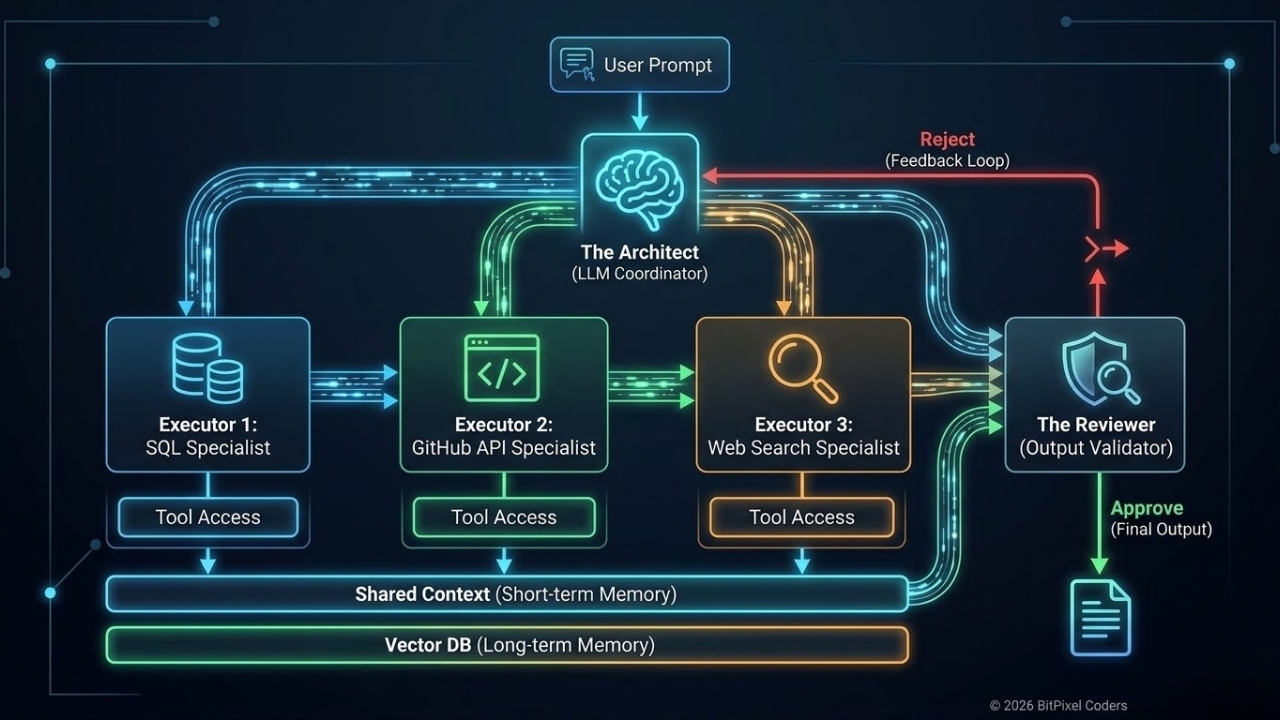
The “Squad” Architecture
Instead of asking a single LLM to be a genius, we break the work down into specialized roles, much like a development team:
- The Architect (LLM Coordinator) – the “brain” that plans tasks but does not perform the work itself.
- The Executors (Specialists) – small, focused agents with specific tool access (e.g., one for SQL, one for web search, one for API calls).
- The Reviewer (Output Validator) – a separate agent that checks the work of the executors before it reaches the user.
Why this works
- Lower token costs – you aren’t sending a massive “do‑everything” prompt for every request.
- Higher accuracy – specialization reduces hallucinations by 60‑70 %.
- Scalability – if the SQL agent fails, the web‑search agent can still operate.
The 2026 Tech Stack
For our internal stack we standardize on LangGraph for state management and the Model Context Protocol (MCP) to keep tool integrations clean.
We’ve documented the exact steps we use to set up these “squads” for our clients. If you’re tired of “toy” agents and want to see a production‑ready system, check out the full guide:
👉 Building AI Agents That Actually Work: A Practical Guide for 2026