
ASML makes breakthrough in EUV chipmaking tech, plans to increase speed by 50% by 2030 — new 1,000-watt light source fires three lasers at 100,000 tin droplets every second
Source: Tom’s Hardware

Image credit: ASML
ASML reaffirmed that it is on track to release a Twinscan NXE extreme ultraviolet (EUV) lithography system featuring a 1 000 W EUV power source and the ability to process up to 330 wafers per hour. Expected around 2030 or later, this machine will deliver roughly 50 % more power than the current flagship, the NXE:3800E, significantly boosting productivity and lowering cost per wafer.
“What was achieved — one kilowatt — is pretty amazing,” said Michael Purvis, ASML’s lead technologist for the EUV source, in an interview with Reuters. “We see a reasonably clear path toward 1,500 W, and no fundamental reason why we couldn’t get to 2 000 W.”
Key technological breakthroughs
- Tin‑droplet generator – A new two‑fold performance generator produces 100 000 tin droplets per second, enabling the higher EUV output.
- CO₂ laser system – The upgraded laser doubles the number of light‑pulse sequences, providing the energy needed for the 1 kW source.
- Debris management – More tin droplets generate more debris, requiring a completely new debris‑collector system to keep wafers clean.
- High‑transmission projection optics – ASML developed optics capable of handling the increased EUV power; these have already been deployed in the NXE:3800E and are scalable to >450 wafers per hour or even 1 500 W sources.
- New resists and pellicles – The higher photon flux demands advanced photoresists and pellicles, prompting industry‑wide preparation.
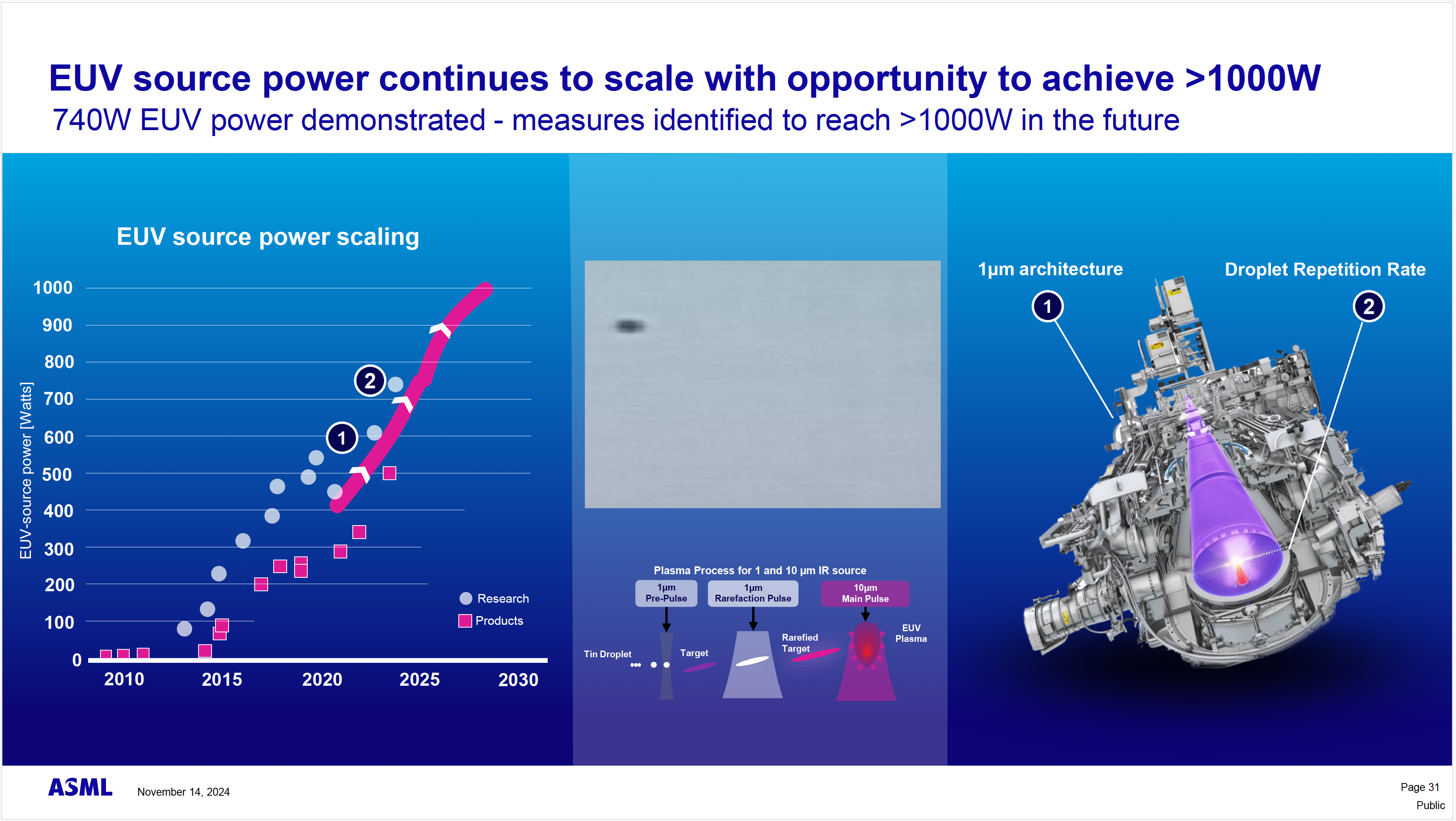
Image credit: ASML
Roadmap to higher productivity
ASML’s roadmap ties a 1 000 W light source to a target throughput of 330 wafers per hour by around 2030. The company’s upcoming systems include:
| Platform | Model | Planned throughput | Key specs | Expected release |
|---|---|---|---|---|
| Low‑NA EUV | Twinscan NXE:4000F | >250 Wph | Matched‑machine overlay (MMO) 0.8 nm for 1.x‑nm nodes | 2027 |
| NXE:4200G | >280 Wph | – | 2029 | |
| High‑NA EUV | Twinscan EXE:5200C | >185 Wph | MMO 195 Wph | – |
These systems will eventually integrate the 1 kW EUV source, with future upgrades aiming for 1 500 W and even 2 000 W, further pushing wafer‑per‑hour rates.
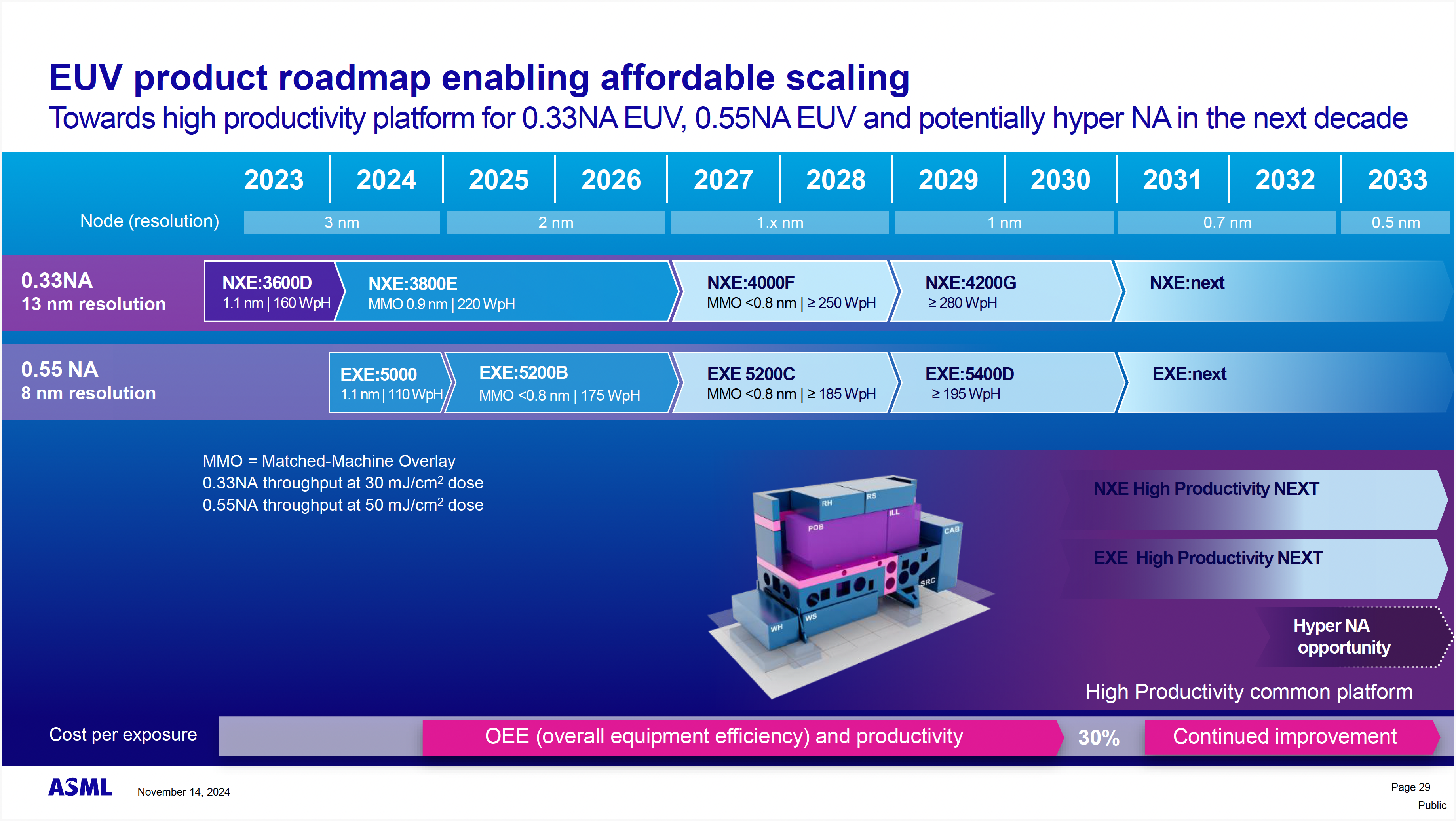
Image credit: ASML