
“로컬 퍼스트 반란”: Home Assistant가 당신 집에서 가장 중요한 프로젝트가 된 이유
Source: GitHub Blog
Franck Nijhof—better known as Frenck—is one of those maintainers who ended up at the center of a massive open‑source project not because he chased the spotlight, but because he helped hold together one of the most active, culturally important, and technically demanding open‑source ecosystems on the planet. As a lead of Home Assistant and a GitHub Star, Frenck guides a project that didn’t just grow—it exploded.
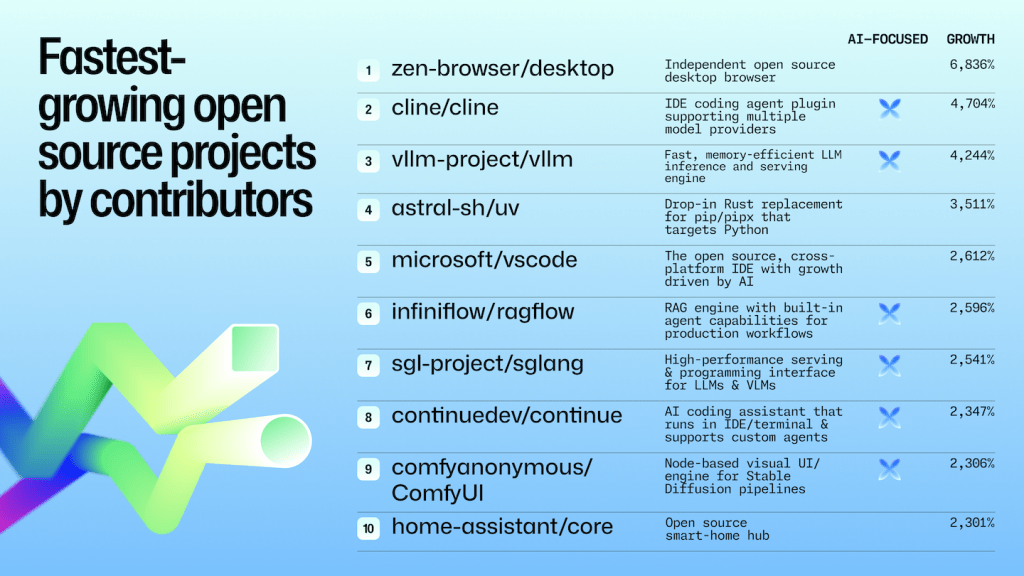
This year’s Octoverse report confirms it: Home Assistant was one of the fastest‑growing open‑source projects by contributors, ranking alongside AI infrastructure giants like vLLM, Ollama, and Transformers. It also appeared in the top projects attracting first‑time contributors, sitting beside massive developer platforms such as VS Code. In a year dominated by AI tooling, agentic workflows, and typed‑language growth, Home Assistant stood out as something else entirely: an open‑source system for the physical world that grew at an AI‑era pace.
The scale is wild. Home Assistant is now running in more than 2 million households, orchestrating everything from thermostats and door locks to motion sensors and lighting—all on users’ own hardware, not the cloud. The contributor base behind that growth is just as remarkable: 21 000 contributors in a single year, feeding into one of GitHub’s most lively ecosystems at a time when a new developer joins GitHub every second.
“Home Assistant is a free and open source home automation platform. It allows you to connect all your devices together, regardless of the brands they’re from… And it runs locally.”
—Franck Nijhof, lead of Home Assistant
He smiles when he describes just how accessible it is. “Flash Home Assistant to an SD card, put it in, and it will start scanning your home,” he says.
This paradox—simple to use but technically enormous—makes Home Assistant compelling to developers: a local‑first, globally maintained automation engine for the home.
The architecture built to tame thousands of device ecosystems
At its core, Home Assistant’s problem is combinatorial explosion. The platform supports “hundreds, thousands of devices… over 3 000 brands,” as Frenck notes. Each one behaves differently, and the only way to normalize them is to build a general‑purpose abstraction layer that can survive vendor churn, bad APIs, and inconsistent firmware.
Instead of treating devices as isolated objects behind cloud accounts, everything is represented locally as entities with states and events. A garage door is not just a vendor‑specific API; it’s a structured device that exposes capabilities to the automation engine. A thermostat is not a cloud endpoint; it’s a sensor/actuator pair with metadata that can be reasoned about.
That consistency is why people can build wildly advanced automations. Frenck describes one inventive example:
“Some people install weight sensors into their couches so they actually know if you’re sitting down or standing up again. You’re watching a movie, you stand up, and it will pause and then turn on the lights a bit brighter so you can actually see when you get your drink. You get back, sit down, the lights dim, and the movie continues.”
A system that can orchestrate these interactions is fundamentally a distributed, event‑driven runtime for physical spaces. Home Assistant may look like a dashboard, but under the hood it behaves more like a real‑time OS for the home.
Running everything locally is not a feature. It’s a hard constraint.
Almost every mainstream device manufacturer has pivoted to cloud‑centric models. Frenck points out the absurdity:
“It’s crazy that we need the internet nowadays to change your thermostat.”
The local‑first architecture means Home Assistant can run on hardware as small as a Raspberry Pi but must handle workloads that commercial systems offload to the cloud:
- Device discovery
- Event dispatch
- State persistence
- Automation scheduling
- Voice‑pipeline inference (if local)
- Real‑time sensor reading
- Integration updates
- Security constraints
If any of this were offloaded to a vendor cloud, the system would be easier to build. But Home Assistant’s philosophy reverses the paradigm: the home is the data center.
Everything from SSD wear leveling on the Pi to MQTT throughput to Zigbee network topologies becomes a software challenge. Because the system must keep working offline, there’s no fallback—engineering with no safety net.
The open home foundation: governance as a technical requirement
When you build a system that runs in millions of homes, the biggest long‑term risk isn’t bugs. It’s ownership.
“It can never be bought, it can never be sold,” Frenck says of Home Assistant’s move to the Open Home Foundation. “We want to protect Home Assistant from the big guys in the end.”
This governance model isn’t philosophical; it is an architectural necessity. A commercial acquisition would introduce cloud lock‑in, break APIs, deprecate integrations, and collapse automations built over years.
The Foundation encodes three engineering constraints that ripple through every design decision:
- Privacy: “Local control and privacy first.” All processing must occur on‑device.
- Choice: “You should be able to choose your own devices” and expect them to interoperate.
- Sustainability: If a vendor kills its cloud service, the device must still work.
Frenck calls out Nest as an example: “If some manufacturer turns off the cloud service… that turns into e‑waste.”
These constraints dictate API longevity, integration strategy, reverse‑engineering priorities, and local inference choices, ensuring the project outlives any individual device manufacturer.
“We cannot build hundreds, thousands of device integrations. I don’t have tens of thousands of devices in my home,” Frenck says.
Developers write integrations for devices they personally own. Reviewers test contributions against devices in their own homes. Break something, and you break your own house. Improve something, and you improve your daily life.
“That’s where the quality comes from. People run this in their own homes… and they take care that it needs to be good.”
Every contributor has access to production hardware; every reviewer has a high‑stakes environment to protect. No staging environment could replicate millions of real homes, each with its own edge cases.
Assist: a local voice assistant built before the AI hype wave
Assist is Home Assistant’s built‑in voice assistant, a modular system that lets you control your home using speech without sending audio or transcripts to any cloud provider.
“We were building a voice assistant before the AI hype… we want to build something privacy‑aware and local.”
Rather than copying commercial assistants like Alexa or Google Assistant, Assist takes a two‑layer approach that prioritizes determinism, speed, and user choice.