
GPU 군주의 종말? 왜 전문화된 가속기가 AI 컴퓨팅의 미래인가
Source: Dev.to
Overview
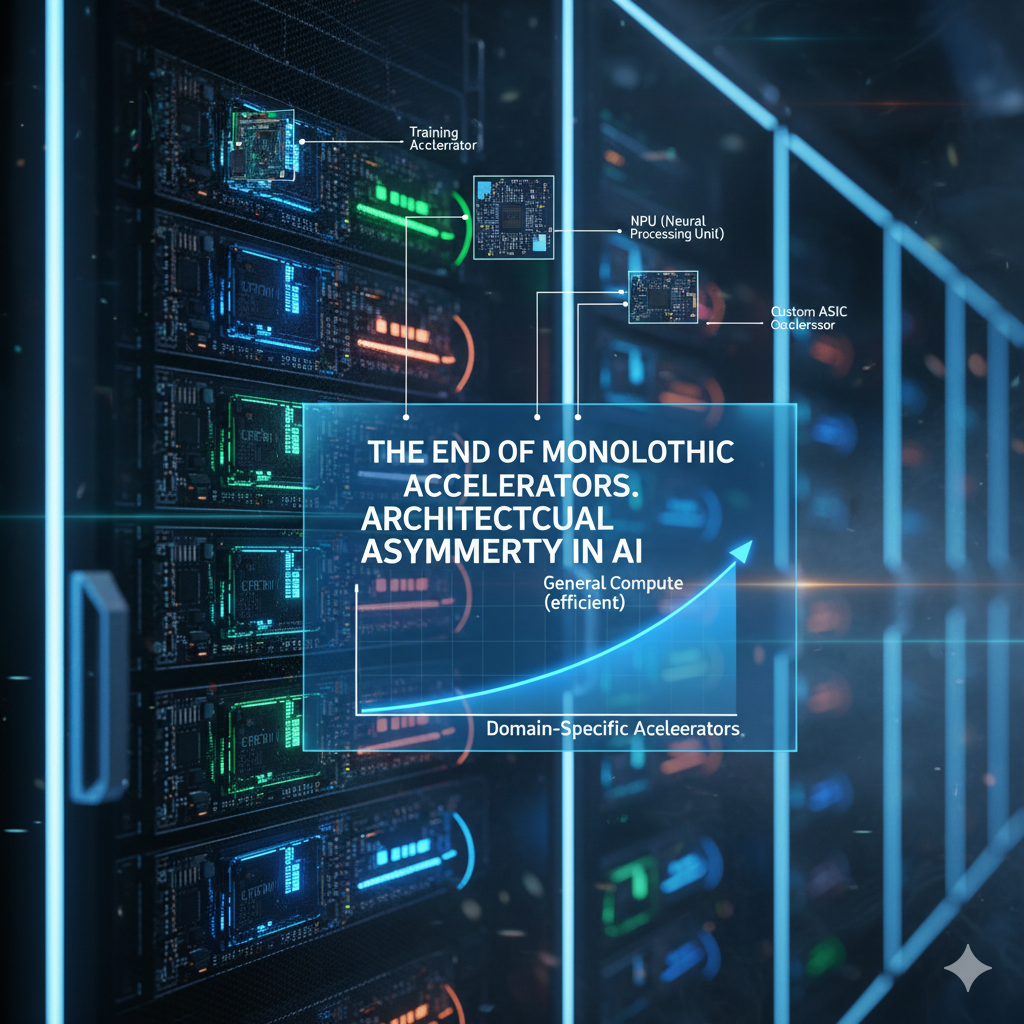
GPU는 지난 10년간 AI의 부인할 수 없는 주역으로, 머신러닝과 딥 뉴럴 네트워크의 거대한 진보를 이끌어 왔습니다. 하지만 범용 가속기의 시대가 조용히 막을 내리고 있다면 어떨까요?
최근에 읽은 흥미로운 기사 “The Rise of Domain‑Specific Accelerators: What Comes After GPUs for AI?”에서는 현재의 컴퓨팅 패러다임이 근본적인 한계에 부딪히는 이유를 깊이 파고듭니다. 이제는 단순히 FLOP 수만이 문제가 아니라 전력, 비용, 그리고 중요한 데이터 이동에서 병목 현상이 나타나고 있습니다.
Key takeaways
- General‑purpose GPUs are becoming inefficient – While great for early, computationally narrow AI tasks (like matrix multiplication), modern AI workloads are far more complex. GPUs often deliver only 35‑45 % of their theoretical performance due to stalls and synchronization, and their high power draw is becoming a major problem.
- The rise of Domain‑Specific Accelerators (DSAs) – As AI workloads stabilize in production, specialized hardware is emerging. Examples include Google’s TPUs for high‑throughput tensor computation, NPUs for low‑latency inference at the edge, and ASICs for fixed, ultra‑efficient production workloads.
- Custom silicon is a strategic imperative – Major tech giants such as Google, AWS, Apple, and Tesla are designing their own chips (Inferentia, Trainium, Neural Engine, AI5/6). This is about gaining control over cost, capacity, pricing, and aligning hardware precisely with continuous AI workloads.
- Economic and competitive advantages – DSAs can deliver up to 4× better performance‑per‑dollar and reduce operational costs by up to 65 % for inference. This shifts leverage back to the platform owner, reducing dependency on external vendors and mitigating geopolitical risks.
- Workload divergence – Training and inference have fundamentally different requirements. Training needs throughput; inference demands low latency and runs continuously. DSAs can be optimized for these distinct needs.
- The end of monolithic accelerators – Future AI systems will be heterogeneous, combining specialized “chiplets” for compute, memory, and interconnect. This enables co‑design, where hardware and models are optimized together, leading to unprecedented efficiency.
The article argues that the future of AI won’t be about a shortage of AI, but a widening gap in how effectively it can be run. Efficient AI, powered by intelligent hardware specialization, will be the ultimate differentiator.
If you’re building AI applications, working with MLOps, or just curious about the future of computing, this is a must‑read. It sheds light on the fundamental shifts happening beneath the surface of the AI boom.
Full article: https://igorvoronin.com/the-rise-of-domain-specific-accelerators-what-comes-after-gpus-for-ai/