
Wikipedia is now 25 years old — world’s 7th most popular website now has over 7 million English articles and 7 billion monthly visitors
Source: Tom’s Hardware
Wikipedia Turns 25
Wikipedia is 25. Founded in 2001, this community‑contributor‑driven site has convincingly usurped what were once the default general reference works of choice, like Encyclopædia Britannica and Microsoft Encarta. Since its launch, this free resource has risen to become the world’s 7th most popular website, with over 7 million English articles and around 7 billion monthly visitors. Wikipedia is the most successful non‑commercial, non‑social, non‑search web destination.
The first entry on Wikipedia was a computer‑ritually headed “Hello, World!” and began with the rather amateurishly optimistic line “This is the new Wikipedia!” Co‑founder Jimmy Wales, a former financial trader and best known as the face of Wikipedia (better known than Larry Sanger, anyway), uploaded the first edit. As an aside, this first page was recreated as a non‑fungible token (NFT) in 2021, making $750,000 at auction.
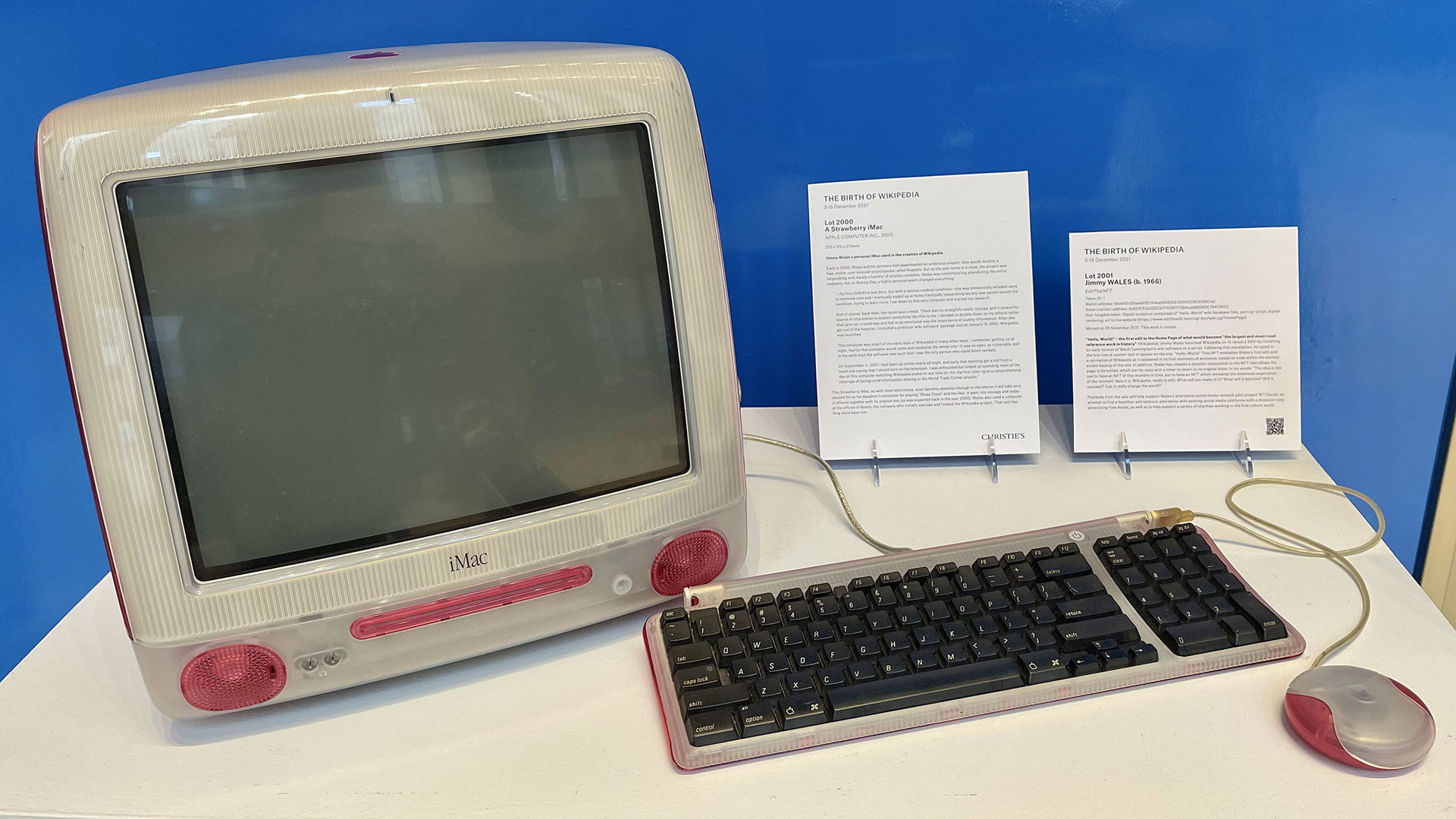
iMac used by Jimmy Wales to make the first edit to Wikipedia. (Image credit: Steve Jurvetson – Attribution 2.0 Generic)
Since we are a hardware site, it is worth remembering that Wales used one of the bulbous, All‑in‑One Apple iMac computers of the era to type his first Wikipedia entry. That first iMac was notable for several milestones: the translucent, candy‑colored computer was the first major product under the renewed leadership of Steve Jobs, and it pioneered USB ports while putting a sizable nail in the floppy‑disk coffin.
Early criticism to roaring success
We’ve already mentioned the amateurish first edit of Wikipedia. From its humble but creditable beginnings, it took some time to find its feet and earn a decent reputation.
- Critics initially highlighted that “anyone could edit it” as a major failing, questioning the reliability of Wikipedia entries.
- Even as the platform grew, the community‑driven knowledge base faced issues such as vandalism and edit wars.
- Like any human‑sourced repository, Wikipedia also suffered from bias. Every contributor brings their own opinions, worldview, and politics, which can cause conflicts in certain topics.
- The lack of an editorial board and a formal fact‑checking system added further wrinkles.
The Wikipedia ship slowly turned around in the mid‑to‑late 2000s, with structural changes being made to solidify its reputation and reference value. By this time, the site began to feel less like a free‑for‑all, and studies started to show that Wikipedia’s accuracy was not far removed from respected tomes like Britannica.
Image credit: Tom’s Hardware
Into the 2010s and beyond, Wikipedia became widely regarded as a trustworthy resource. It has long been integrated into Google as a primary data source for the “knowledge graph.” It remains the world’s top non‑commercial, non‑social, non‑search web destination. Wikipedia is also available in 342 languages.