
Why Top AI Apps Convert at 12% While Most Struggle at 2%
Source: Dev.to
The Pattern: Contextual, Capability‑Based Gating
Top‑converting paywalls appear at high‑intent moments—during the first session or when a usage limit is reached—and frame the upgrade as unlocking a capability the user just tried to use.
Mechanic: remove a blocker the user is already feeling, not one they might encounter later. Industry data shows 82 % of trial starts happen on Day 0, making early, contextual exposure critical.

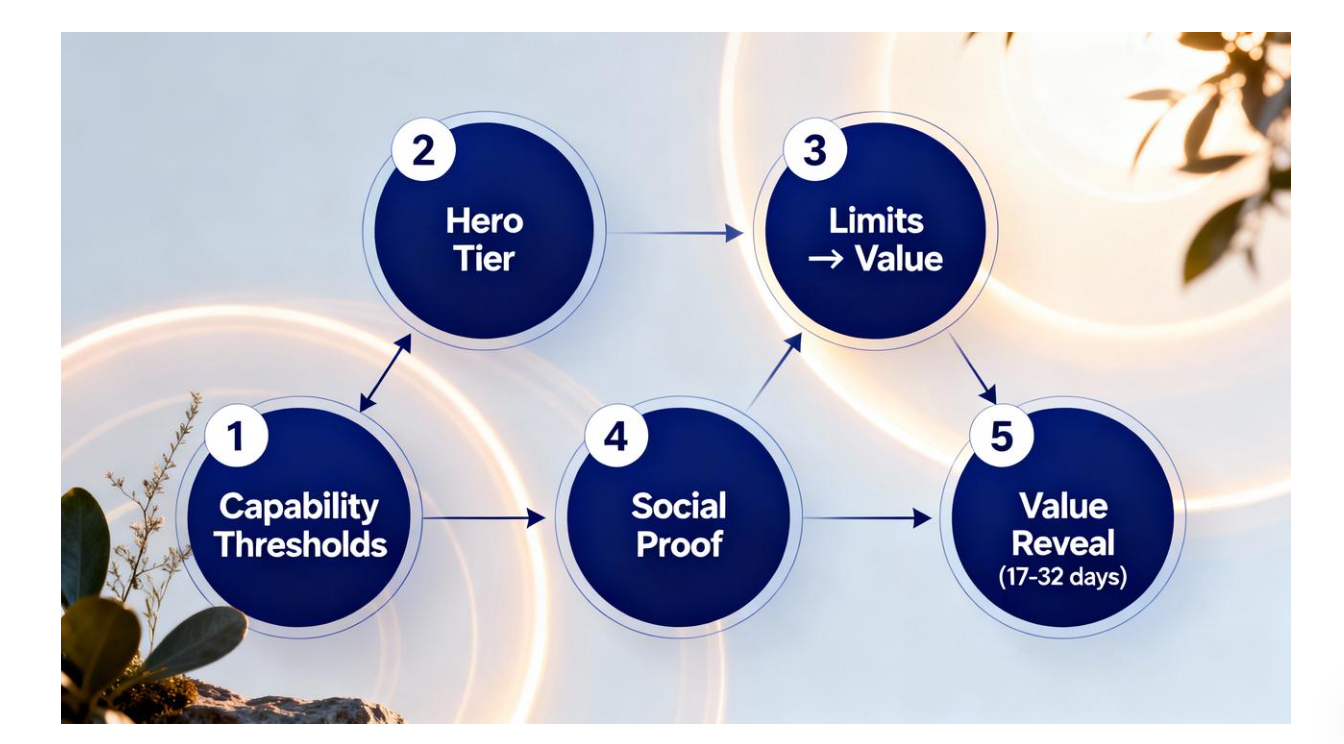
5 Essential Elements
1. Trigger at Capability Thresholds
Gate when users try to access a premium feature or hit limits—not on settings pages. Example: ChatGPT shows the paywall when you switch models, so you understand exactly what you’re paying for.
2. Lead with ONE Hero Tier
ChatGPT has “Plus.” Claude has “Pro.” A single recommended tier reduces decision fatigue. Use a clear feature grid—avoid vague promises like “Premium Features.”
3. Convert Limits into Value
Claude says “5× more usage” instead of “remove limits.” Users perceive gains more favorably than loss‑framing. Show remaining capacity with temporary grace, not hard lockouts.
4. Layer Social Proof
Notion embeds customer logos; Jasper shows Forbes and HubSpot. When users see respected brands using the paid tier, the upgrade feels validated. Make it one‑click.
5. Design for Value‑Reveal Trials
Trials lasting 17–32 days convert at 45.7 % median. Longer trials let users integrate the product and experience multiple value moments before deciding.
How Leading AI Apps Use This
- ChatGPT Plus – gates at model switching; users experience quality firsthand before the paywall.
- Claude Pro/Max – uses session‑based limits and shows remaining capacity.
- Midjourney – eliminated free trials, self‑selecting for intent‑driven users with transparent GPU‑based pricing.
- Notion AI – embeds AI in the business tier with 30‑day trials that create switching costs.
- Jasper – layers social proof throughout onboarding.
Hard paywalls with contextual gating: 12 % vs. 2 % (RevenueCat 2025)
Why It Works: Psychology
- Perceived Value – Capability‑Based: Pricing maps to concrete outcomes (“5× more messages”).
- Loss Aversion – Gain Framing: “5× more usage” converts better than “remove limits.”
- Pricing Clarity: Specific capabilities (“45 messages/session”) outperform vague promises (“Premium Features”).
When to Use (and Skip)
Use when
- Immediate value can be demonstrated
- Costs are usage‑based
- Market has clear tiers
- High‑intent moments are identifiable
- Early monetization is a priority
Skip when
- Value reveals slowly
- Users expect free access
- Variable costs are low
- Strong network effects dominate
- Tier differences are unclear
Your Action Plan
- Identify the ONE capability users try first—that’s your Day‑0 gate.
- Trigger at that moment with clear before/after messaging.
- Create a hero tier with concrete feature comparison.
- Match trial length to your value‑reveal time (17‑32 days if complex).
- Test outcome‑focused messaging (“Finish faster”) over generic CTAs.
Copy 70 % of this pattern and adapt 30 % to your context. The conversion gap is real—12 % vs. 2 %—but execution matters: gate too early and lose trust; gate too late and miss the window. The sweet spot is right when users feel the need.