
Why Is Cloud Infrastructure Event-Driven?
Source: Dev.to
What Event‑Driven Architecture Really Means (Beyond the Textbook)
At its core, event‑driven architecture is simple:
Something changes → the system reacts automatically.
An event is any meaningful state change, for example:
- CPU crosses a threshold
- Traffic suddenly spikes
- A VM becomes unhealthy
- A deployment is pushed
- A cost anomaly appears
- A security rule is modified
Instead of waiting for a human or a synchronous request, systems listen for these changes and respond in real time.
This creates:
- Loosely coupled systems
- Faster reactions
- Higher resilience
- Far less human intervention
Cloud platforms like Amazon Web Services, Microsoft Azure, and Google Cloud are fundamentally built around this model, using services such as AWS Lambda and Google Cloud Pub/Sub.

Reactive Scalability: Scale Because Something Happened
Traditional infrastructure scales based on assumptions.
Event‑driven infrastructure scales based on reality.
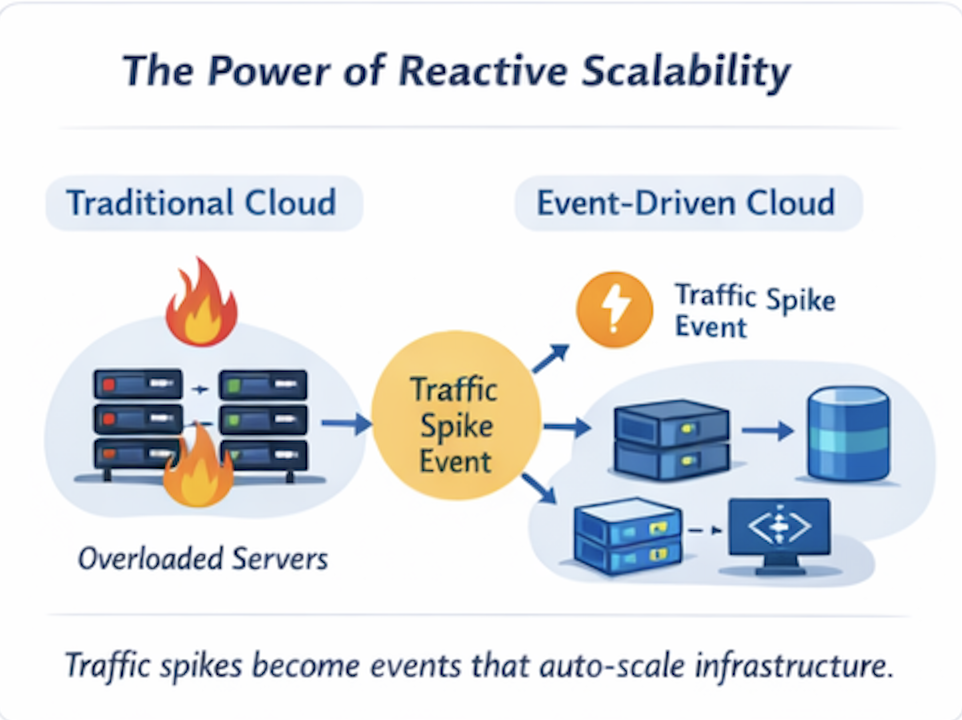
The old problem
A sudden traffic surge (flash sale, feature launch, marketing spike) overwhelms fixed capacity.
Result
- Slow response times
- Errors
- Pager alerts
- Revenue loss
The event‑driven reality
Traffic increase is treated as an event, not a surprise. That single signal automatically triggers:
- New containers or instances spinning up
- Load balancers redistributing traffic
- Read replicas scaling out
- Caches warming proactively
All of this happens in seconds, without human involvement.
- Developers experience fewer firefights.
- FinOps sees capacity only when it’s needed—no idle waste.
Automated Remediation: Failures Are Just Another Event
Failures are inevitable. Downtime is not.
In an event‑driven cloud, failures don’t trigger panic—they trigger workflows.
Example
- A node becomes unresponsive
- Monitoring emits a failure event
- The instance is removed from rotation
- A replacement is provisioned
- Traffic is rerouted
- The incident is logged and alerted
No tickets. No waiting. No heroics.
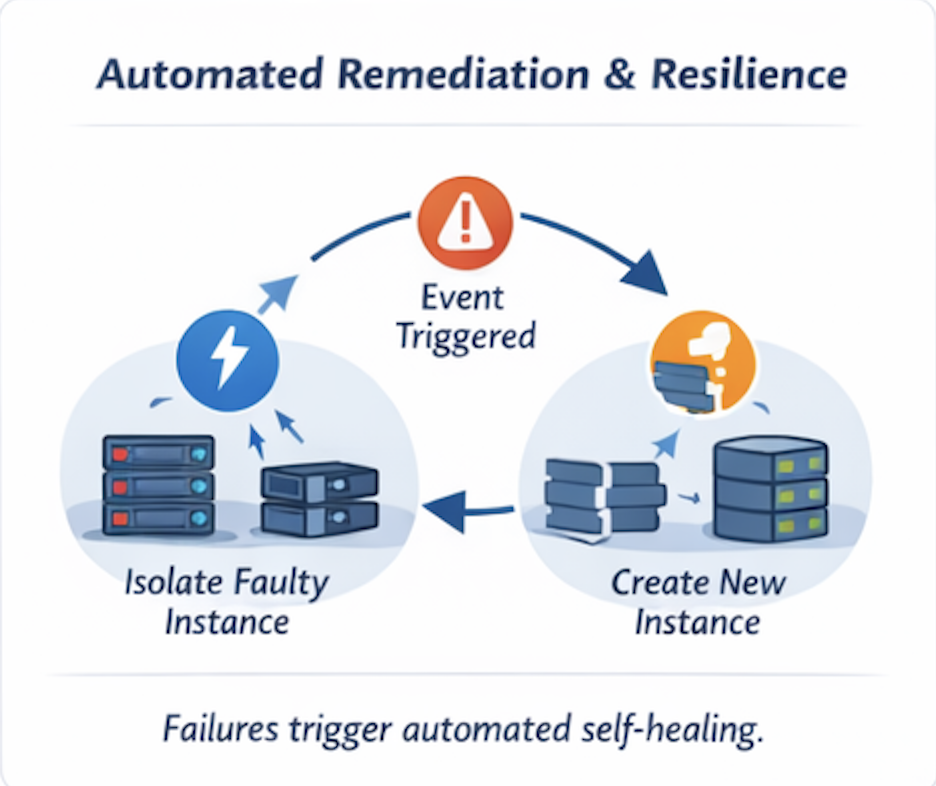
This is self‑healing infrastructure, and it’s only possible when systems react to events instead of relying on manual processes.
Configuration, Governance, and Compliance – Enforced by Events
In large cloud environments, configuration drift is guaranteed. Manual enforcement does not scale.
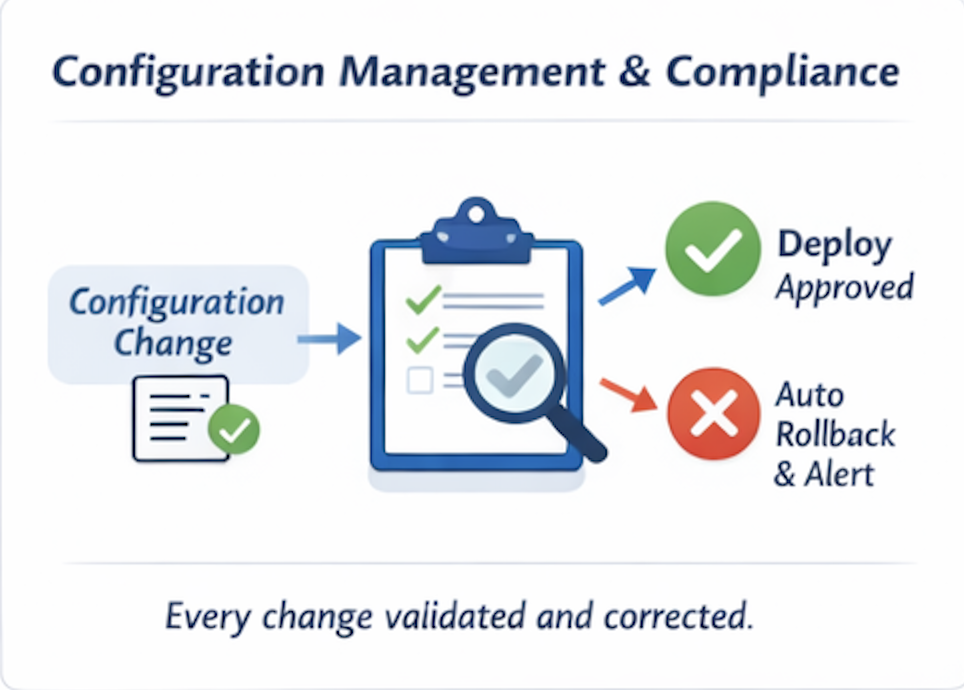
Event‑driven governance flips the model:
- Every infrastructure change becomes an event
- Every event triggers automated policy checks
- Violations generate corrective actions or alerts instantly
- Drift is detected and corrected in near real time
Instead of periodic audits and retroactive fixes, compliance becomes continuous and automatic. This is especially critical for:
- Regulated environments
- Multi‑account, multi‑cloud setups
- High‑velocity engineering teams
Automation: Turning Signals Into Outcomes
This is where event‑driven cloud truly compounds value. Think of events as the glue that connects your entire platform.

A single event can fan out into multiple automated actions:
- Storage upload → processing function
- Processing completion → database update
- Database update → notification
- Notification → downstream workflow
Each step emits new events, chaining actions without tight coupling.
The result?
Fewer sc
Benefits of Event‑Driven Cloud Infrastructure
- Fewer cron jobs
- Fewer manual runbooks
- More reliable systems
Engineers focus on building products.
FinOps teams focus on optimizing signals, not chasing bills.
Why This Matters Even More for FinOps
Here’s the uncomfortable truth:
Cloud costs don’t spike randomly. They spike because something happened.
- A workload scaled unexpectedly
- A schedule was removed
- A deployment looped
- A service went idle but stayed on
All of these are events.
Event‑driven infrastructure allows FinOps teams to:
- Detect cost‑impacting events instantly
- React before bills explode
- Automate shutdowns, scale‑downs, and optimizations
- Tie cost directly to system behavior
Without events, FinOps is reactive.
With events, FinOps becomes real‑time cost control.
The Cloud Doesn’t Wait – Neither Should Your Infrastructure
Modern cloud infrastructure isn’t about managing servers.
It’s about responding intelligently to change.
Event‑driven architecture enables that shift by making every change observable, actionable, and automated.
- Intelligent scaling
- Self‑healing systems
- Continuous compliance
- Real‑time cost optimization
Event‑driven design is no longer optional.
If your cloud cannot react automatically to what’s happening right now, you’re already behind.
The future of cloud infrastructure isn’t static.
It listens. It reacts. It optimizes.
And it’s event‑driven.