
Why a Single Platform for VMs and Containers Is the Future of Modern IT
Source: VMware Blog
Enterprises today are under immense pressure to modernize applications while maintaining the performance, reliability, and security that their business demands. A key question remains: how do containers and virtual machines (VMs) fit together in a modern IT strategy?
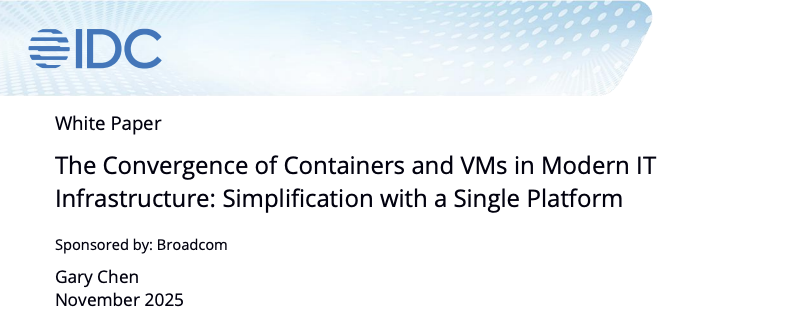
A new IDC White Paper, The Convergence of Containers and VMs in Modern IT Infrastructure: Simplification with a Single Platform, by Gary Chen, Research Director at IDC, provides clarity on this topic.
Key Findings from IDC
- VMs provide strong workload isolation, security boundaries, and efficient server consolidation.
- Containers deliver speed, portability, and consistent deployment for cloud‑native applications.
IDC forecasts that nearly 85 % of all containers will continue running inside VMs through 2028 because enterprises trust the virtualization layer for governance, security, and operational control.
As organizations scale modern application initiatives, they often manage two separate worlds: traditional VM‑based apps and fast‑growing containerized workloads. This creates silos, duplicate tooling, inconsistent policies, and operational friction.
IDC’s paper highlights that the most resilient and efficient organizations are shifting to a single‑platform approach that integrates both VMs and containers across a unified infrastructure. A unified platform enables:
- Operational simplicity – one set of tools and consistent workflows for provisioning, lifecycle management, networking, and security.
- Stronger security and governance – enterprise‑grade isolation for workloads with consistent policies.
- Greater efficiency and flexibility – platform engineers gain self‑service access to all infrastructure resources, VMs, and containers.
- Faster app modernization – app teams can modernize at their own pace, containerizing parts of an application while keeping others in VMs.
Why VMware Technology Is at the Center of This Convergence
VMware pioneered enterprise virtualization and now, as part of Broadcom, offers a complete platform for running VMs and containers together, delivering consistency from infrastructure to application. With vSphere Kubernetes Service (VKS), organizations gain a powerful Kubernetes runtime built directly into VMware Cloud Foundation, offering:
- A CNCF‑certified Kubernetes distribution that ensures upstream compatibility, ecosystem portability, and alignment with the latest community innovations.
- Unified networking, storage, and security, tightly integrated with NSX and vSAN, to provide consistent policies, automated provisioning, and end‑to‑end workload protection.
- Consistent operations across the private cloud, whether deployed on‑premises, at the edge, or on a hyperscaler cloud, enabling platform teams to deploy, manage, and scale Kubernetes clusters with the same tools and processes they use for VMs.
- Enterprise‑grade robustness and security, backed by VMware’s decades of platform hardening, patch management, and Zero Trust architecture capabilities.
This unique combination enables customers to modernize with confidence, leveraging containers where they excel and VMs where they remain essential.
As IDC concludes, containers and VMs are distinct layers of the stack, each indispensable to modern enterprise IT. The future is not about choosing one over the other, but bringing them together into a powerful, simplified, and consistent platform.
Read the full paper here. To learn more about VKS, visit vmware.com/vks.