
What to expect for open source in 2026
Source: GitHub Blog
Open Source Evolution & Challenges
- Growth: Over the past decades, open‑source software has expanded hand‑in‑hand with the evolution of software development, turning the community into a truly global ecosystem.
- Pain points: Every period of growth brings new challenges. Identifying and addressing these issues is crucial for the continued health and vitality of open source.
- Looking ahead: The Octoverse 2025 report highlights emerging trends and the direction in which open source is heading.
“To keep open source thriving, we must understand its challenges and work together to overcome them.”
Feel free to explore the full report and make your own predictions:
Octoverse 2025 – Full Report
Global Growth in Open‑Source Communities
In 2025, GitHub welcomed ≈ 36 million new developers. The sheer size of this influx is impressive, but the geographic distribution tells an even more compelling story.
Where the Growth Is Coming From
| Region / Country | New Developers |
|---|---|
| India | 5.2 M |
| Brazil | – |
| Indonesia | – |
| Japan | – |
| Germany | – |
Note: Exact numbers for Brazil, Indonesia, Japan, and Germany were not disclosed, but each saw significant growth.
What This Means for Open Source
- A truly global talent pool – Most contributors now live outside the regions where many projects originated.
- Shift in project dynamics – While globally‑distributed projects have always existed, they are becoming the norm rather than the exception.
- New challenges – Contributors differ in work‑hour availability, communication styles, cultural expectations, and language.
How Projects Can Thrive at Scale
Explicit Communication
- Clear contribution guidelines
- Well‑defined code of conduct
- Transparent review expectations
Robust Governance
- Documented decision‑making processes
- Defined roles and responsibilities
Inclusive Infrastructure
- Multilingual documentation where feasible
- Flexible contribution windows to accommodate different time zones
Bottom line: Projects that invest in these foundational documents and practices will scale more smoothly, become more resilient, and offer a welcoming path for new contributors worldwide. Those that neglect them risk bottlenecks and stagnation as their contributor base diversifies.
The Double‑Edged Sword of AI
AI has played a major role in accelerating global participation in open‑source development, especially since 2025. It has:
- Lowered the barrier to entry – new developers can start contributing faster.
- Helped understand unfamiliar codebases – by summarising files, suggesting patches, and even scaffolding new projects.
- Enabled first‑time contributions – allowing newcomers to make meaningful edits sooner.
The downside: “AI slop”
While AI brings many benefits, it also generates a large amount of low‑quality, often inaccurate contributions—sometimes called AI slop. These contributions:
- Add little or no value to the project.
- Require extensive rework, making it faster to implement the solution manually.
- Inflate the number of issues and pull requests without improving overall quality.
Consequences for maintainers
- Increased review workload – more time spent triaging contributions from developers with widely varying skill levels.
- Potential bottlenecks – the rate of review effort can outpace the growth of the maintainer team.
- Attention overload – the sheer volume can feel like a denial‑of‑service attack on human attention.
Strategies for cutting through the noise
Maintainers are asking: How do we sift through the noise and surface the most important contributions? A few approaches are already proving useful:
- GitHub’s new tooling – see the announcement of the latest maintainer‑focused features.
- Open‑source AI projects targeting AI slop – several community‑driven tools aim to filter, rank, and validate AI‑generated contributions.
- Defensive AI usage – employing AI to:
- Triage and prioritize issues.
- Detect duplicate reports.
- Automate routine maintenance tasks (e.g., labeling, assigning).
By offloading these “grunt‑work” tasks, maintainers can focus on decisions that truly require human judgment.
Looking ahead
Projects that integrate AI into their community infrastructure are likely to thrive over the next year. To handle the growing information load, AI must evolve beyond a simple coding assistant and become a scalable maintainer aid, helping to:
- Reduce review fatigue.
- Prioritize high‑impact contributions.
- Keep the project’s direction clear and sustainable.
Embracing these practices will turn AI from a source of noise into a powerful ally for open‑source maintainers.
Record Growth Is Healthy—If It’s Planned For
On the surface, record global growth looks like success. However, the influx of newer developers can also become a burden. The popularity of “first‑pull‑request” tutorials shows that many newcomers are still in the early stages of comfort with open source. They often face uncertainty about how to move forward, how to interact with the community, and they generate repetitive onboarding questions and duplicate issues.
This creates a widening gap between the number of participants in open‑source projects and the number of maintainers who feel a sense of ownership. As new developers grow at record rates, the gap will only expand.
What’s needed
Addressing the problem isn’t just about assigning more mentors—although mentorship remains valuable. The focus should be on building durable systems that demonstrate organizational maturity. Below is a non‑exhaustive list of such systems:
- Clear progression paths – Define a transparent route from contributor → reviewer → maintainer. Make the criteria, expectations, and required skills explicit so contributors can see how to advance, even without a dedicated mentor.
- Shared governance models – Distribute decision‑making across time zones and diverse groups rather than relying on a single individual or a small core team. This reduces bottlenecks and improves resilience.
- Comprehensive documentation – Provide up‑to‑date guides that explain how to contribute, the project’s goals, coding standards, review processes, and any tooling requirements. Good docs reduce repetitive onboarding questions.
Why it matters
If the number of maintainers keeps pace with the number of contributors, projects can harness record growth without collapsing under its weight. While this does add short‑term effort for current maintainers, the investment builds a solid foundation that yields a more stable, scalable structure in the long run.
Projects that ignore these systemic improvements risk:
- Stalling or regressions as the community outpaces the core team.
- Accumulating technical debt due to rushed or poorly reviewed contributions.
- Decreased community morale when newcomers feel unsupported.
By proactively establishing clear paths, shared governance, and solid documentation, open‑source projects can turn rapid growth into sustainable success.
What Are People Building?
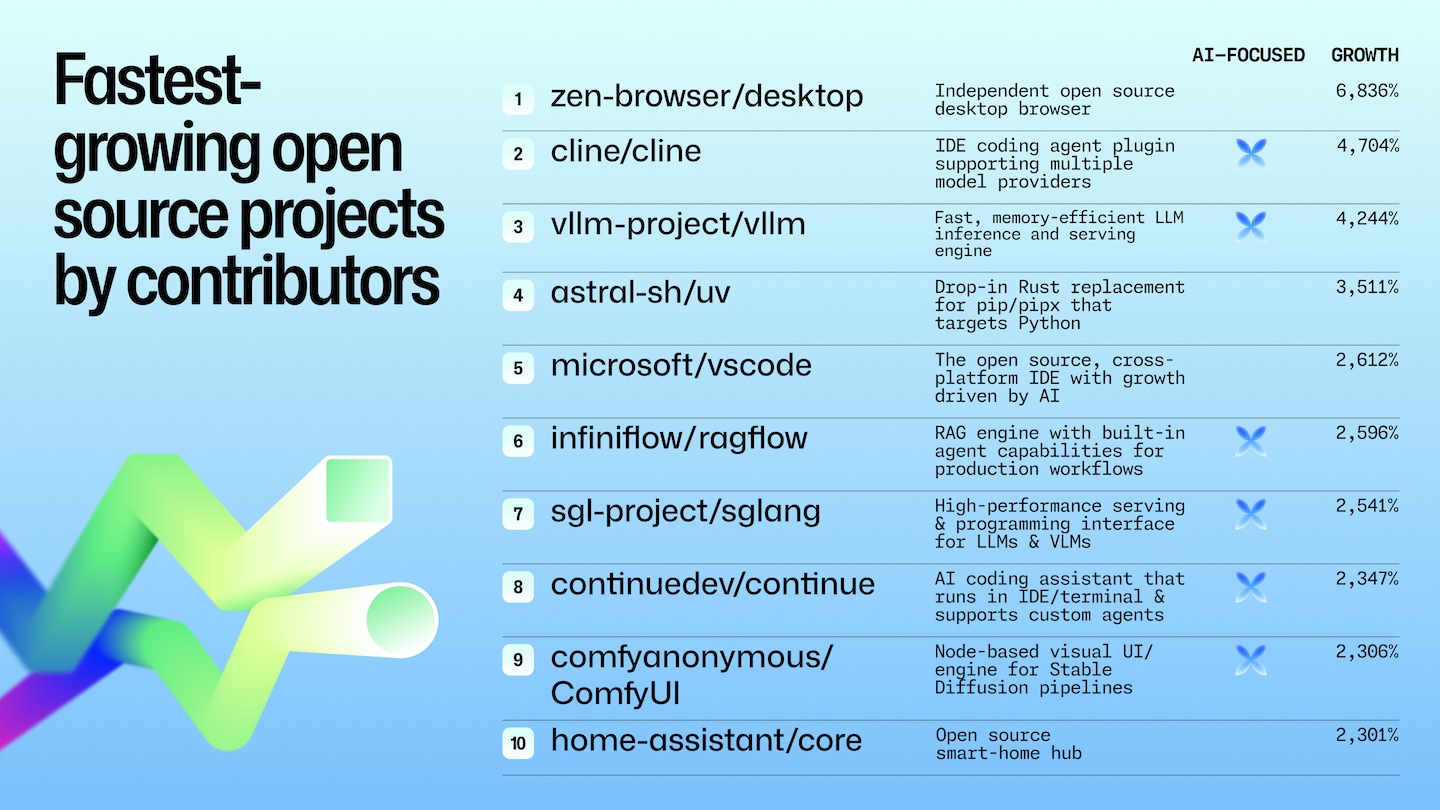
AI remains a major focus—about 60 % of the fastest‑growing projects are AI‑related. However, many successful projects have nothing to do with AI. Examples such as Home Assistant, VS Code, and Godot continue to thrive because they solve real problems and serve large, international communities.
Key Takeaways
- AI dominates the growth charts, but it’s not the only driver of open‑source activity.
- Non‑AI projects that address universal needs (e.g., home automation, IDEs, game engines) continue to attract contributors worldwide.
- The global developer community is expanding, and projects that support diverse users are likely to remain popular and well‑supported.
These trends reinforce that open source is increasingly a global phenomenon, not just a collection of local initiatives.
What This Year Will Likely Hold
Open source in 2026 won’t be defined by a single trend that emerged over 2025. Instead, it will be shaped by how the community responds to the pressures identified over the last year—particularly the surge in AI and an explosively growing global community.
For developers, this means that it’s important to invest in processes as much as code. Open source is scaling in ways that would have been impossible to imagine a decade ago, and the important question going forward isn’t how much it will grow—it’s how you can make that growth sustainable.
Written by

Dylan Birtolo – senior content writer at GitHub. He spends his days sharing the good things GitHub has to offer. With almost 20 years of technical‑writing experience (including stints across Microsoft), Dylan’s off‑time is filled with animals, gaming, and professional jousting.
Explore more from GitHub
 Docs DocsEverything you need to master GitHub, all in one place. Go to Docs → |  GitHub GitHubBuild what’s next on GitHub, the place for anyone from anywhere to build anything. Start building → |  Customer stories Customer storiesMeet the companies and engineering teams that build with GitHub. Learn more → |
 The GitHub Podcast The GitHub PodcastCatch up on the GitHub podcast, a show dedicated to the topics, trends, stories and culture in and around the open‑source developer community on GitHub. Listen now → |