
The new identity of a developer: What changes and what doesn’t in the AI era
Source: GitHub Blog
For the past four years, the conversation about AI and software development has moved faster than most people can track. Every week, there is a new tool, a new benchmark, a new paper, or a new claim about what AI will or won’t replace. There is certainly noise, but even if sometimes data seems inconclusive or contradictory, we still know more now than three years ago about AI adoption.
With four years of AI adoption under our belt, we are also able to start seeing the shift in what it means to be a software developer. I lead key research initiatives at GitHub where I focus especially on understanding developers’ behavior, sentiment, and motivations. The time we are in with AI is pivotal, and I interview developers regularly to capture their current perspective. Most recently I conducted interviews to understand how developers see their identity, work, and preferences change as they work more closely than ever with AI.
TL;DR: The developers who have gone furthest with AI are working differently. They describe their role less as “code producer” and more as “creative director of code,” where the core skill is orchestration and verification rather than implementation.
2023: Curiosity, hesitation, and identity questions
Two years ago, we interviewed developers to understand their openness to having AI more deeply integrated into their workflow. At the time, code completions had become mainstream and agents were only a whisper in the AI space. Back then, we found developers eager to get AI’s help with complex tasks, not just filling in boilerplate code. Developers were most interested in:
- Summaries and explanations to speed up how they make sense of code related to their task, and
- AI‑suggested plans of action that reduce activation energy.
In contrast, developers wanted AI to stay at arm’s length (at least) on decision‑making and generating code that implements whole tasks.
The explanation of that qualitative trend from 2023 is important. At the time, AI was seen as still unreliable for large implementations. But there was more to the rationale. Developers were reluctant to cede implementation because it was core to their identity.
That was our baseline in 2023, which we documented in a research‑focused blog. Since then, developers’ relationship with AI has changed (and continues to evolve), making each view a snapshot. That makes it critical to update our understanding as the tools have evolved and developer behavior has consequently changed.
One of the interviewees in 2023 wrapped their hesitation in a question: “If I’m not writing the code, what am I doing?”
That question has been important to answer since then, especially as we hear future‑looking statements about AI writing 90 % of code. If we don’t describe what developers do if/when AI does the bulk of implementation, why would they ever be interested in embracing AI meaningfully for their work?
2025: Fluency, delegation, and a new center of gravity
Fast forward to this year: we interviewed developers again, focusing on advanced users of AI. This was, in part, because we found a growing number of influential developer blogs describing agentic workflows and signaling optimism around coding with and delegating to AI (see Mike McQuaid, Harper, and Gh. Iculescu for a few examples).
The developers we spoke with described their agentic workflows and how they reached AI fluency: relentless trial‑and‑error and pushing themselves to use AI tools every day for everything.
That was their method for gaining confidence in their AI strategy, from identifying which tools would be helpful for which task to prompting and iterating effectively. The tools did not feel magical or intuitive all the time, but their determination eventually led them to make more informed decisions—for example, when to work synchronously with an agent, when to have multiple agents working in parallel, or when to prompt an AI tool to “interview” them for more information (and how to check what it understands). None of these AI strategists started out that way; most began as skeptics or timid explorers.
As we synthesized the interviewees’ reported experiences, we identified a progression:
- Skeptic
- Explorer
- Collaborator
- Strategist
Fluency stages
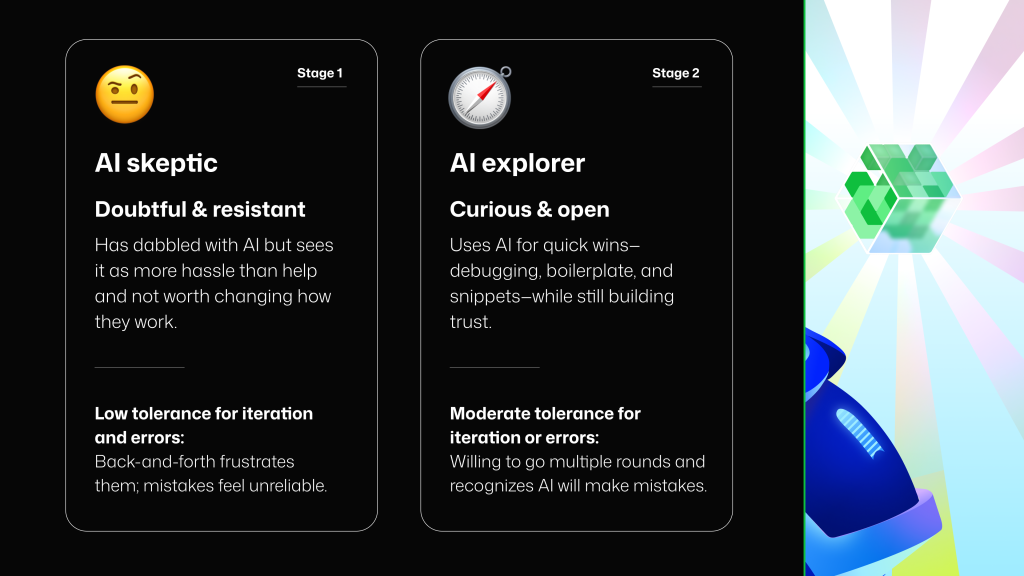
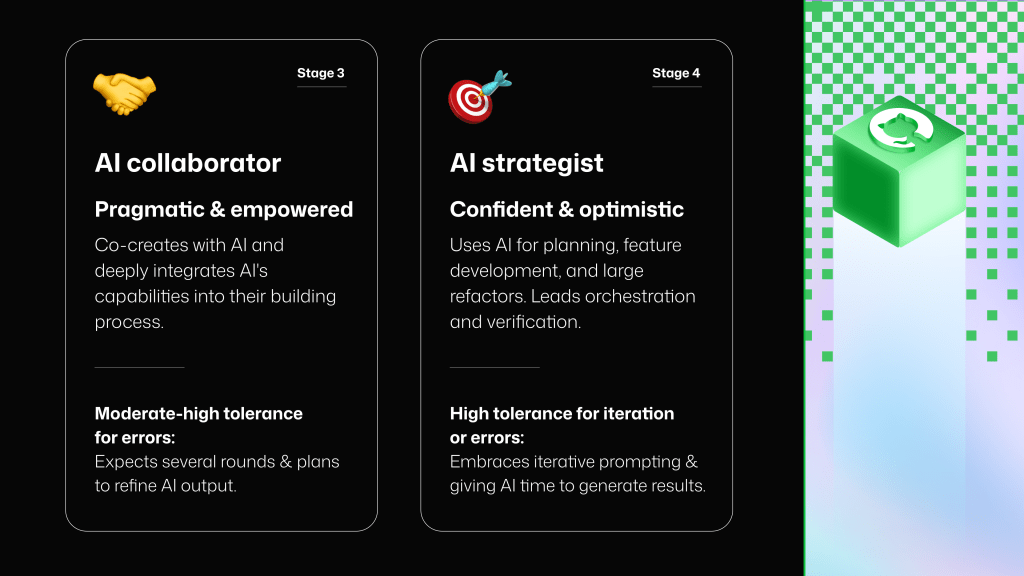
Each stage came with a better understanding of capabilities and limitations, and differ…