
The Dark Side of the Enlightenment
Source: Hacker News
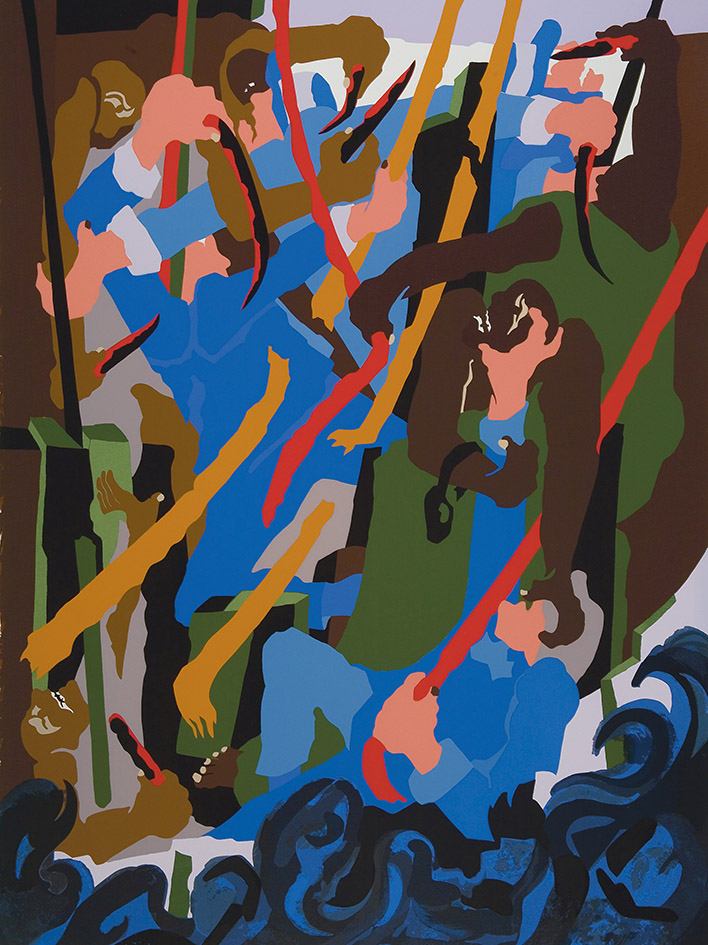 Free thinking: Revolt on the Amistad (1989), a silkscreen print by Jacob Lawrence that imagines an 1839 rebellion aboard a Spanish slave ship. Image courtesy of The Amistad Research Center, New Orleans, LA / Bridgeman Images
The Killing Age and the “Mortecene”
In The Killing Age, the American historian Clifton Crais contends that the modern era should not be defined as the Anthropocene – an Age of Man characterised by rapidly expanding knowledge and large‑scale human influence on the planet – but rather as an age defined by mass killing, in which state power converges with economic exploitation and environmental destruction.
“Instead of the Anthropocene,” he writes, “we should consider speaking of the Mortecene, the Age of Death and Killing. The Industrial Revolution in England and the United States cannot be explained without understanding the enslavement of Africans and their exploitation in the Americas and the changed landscapes that both created… The Anthropocene effectively leaves out human predation, slavery and even imperialism. It leaves out the massive killing at the heart of a fossil economy, an era when violence reduced everything, including human beings, to goods that can be exchanged in a so‑called free market. All this death left its own markers. The Mortecene has shaped who we are, what we value, what we fear and what we have forgotten, and the precarious present we inhabit today.”
Critique of Crais’s Narrative
Crais shows how a liberal version of Enlightenment ideals legitimised slaughter and environmental degradation on a grand scale. Anyone who has doubted the Panglossian view of history peddled by progressive rationalists like Steven Pinker will find their scepticism vindicated by Crais’s richly detailed recreation of the gory underside of capitalist progress.
However, Crais says little about how another variant of Enlightenment philosophy mandated mass murder and the despoliation of the natural world in states dedicated to the overthrow of capitalism. His account is narrowly Anglocentric, centring on Adam Smith’s doctrine of “the transformative potential of a fully commercial society” while largely ignoring Karl Marx’s Enlightenment‑inspired vision, which produced ecological disaster in the former Soviet Union.
Omissions and Gaps
A book’s index often reveals what is left out. The story told in The Killing Age stretches from around 1750 to the early 20th century, yet:
- No entry for the French Revolution, Robespierre, or the Jacobins, pioneers of methodical killing.
- Donald Trump appears as an avatar of evil, but Vladimir Putin and Xi Jinping are absent.
- Major 20th‑century atrocities are missing:
- Holocaust – no mention, only “holocausts, African, continental and slavery”.
- Holodomor – the Soviet‑engineered famine in Ukraine is omitted.
- Mao Zedong – listed only as a Chinese uprising leader; no reference to the Great Leap Forward or Cultural Revolution, which caused tens of millions of deaths.
The general reader could read every word of this 736‑page, heavily footnoted tract and remain ignorant of some of the most atrocious examples of modern industrial killing.
Extractive Violence and Capitalism
The silence surrounding these deaths is a political decision. Crais, a distinguished historian of Africa, focuses on the extractive violence of market capitalism that enabled Western industrialisation. In this view, the modern state has, since its inception, extracted market value from labour by effectively manufacturing death. The slave ship, concessionary company, and colonial police force are the infrastructure of modernity and the core institutions of the Mortecene.
The thesis that the free market was established through state coercion is not new; Karl Polanyi’s The Great Transformation (1944) presented it with unsurpassed force. Crais acknowledges that “it would be myopic to imagine that life didn’t improve for millions (later billions) of people because of the Industrial Revolution.” Yet he downplays the role of fossil fuels, which have been essential for mechanised agriculture, fertilisers, refrigeration, and global transportation—without which today’s population would not exist.
Soviet Gulag as State‑Managed Extraction
Crais’s exclusive focus on extractive violence under capitalism is problematic and selective. The Soviet gulag was both a tool of political oppression and a gargantuan state‑managed extractive apparatus, producing gold, timber, coal, and infrastructure. Prisoners were treated as human resources, their labour coerced and often fatal.
In Varlam Shalamov’s Kolyma Tales, survivors recount tags being attached to the thumbs or big toes of dead prisoners to tally defunct labour units. High mortality rates were integral to the camps’ operations, making the gulag an exemplary Mortecene institution.
Revolutionary Violence
The violence of the French Revolution was pedagogic, aimed at forging a higher type of humankind. Estimates suggest 35–45 thousand died in the Reign of Terror (1793‑94) and 150–200 thousand in the Vendée civil war—figures comparable to the death toll under Pol Pot in Cambodia.
Crais notes that nearly 20 million perished in the Great War (1914‑1918) but omits the 7–12 million who died in the Russian Civil War, where famine, disease, massacres, and pogroms claimed countless lives.
Racial Science and Eugenics
Crais briefly mentions the War of Canudos (1896‑97) and the exhumation of a priest’s head for phrenological analysis. Racial pseudo‑science, however, extended far beyond craniometry. Francis Galton (1822‑1911), the founder of eugenics, built on Enlightenment philosophers like Julien Offray de la Mettrie to argue for a hierarchy of distinct racial groups with unequal intelligence and capabilities.
Environmental Crimes of Anti‑Capitalist Regimes
Crais’s analysis of capitalist‑driven environmental destruction omits comparable crimes by anti‑capitalist states.
- Soviet Whaling: Around 180 000 whales disappeared from Soviet waters. Between 1948 and the early 1960s, Soviet fleets killed far more than the officially reported 2 710 humpback whales; estimates suggest nearly 50 000 whales were slain in secrecy.
- White Sea‑Baltic Canal: Built in 1933 by up to 250 000 prisoners, with 25 000 likely perishing from overwork, starvation, and beatings. The canal was largely useless, embodying a Soviet ideology that valued the Earth only as an instrument of human ambition.
Book Details
The Killing Age: How Violence Made the Modern World
Clifton Crais – Picador, 736 pp, £28.50
Purchasing a book may earn the NS a commission from Bookshop.org, who support independent bookshops.
Further Reading
American hegemony comes for our lunch
Related


This article appears in the 11 Feb 2026 issue of the New Statesman, “Labour in free fall.”