
Storage for Kata Containers - 9pfs vs virtio-blk
Published: (December 29, 2025 at 01:34 PM EST)
2 min read
Source: Dev.to
Source: Dev.to
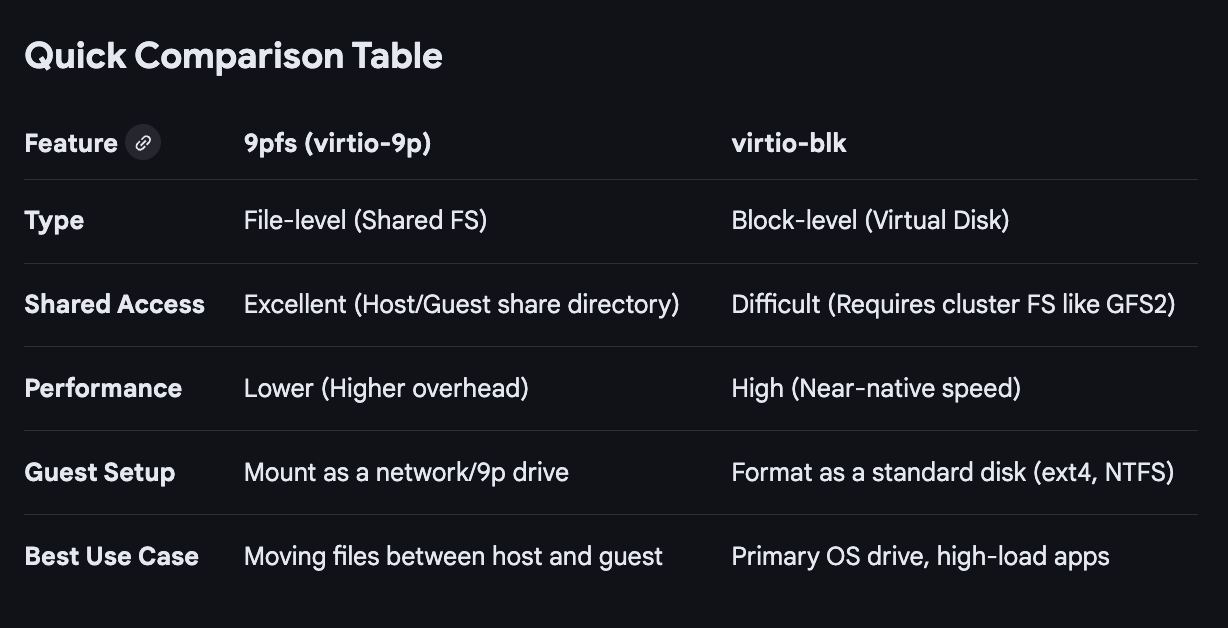
9pfs (virtio-9p)
9pfs exposes a specific directory on the host machine directly to the guest. It is often used for “shared folders” where the host and guest need simultaneous access to the same files.
Pros
- Elasticity – Storage is only consumed by actual files on the host; no need to pre‑allocate a large image file.
- Ease of Use – Ideal for development: edit code on the host and run it immediately in the guest.
Cons
- Performance – Generally slower than block devices because every file operation must go through the 9P protocol and host system calls.
- Compatibility – Linux support is excellent, but Windows support is limited and often requires third‑party drivers.
- Modern Alternative –
virtio-fsis the successor to 9pfs in many modern QEMU setups, offering significantly better performance and POSIX compliance.
virtio-blk
This presents a virtual raw block device (a “hard drive”) to the guest. The guest OS treats it like a physical disk and manages its own filesystem (e.g., ext4, XFS) on top of it.
Pros
- High Performance – Optimized for low latency and high throughput. Features like IOThread Virtqueue Mapping (introduced in QEMU 9.0) allow it to scale across multiple vCPUs efficiently.
- Full Feature Support – Supports TRIM/Discard (to reclaim space), bootable partitions, and standard disk‑management tools.
Cons
- Isolation – The host cannot easily “see” or edit files inside the block device while the guest is running without risking corruption.
- Fixed Size – Typically requires pre‑allocation or the use of “sparse” image formats (e.g., QCOW2), which can have their own performance trade‑offs.
When to use which
Use 9pfs when
- You need to share a host directory into a guest for development, simple file exchange, or testing.
- You value ease of sharing over raw performance and strict isolation.
Use virtio-blk when
- You are provisioning a root disk or data disk for a VM.
- You care about performance, isolation, and standard disk semantics (snapshots, independent filesystems per VM).