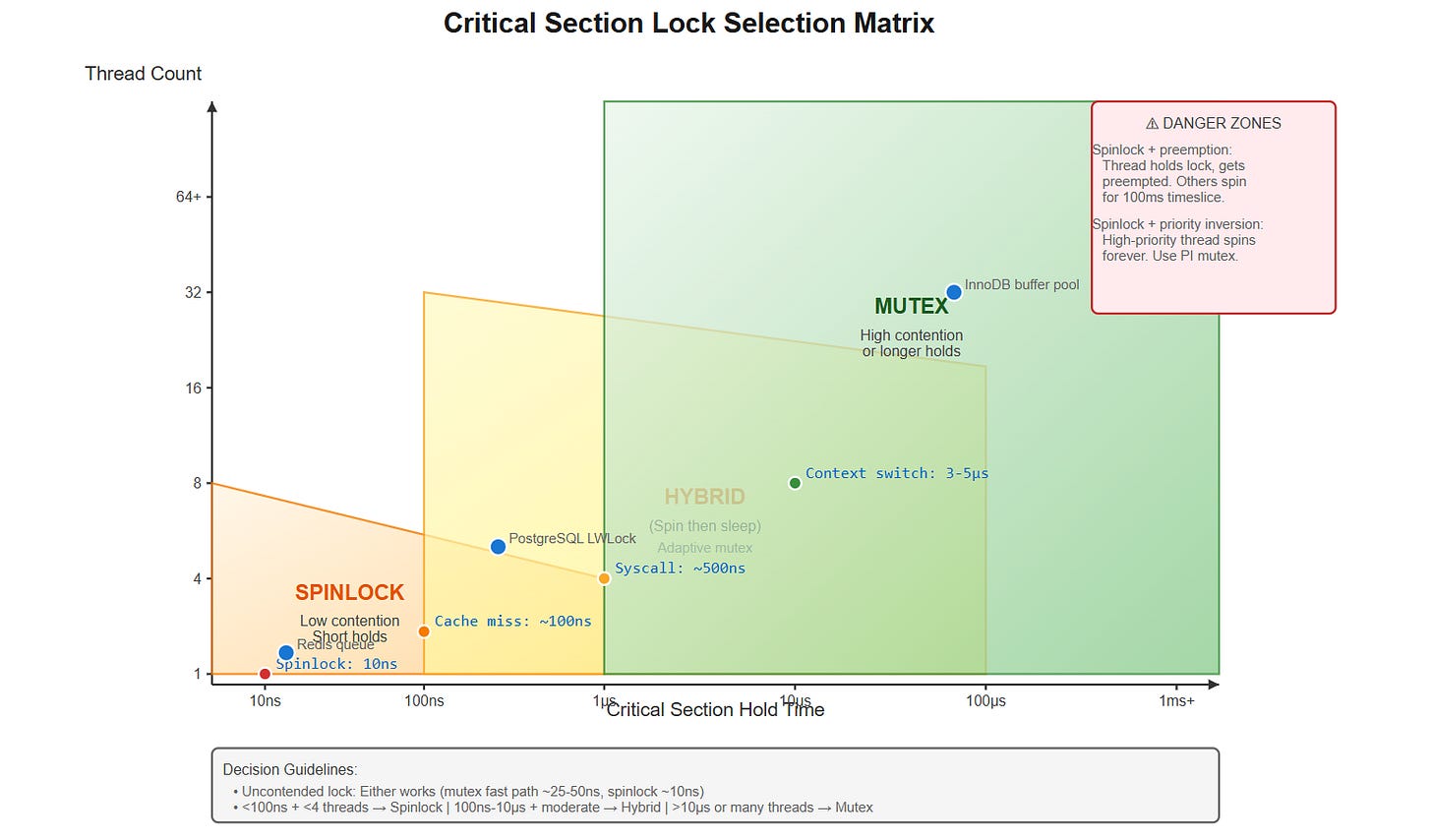
Spinlocks vs. Mutexes: When to Spin and When to Sleep
Source: Hacker News
Introduction
You’re staring at perf top showing 60 % CPU time in pthread_mutex_lock. Your latency is terrible. Someone suggests “just use a spinlock,” and suddenly your 16‑core server is pegged at 100 % doing nothing useful. This is the synchronization‑primitive trap: engineers often choose the wrong primitive because they don’t understand when each makes sense.
Spinlocks vs. Mutexes
| Property | Mutex | Spinlock |
|---|---|---|
| Behavior | Sleeps when contention occurs. | Busy‑waits (spins) in userspace. |
| Cost when uncontended | 25–50 ns (fast path) | One atomic LOCK CMPXCHG (≈40–80 ns). |
| Cost when contended | Syscall (futex(FUTEX_WAIT)) ≈ 500 ns + context switch (3–5 µs). | 100 % CPU while looping; each failed attempt bounces the cache line between cores. |
| Preemptible contexts | Safe – thread can be descheduled. | Dangerous – if the holder is preempted, other threads waste a full timeslice. |
| Priority inversion | Solved with Priority‑Inheritance (PI) mutexes. | Cannot be solved; high‑priority thread may spin forever while low‑priority holder never runs. |
| False sharing | Same issue – every atomic invalidates the cache line. | Same issue – extra care needed to align locks. |
When to Use Which Primitive
| Critical‑section duration | Contention level | Recommended primitive |
|---|---|---|
| ** 10 µs** or high contention | High | Regular mutex – let the scheduler handle sleeping/waking. |
| Real‑time requirements | Any | Priority‑Inheritance mutex on a PREEMPT_RT kernel. |
Profiling Tips
-
CPU vs. context switches – Run:
perf stat -e context-switches,cache-misses- High context‑switch count with low CPU usage → mutex overhead may dominate.
- High cache‑misses with 100 % CPU → lock contention / false sharing.
-
Syscall count – Use
strace -cto countfutex()calls. Millions per second indicate a hot contended lock that might benefit from sharding or lock‑free techniques. -
Voluntary vs. involuntary switches – Check
/proc//status. Involuntary switches while holding a spinlock suggest preemption problems.
Real‑World Examples
-
Redis – Uses spinlocks for its tiny job queue (critical sections).
#include <pthread.h>
#include <stdatomic.h>

#define NUM_THREADS   4
#define ITERATIONS    1000000
#define HOLD_TIME_NS  100   // simulated work

typedef struct {
    atomic_int lock;
    long       counter;
} spinlock_t;

static void spinlock_acquire(spinlock_t *s) {
    int expected;
    do {
        expected = 0;
    } while (!atomic_compare_exchange_weak(&s->lock, &expected, 1));
}

static void spinlock_release(spinlock_t *s) {
    atomic_store(&s->lock, 0);
}

static void *worker_thread(void *arg) {
    spinlock_t *s = (spinlock_t *)arg;
    for (long i = 0; i < ITERATIONS; i++) {
        spinlock_acquire(s);
        s->counter++;
        /* Simulate ~100 ns of work */
        for (volatile int j = 0; j < HOLD_TIME_NS; j++) {
            // busy‑wait
        }
        spinlock_release(s);
    }
    return NULL;
}
Illustrations