
Solving tool overload, one automation step at a time
Source: Red Hat Blog
Overview
Modern IT departments are wrestling with a sprawling array of automation and operations tools, often numbering in the dozens or even hundreds. This complexity makes efficient management and integration a significant obstacle, especially as organizations accelerate their investment in hybrid IT ecosystems, cloud services, and cloud‑native application modernization. To help overcome this “tool sprawl” and its impact on productivity, enterprises are working to establish a common environment for orchestrating and managing critical IT processes—a “unified IT automation platform.”
To understand the business imperatives driving this shift, we asked S&P Global Market Intelligence 451 Research to conduct a comprehensive survey with 900 business and IT decision‑makers and influencers. These leaders provided their perspectives on the current state of IT automation, anticipated changes, and the implications of relying on so many different tools. Their insights also helped shape our understanding of the definition and expectations for a unified IT automation platform.
Key insights from the report
Automation challenges
The journey to stable and reliable IT automation isn’t without its challenges. The top hurdles identified by respondents were:
- Complex and lengthy implementation processes – 58%
- Integration with existing systems and software – 51%
- Budget constraints – 44%
- Skills shortages – 40%

Excess IT tooling
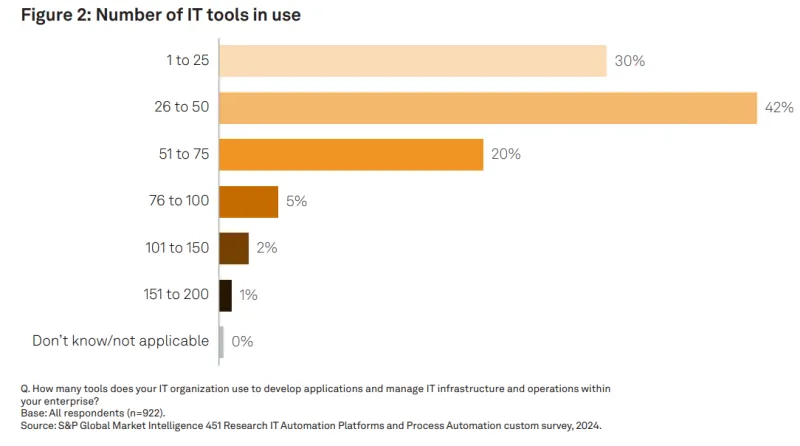
Tool sprawl remains a pervasive challenge:
- 42% of respondents use 26‑50 different tools.
- 28% report using more than 50 tools.
Despite this fragmentation, 69% of enterprises have already established platform‑engineering programs or are actively committing resources to integrate these tools through a unified orchestration layer. This approach lets teams keep the tools they find most useful while improving efficiency and visibility through a connected ecosystem.
Cost savings through automation
Enterprises recognize automation’s potential for cost savings and efficiency:
- 58% anticipate an increase in their IT automation budget in 2025 compared to 2024.
- 1% expect a decrease.
- 40% forecast a flat budget.
Automation helps organizations adapt to ongoing changes by reducing manual errors, boosting productivity, and reallocating resources to more strategic tasks. With Red Hat’s automation dashboard, customers gain better visibility into the entire automation deployment, maximizing the value of their Red Hat subscription.

Defining the unified IT automation platform
- 56% described it as “a single platform that integrates various IT automation tools and processes into a cohesive system.”
- This underscores the need for a centralized control plane that uses AI to integrate, automate, and orchestrate multiple IT tools, processes, and resources, enabling better collaboration across the entire IT environment.
Essential capabilities for enterprise IT
When asked about critical capabilities for an ideal unified platform, respondents highlighted:
- IT service management – 56%
- Generative AI – 53%
- Endpoint security – 50%
- DevOps – 47%
- Identity and access management – 43%
- Configuration management tools – 38%

How unified automation and AI can propel your operations
AI and automation work together to streamline IT, analyzing data and events in real time, then independently making decisions based on defined policies. This enables them to prevent or resolve IT issues without requiring human intervention.
Learn more: 3 reasons why enterprises need a unified automation platform.