
Resident Evil Requiem's director on redefining the survival horror genre
Source: BBC Technology
Introduction
Published 11 hours ago • Laura Cress, Technology reporter

Grace Ashcroft joins the Resident Evil series as a new playable character in Requiem.
Thirty years ago, a game named Resident Evil ushered in the survival‑horror genre—a blend of nerve‑shredding tension, elaborate puzzles, and intricate inventory management. The series became Japanese developer Capcom’s best‑selling franchise ever, spawning books, films, TV programmes, and numerous sequels.
So how does the latest edition, Resident Evil Requiem—released to excited fans worldwide on Friday—keep the scares feeling fresh three decades on?
“The balancing act between familiarity and freshness has been a huge challenge,” said director Koshi Nakanishi to the BBC.
“I hope the new title manages to redefine survival horror in interesting new ways, while still respecting the DNA of the series.”
Over the years, the franchise has see‑sawed between focusing on terror and high‑octane action, with mixed results. After hearing that the latest game would try to combine the two, some fans feared it might feel too jarring.
However, producer Masato Kumazawa told the BBC that the team has always been clear on Requiem’s and Resident Evil’s signature mood—fear.
“Fear is such a human emotion,” he said.
“Through entertainment we find ways to use fear as a thrill, but in a positive way.
So I think that even with 30 years on the game’s legacy, people still want to go through those thrills over and over again, because that’s really what makes us human.”
The Evolution of Evil
“They have escaped into the mansion where they thought it was safe. Yet…”
With those mysterious opening lines, Resident Evil created a new type of game.
While many consider the 1989 Capcom title Sweet Home the first true survival‑horror, the term was coined specifically to market Resident Evil’s 1996 release, a decision made by its director Shinji Mikami. The phrase helped describe the game’s tense atmosphere—fixed camera angles, forever‑encroaching zombies, and a limited supply of ammunition.
Freelance games journalist Vikki Blake told the BBC that the series has not always stuck to its genre roots. She noted that its later “pivot to action” left some fans feeling “like Resident Evil forgot about the horror part of survival horror.” By the time the set‑piece‑heavy Resident Evil 6 arrived in 2012, Blake said the franchise was doing “very little” to distinguish itself from “the army of cookie‑cutter zombie games that had popped up in its wake.”
Resident Evil 7: Biohazard marked a “return to form,” but the upcoming Resident Evil Requiem will re‑introduce some action elements—this time as a nod to the past, through one of its two playable protagonists: an older Leon S. Kennedy.
“The decision to include a second, brand‑new lead character, FBI agent Grace Ashcroft, will allow players to experience a more tense gameplay style, befitting a character without the training to tackle monsters head‑on,” says producer Nakanishi.


Capcom
Requiem will see the return of a now‑older “hot‑uncle” Leon S. Kennedy. While he revisits classic locations—such as Raccoon City’s police department from the second game—both Leon and Grace will also explore brand‑new areas.
Nakanishi admitted it was “tricky” to blend so many elements—old and new, action and horror—into a cohesive whole:
“It’s never possible to make something 100 % original. You always need to ground it in something familiar as a starting point, so players know it will be the kind of game they liked before.”
Producer Kawata echoed this sentiment, noting that the team still managed to bring something new to the table:
“We don’t want players to feel like we’ve just produced another entry with the same old content. I want them to feel this is a fresh new entry in the series.”
“The double‑protagonist angle lets us explore the duality of the characters, the storyline, and the different horror approaches,” Nakanishi adds.
Fan Perspective
Monique Alves, a Brazilian content creator who runs the fan site and YouTube channel Resident Evil Database, told the BBC that when Requiem was first announced, some fans feared a repeat of Resident Evil 6.
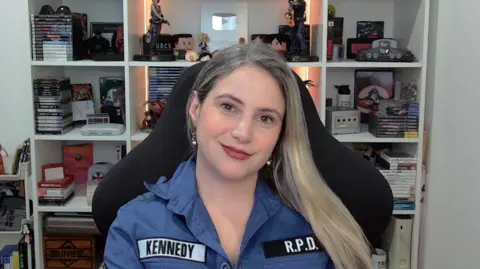
Monique Alves – content creator
Having been granted three hours of early access due to her “super‑fan” status, Alves said the experience felt “different” this time:
“Resident Evil 6 is a product of its time, so of course it had more action and explosives. I think we’re safe in that aspect now. The Grace and Leon roots are very well combined.”
Critical Reception
Most critics agree that marrying two distinct gameplay styles has been a success rather than a step back for the series. See the aggregated reviews on Metacritic.
“We’ve really taken care not to do the same thing over and over again,” Nakanishi says. “Fans know they want another game because they’re never quite sure what kind of experience they’ll get—that’s exciting as a player.”
