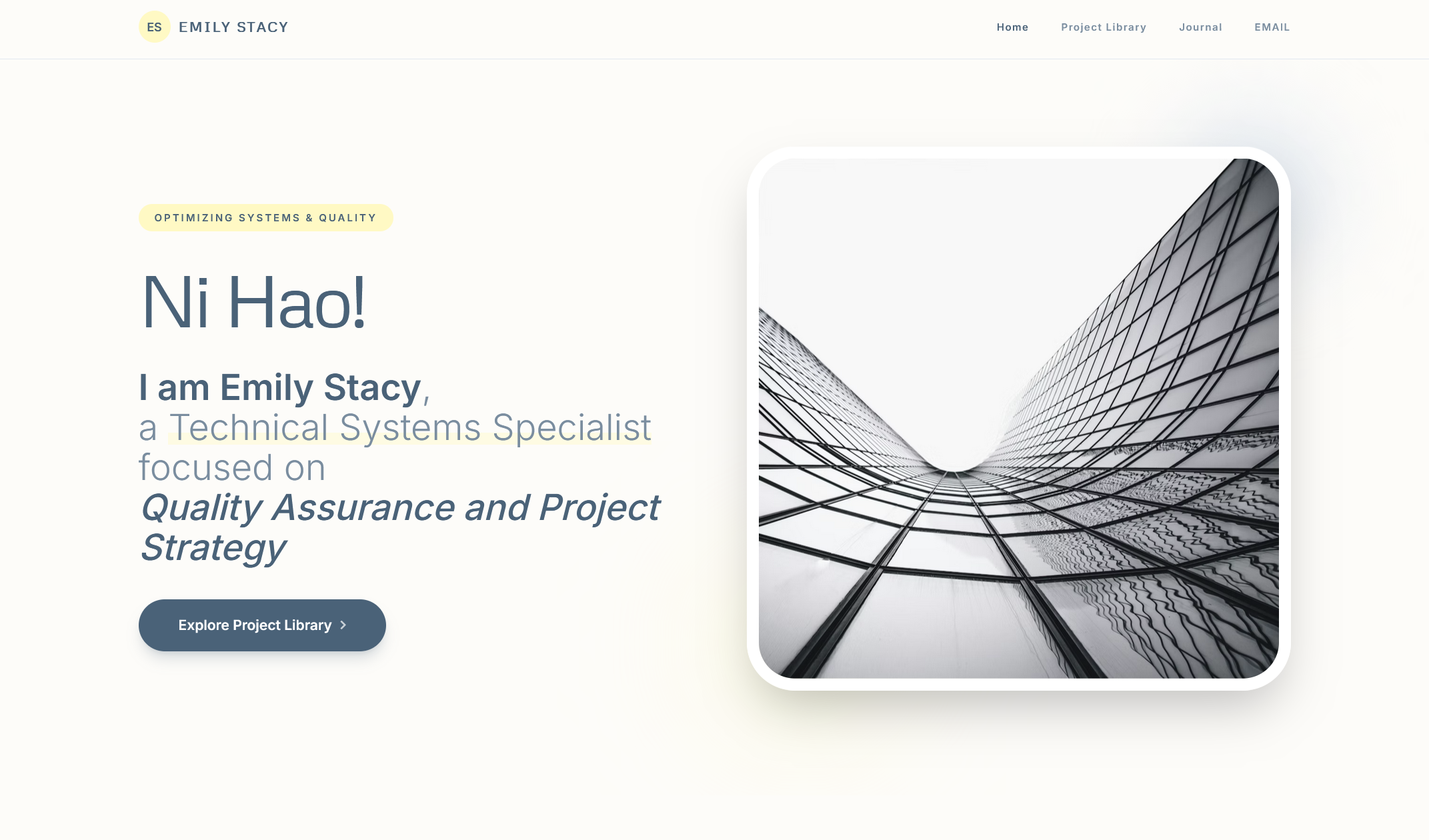
Portfolio & Summarizing Dev Journals Using Google AI & Cloud Run
Source: Dev.to
About Me
I’m a software engineer with a background in education and instructional design. Before moving into engineering full‑time, I spent years teaching and designing learning materials, which shaped how I think about clarity, structure, and how people actually absorb technical information.
With this portfolio, I wanted to explore the intersection of software engineering, learning, and AI‑assisted reflection—not just showcasing projects, but also capturing how I learn and reason about systems over time. This portfolio is both a technical artifact and a learning journal, and I want a platform where I can store all of my work.
Portfolio
Here is my live portfolio deployment on Google Cloud Run:
For the deployment label requirement, I deployed this service with:
--update-labels dev-tutorial=blog-devcommunity2026How I Built It
Frontend
- React + TypeScript
- Custom journal schema to support multiple content formats (sections, tables, lists, code blocks)
- Review Mode UI that hides details and emphasizes high‑level takeaways
Backend
- Node.js + Express, containerized and run on Google Cloud Run
- A custom summarization endpoint that sends journal content to Google Gemini and normalizes the response
Google AI
- Google Gemini (
gemini-2.5-flash) for summarization - Instead of assuming a fixed AI response format, I built a resilient extraction layer that can interpret multiple JSON shapes (sections, arrays, nested objects, tables, etc.) with the help of Gemini. (Note: on the free tier, requests may return 429 (quota exceeded) errors when the usage limit is reached.)
- This mirrors real‑world conditions where AI outputs aren’t always predictable.
Design Decisions
- Treated AI as a helper, not a source of truth.
- The system falls back gracefully when summaries can’t be confidently generated.
What I’m Most Proud Of
- AI integration – handling inconsistent AI outputs without breaking the UI was one of the hardest and most rewarding parts.
- Learning‑first design – the portfolio doesn’t just show results; it captures the thinking process behind them.
- End‑to‑end ownership – from frontend design to backend APIs to Cloud Run deployment and CI/CD, this project represents full‑stack ownership.
- Practical AI usage – instead of flashy demos, the AI feature solves a real personal problem: reviewing and retaining complex technical knowledge.