
Oracle AI Database 26ai in Production
Source: Dev.to
Oracle AI Database 26ai changes the traditional model of moving data to external AI systems by embedding AI capabilities directly into the database engine. Vector search, semantic similarity, and AI‑ready retrieval now operate alongside SQL, transactions, and security controls, allowing engineers to build AI‑powered applications without new data pipelines or external vector databases.
This article explains how Oracle AI Database 26ai works from a technical perspective and how it can be used to build real production‑grade AI systems.
What Is Oracle AI Database 26ai?
Oracle AI Database 26ai is Oracle’s newest long‑term‑support release of its flagship database, designed for enterprises that need AI‑enabled data platforms. It replaces the earlier Oracle Database 23ai release, and all features from 23ai are included in 26ai.
The core idea is to architect AI into the foundation of data management, enabling intelligent processing, analytics, and application support without exporting data to external systems.
Key highlights
- AI built into the data engine
- Native vector support and similarity search
- Unified support for relational, document, JSON, graph, spatial, and other data types
- Developer‑productivity features like AI‑assisted code generation
- Enterprise‑grade performance, governance, and security
- Distributed and multicloud deployment options
Why AI in the Database?
Traditional AI architectures often rely on multi‑tier systems where data is moved from the database to feature stores, vector layers, or external services. This movement introduces complexity, latency, and security challenges.
Oracle’s approach is different:
The database itself becomes a unified platform for data storage, vector computation, intelligence, and AI‑driven workflows.
Benefits
- Performance: Analytics and AI run where the data resides, reducing round‑trip costs.
- Security: Data governance and access control are enforced at the database level.
- Simplicity: Fewer systems and pipelines to manage.
- Scalability: Enterprise workloads can scale with distributed database features.
Key Technical Innovations
Native Vector Search and Multimodal Support
Oracle AI Database 26ai includes built‑in support for vector data types, enabling semantic and similarity searches directly within SQL queries. You can index and search vectors generated from text, images, or other media without external systems.
- Reference: Oracle – 26ai product page
- Docs: Oracle Database Documentation
Use cases
- Semantic search across enterprise knowledge bases
- Hybrid relational + vector queries
- Business logic combined with nearest‑neighbor search
Agentic AI Workflows
Oracle AI Database 26ai introduces support for in‑database AI agents—frameworks that can execute autonomous or semi‑autonomous tasks on behalf of applications. These agents can combine data access, analysis, decision logic, and actions without leaving the data platform.
- Reference: Futurum – Oracle AI World 2025
By making agents part of the database ecosystem, Oracle simplifies complex AI workflows that would otherwise require external orchestration layers.
Unified Lakehouse and Data Fabric
A major component of the 26ai strategy is the Oracle Autonomous AI Lakehouse, which supports open data formats like Apache Iceberg. This brings analytics, data governance, and AI together over large datasets that may reside in data lakes.
- Reference: Oracle announcement (Oct 14 2025)
The lakehouse capability blurs the traditional lines between OLTP, OLAP, and AI workloads, enabling:
- Unified governance
- Real‑time analytics
- Schema flexibility
- Efficient storage for large datasets
Developer Productivity and App Development
Oracle AI Database 26ai also focuses on making AI development easier:
-
Integrated support for AI‑enhanced code generation
-
Built‑in APEX enhancements with AI‑assistant support
-
JavaScript stored procedures and modern language support
-
SQL and PL/SQL enhancements for AI‑centric logic
-
Reference: Oracle Blog – AI Database 26ai
Developers can build intelligent applications using familiar database tools and languages.
Enterprise Readiness
Oracle has positioned 26ai for mission‑critical workloads:
- Availability on leading cloud platforms (OCI, AWS, Azure, GCP)
- On‑premises support with upcoming releases for Linux x86‑64
- Distributed database capabilities with Raft‑based replication
- Integrated security, auditing, and governance features
- Free and developer editions to experiment with core features
These capabilities make 26ai suitable for large enterprises that need both AI power and operational reliability.
What This Means for Practitioners
For engineers and architects, Oracle AI Database 26ai represents a single, unified platform where data storage, vector computation, and AI logic coexist. It eliminates the need for separate feature stores or external vector databases, reduces latency, and simplifies governance—all while delivering the performance and scalability required for enterprise workloads.
A Shift in How We Build AI‑Powered Systems
Move complex AI logic closer to the data
- Reduce dependency on external vector databases or feature stores
- Leverage a single platform for analytics, AI, and transaction processing
- Maintain security and governance at enterprise scale
Adopting AI at the database layer simplifies many traditional challenges in AI pipelines, especially for regulated industries where data governance is critical.
By architectural design, 26ai turns the database from a passive data store into an active AI platform. This represents a significant evolution in database engineering and opens a path for building high‑performance, secure, AI‑driven applications without complex external stacks.
If you’re exploring AI for enterprise workloads, 26ai is worth serious technical evaluation.
Oracle AI Database 26ai as an AI Execution Engine
That claim only matters if it holds up under:
- Query planning
- Real retrieval pipelines
- Operational constraints
- Comparison with existing open‑source stacks
Let’s validate it properly.
1. EXPLAIN PLAN for Vector Queries (What the Optimizer Actually Does)
A common concern is whether vector search is treated as a first‑class citizen or just an expensive function call.
Example Query
EXPLAIN PLAN FOR
SELECT doc_id, title
FROM knowledge_base
WHERE category = 'payments'
ORDER BY VECTOR_DISTANCE(embedding, :query_embedding)
FETCH FIRST 5 ROWS ONLY;
Sample EXPLAIN PLAN Output (Simplified)
------------------------------------------------------------
| Id | Operation                 | Name                |
------------------------------------------------------------
|  0 | SELECT STATEMENT          |                     |
|  1 |  SORT ORDER BY            |                     |
|  2 |   VECTOR INDEX RANGE SCAN | KB_VECTOR_IDX       |
|  3 |    TABLE ACCESS BY INDEX  | KNOWLEDGE_BASE      |
------------------------------------------------------------
Why This Matters
Key observations
- VECTOR INDEX RANGE SCAN is a native access path.
- Relational predicates (
category = 'payments') are applied early. - Vector distance calculation is costed by the optimizer.
- The plan is parallelizable like any other Oracle query.
This is fundamentally different from:
- External vector‑DB calls
- Post‑filtering results in application code
- Pulling large candidate sets into memory
In Oracle 26ai, vector search participates in the same optimization framework as joins, filters, and aggregates.
2. End‑to‑End RAG with OCI Generative AI
Architecture Overview
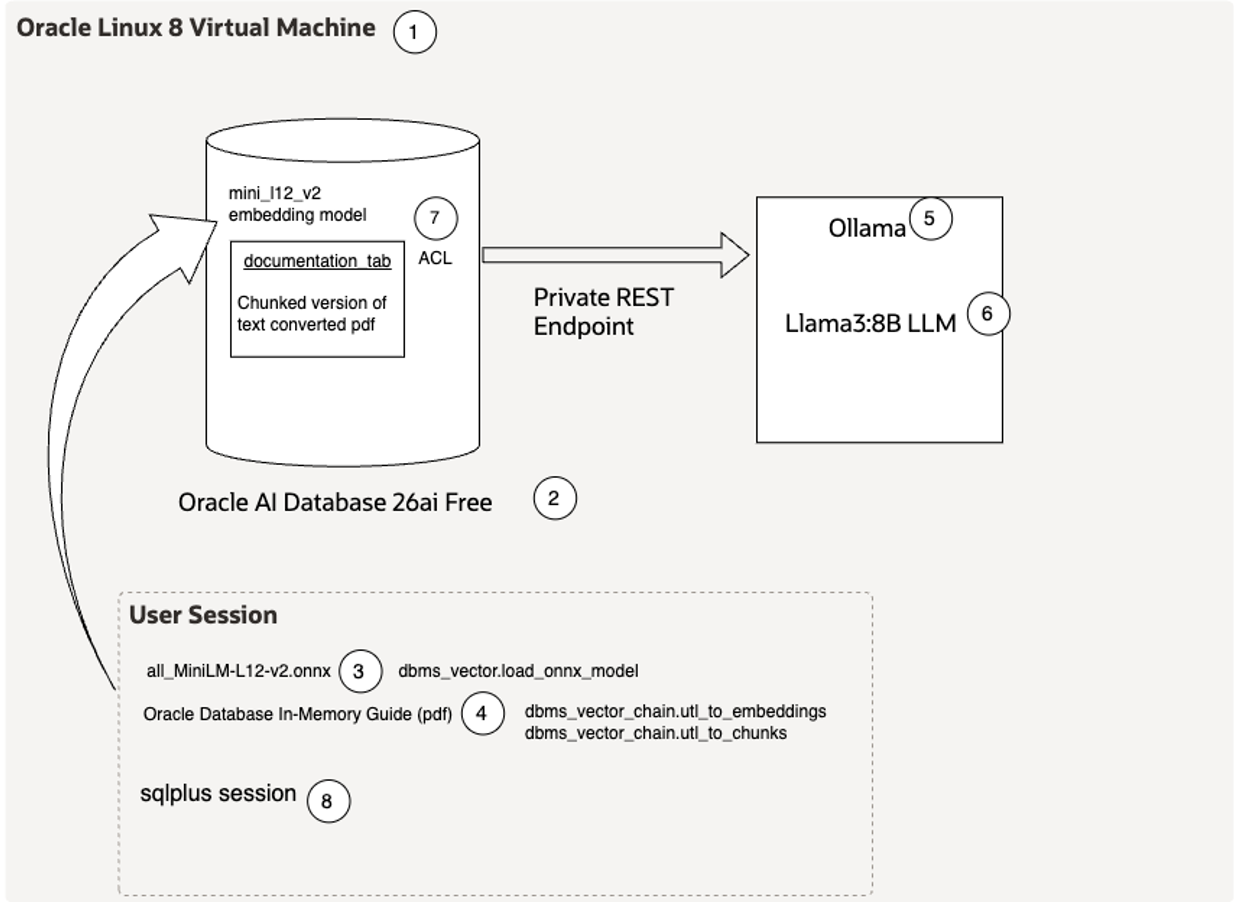
Figure 1 – High‑level flow
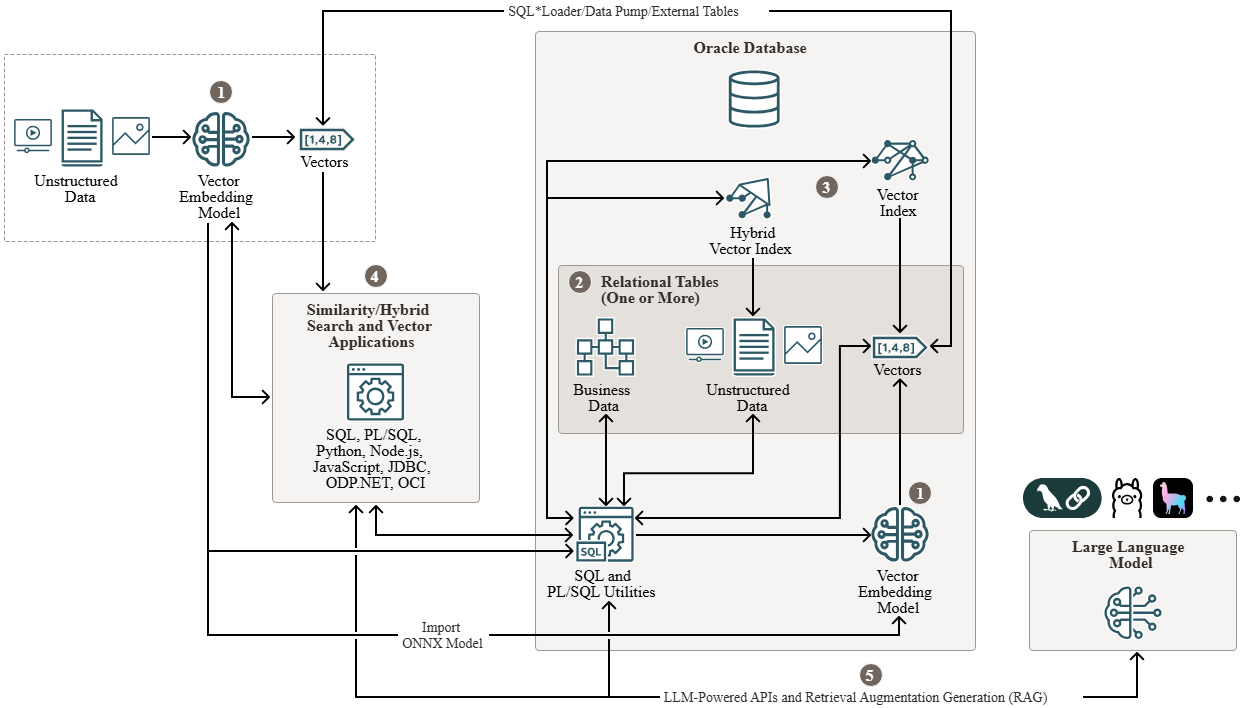
Figure 2 – OCI Generative AI service
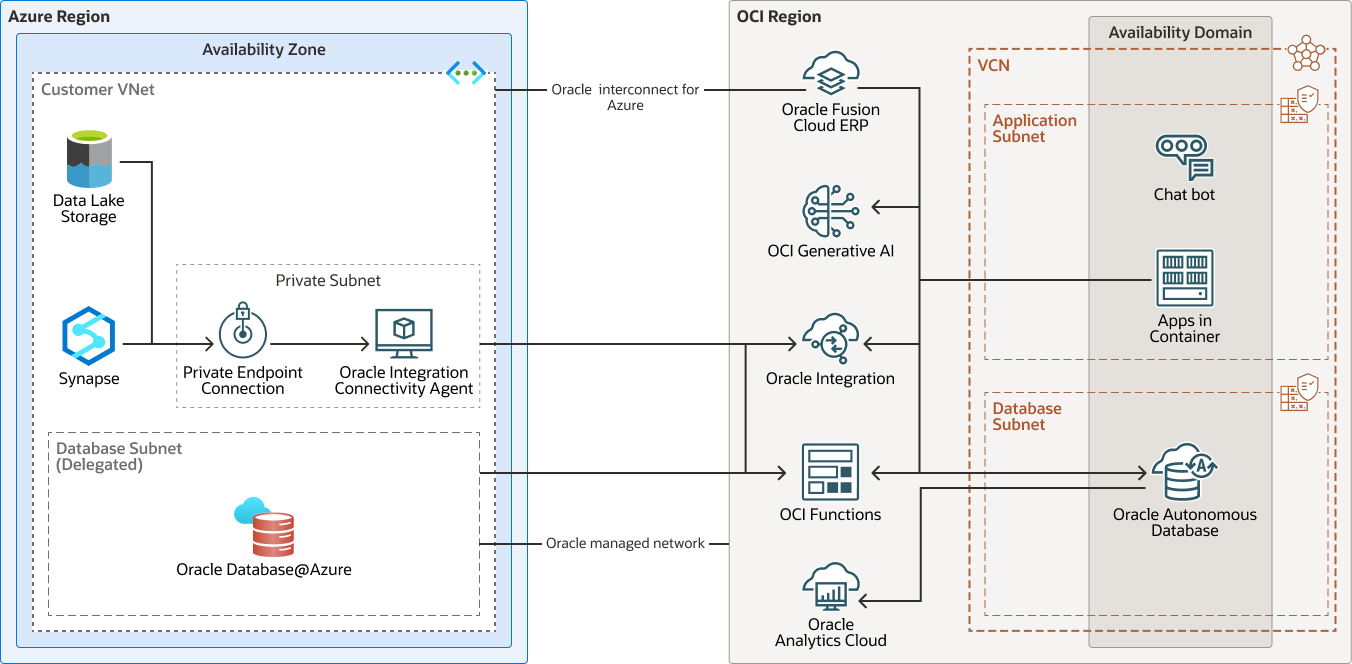
Figure 3 – Secure context retrieval
Flow
- User submits a natural‑language query
- Application generates an embedding
- Oracle 26ai retrieves relevant context securely
- Context is sent to OCI Generative AI
- Model generates a grounded response
Step 1 – Generate Query Embedding
Typically done using OCI Generative AI embedding models.
# Pseudo‑code (application layer)
query_embedding = generate_embedding(
    model="cohere.embed-english",
    text=user_query
)
Step 2 – Secure Context Retrieval in Oracle 26ai
SELECT content
FROM knowledge_base
WHERE VECTOR_DISTANCE(embedding, :query_embedding) < 0.30
ORDER BY VECTOR_DISTANCE(embedding, :query_embedding)
FETCH FIRST 5 ROWS ONLY;
Important points
- Row‑level security applies automatically.
- Masked columns remain masked.
- Auditing records the access.
This step is where most RAG systems fail from a governance perspective. Oracle does not.
Step 3 – Call OCI Generative AI with Retrieved Context
Prompt template example
You are an enterprise assistant.
Answer the question using only the context below.

Context:
{{retrieved_documents}}

Question:
{{user_query}}
The database never exposes unauthorized data, and the model never hallucinates beyond the approved context.
3. Oracle 26ai vs. PostgreSQL + pgvector Comparison
| Dimension | Oracle AI Database 26ai | PostgreSQL + pgvector |
|---|---|---|
| Vector type | Native kernel type | Extension |
| Query optimizer | Fully vector‑aware | Limited cost awareness |
| Security | Row‑level, masking, auditing | Partial, app‑driven |
| RAG governance | Strong | Weak by default |
| HA & DR | Built‑in enterprise‑grade | DIY |
| Operational overhead | Low | Moderate to high |
| Compliance readiness | High | Depends on implementation |
Conclusion – Oracle’s 26ai brings vector search into the core relational engine, delivering native optimization, enterprise‑grade security, and governance that are difficult to achieve with add‑on extensions such as pgvector. For organizations that need robust, regulated AI workloads, the integrated approach is a compelling alternative.
On Setup
Key Insight
- pgvector works well for prototypes, research, and small‑to‑medium workloads.
- Oracle 26ai is designed for regulated enterprises, mission‑critical systems, and large‑scale operational AI.
The difference is not performance alone; it is operational correctness under pressure.
Production Checklist for AI Databases
Most AI failures are not model failures—they are architecture and operations failures. Below is a practical checklist for running AI workloads inside a database.
Data and Schema Design
- Choose embedding dimension deliberately
- Separate raw text and embeddings
- Version embeddings if models change
- Normalize metadata for relational filtering
Indexing and Performance
- Create vector indexes explicitly
- Monitor vector index usage
- Validate EXPLAIN PLAN regularly
- Use relational predicates to reduce search space
Security and Governance
- Enforce row‑level security on source tables
- Mask sensitive columns before RAG
- Enable auditing for AI access paths
- Treat embeddings as sensitive data
Operational Readiness
- Include vector indexes in backup strategy
- Test DR scenarios with AI workloads
- Monitor vector query latency separately
- Capacity‑plan for mixed OLTP + AI workloads
Model and Prompt Hygiene
- Store prompt templates in versioned tables
- Log prompts and responses for traceability
- Use strict system prompts for RAG
- Avoid free‑form context injection
DevOps and Platform Integration
- Treat AI queries as first‑class workloads
- Add SLOs for AI retrieval latency
- Monitor plan regressions after upgrades
- Align AI deployments with DB change management
Final Perspective
Oracle AI Database 26ai does not try to replace models; it replaces fragile architecture. By making vectors, retrieval, security, and optimization part of the database engine, Oracle reduces the number of places AI systems can fail. For enterprises, this matters more than novelty. AI is impressive when it works every day, under load, under audit—and 26ai is built for that reality.