
Now Live: The World’s Most Powerful AI Factory for Pharmaceutical Discovery and Development
Source: NVIDIA AI Blog
Overview
Built with over 1,000 NVIDIA Blackwell Ultra GPUs, LillyPod is now online to power scientific research and super‑charge the future of medicine.
Saving and improving lives — that most human endeavor — just got a super‑computational boost.
Lilly this week launched the most powerful AI factory wholly owned and operated by a pharmaceutical company to help its teams make meaningful medical advancements faster, more accurately, and at unprecedented scale. Dubbed LillyPod, it’s the world’s first NVIDIA DGX SuperPOD equipped with DGX B300 systems.
- Hardware: DGX SuperPOD with 1,016 NVIDIA Blackwell Ultra GPUs
- Performance: >9,000 petaflops of AI compute
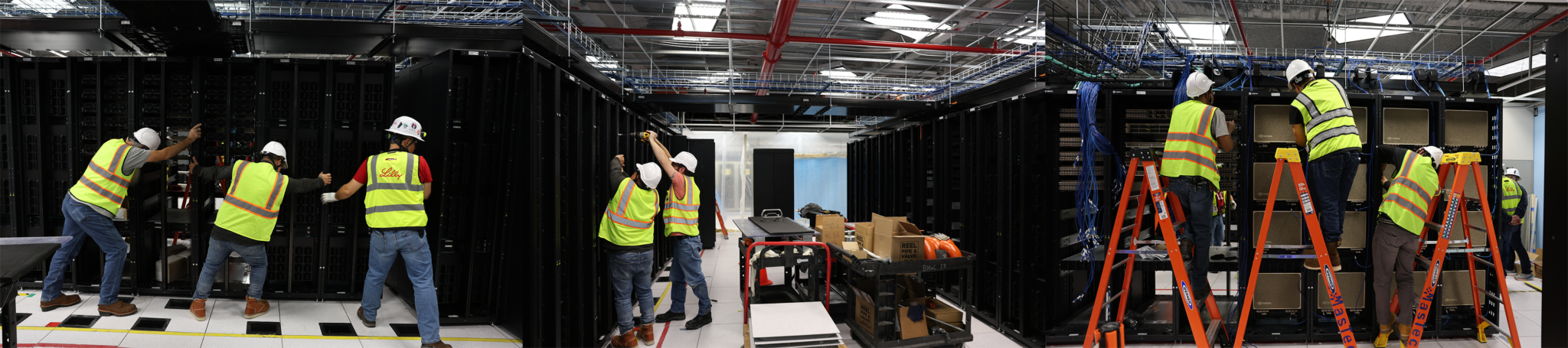
- Build time: Assembled in just four months
“It’s a big day for us with the supercomputer coming on board, but it’s a day 150 years in the making,” said Diogo Rau, Executive Vice President and Chief Information & Digital Officer at Lilly. “LillyPod is a powerful symbol of who we are and why we do this work: to make life better for people around the world. We are, right here, right now, at the right moment to advance biology in a way that has just never been done before.”
Launch Event
LillyPod was inaugurated on Wednesday with a ribbon‑cutting ceremony in Indianapolis.
Video placeholder – original page contained a video that could not be displayed.
For more details on the DGX SuperPOD and DGX B300 systems, visit the NVIDIA links above.
Behind the Scenes of the LillyPod
Computational power that once required 7 million Cray supercomputers now fits inside a single NVIDIA GPU — and the LillyPod contains more than 1,000 of them. This infrastructure enables Lilly’s genomics team to harness 700 TB of data using over 290 TB of high‑bandwidth GPU memory.
“Computation is at the heart of biology and it is at the heart of science,” said Thomas Fuchs, senior vice president and chief AI officer at Lilly.
“Being able to compute at scale is not something optional for a company like ours; it is absolutely necessary. So we are building the computational future of medicine and you see that in all areas along the pharmaceutical value chain.”
Lilly’s AI factory is set to support the large‑scale training of:
- Protein diffusion models
- Small‑molecule graph neural network models – see the NVIDIA blog post on graph neural networks
- Genomics foundation models – see the NVIDIA blog post on foundation models
NVIDIA’s Full‑Stack AI Factory Architecture
The NVIDIA DGX SuperPOD provides a secure, scalable platform for the highly regulated workflows of healthcare and life sciences. Its key components include:
- Accelerated computing (DGX systems)
- NVIDIA Spectrum‑X Ethernet networking – learn more
- Optimized AI software stack
NVIDIA Mission Control software lets Lilly manage its DGX SuperPOD, orchestrate workloads, monitor performance, and automate AI operations securely and efficiently – see the Mission Control product page.
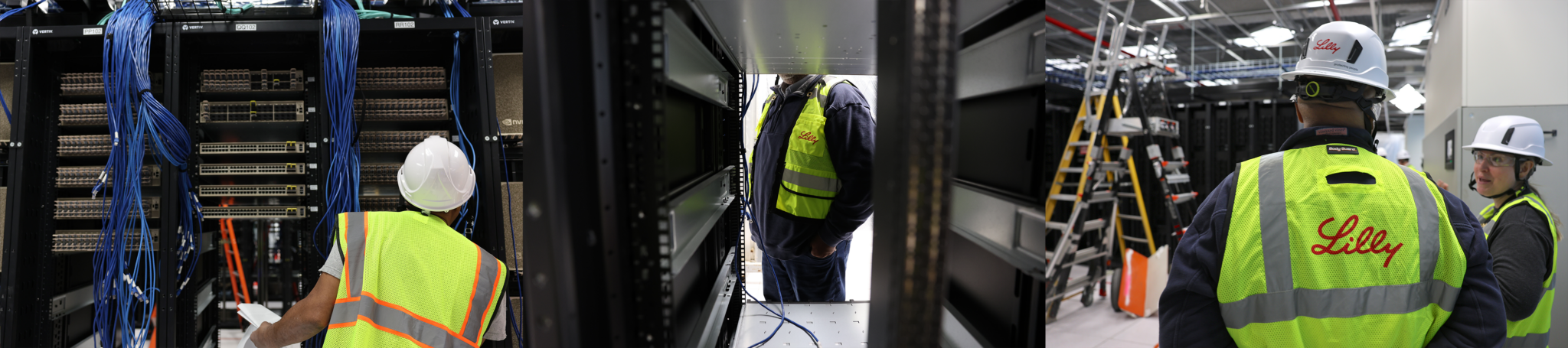
The supercomputer’s nearly 5,000 connections are built with more than 1,000 lb of fiber cables. Lilly aims for its new AI supercomputing infrastructure to run on 100 % renewable electricity by 2030, using efficient liquid cooling and minimizing incremental energy impact.
Advancing Foundation Models, Physical and Agentic AI
LillyPod is more than a tool — it’s a new scientific instrument that brings together proprietary data and advanced AI models.
With this foundation, Lilly teams can analyze genomes, explore billions of chemical possibilities, and apply AI across clinical development and manufacturing to design better trials, optimize production, and accelerate decision‑making. Together, these capabilities enable faster, more precise, and more scalable creation and delivery of medicines.
“LillyPod will usher in a new era of AI‑driven drug discovery,” said Tim Coleman, senior vice president and chief technology officer at Lilly. “We believe that computation is foundational to science and that Lilly patients deserve every advantage that we can give them.”
Lilly TuneLab
Select models will be made available through Lilly TuneLab, an AI‑and‑machine‑learning platform that provides biotech companies with access to drug‑discovery models built on proprietary Lilly data generated at a cost of over $1 billion.
As the first drug‑discovery platform that will offer both Lilly models and NVIDIA BioNeMo open foundation models for healthcare and life sciences, TuneLab uses a federated‑learning infrastructure built on NVIDIA FLARE. This architecture enables biotech companies to tap into powerful proprietary AI models while keeping their data private and separate from other users. As more companies participate, the models improve, benefiting all users and further expanding AI access for the biotech ecosystem.
Breaking the Wet‑Lab Limit
Historically, drug discovery has been constrained by the physical limits of the wet lab. Even highly productive teams can typically analyze roughly 2,000 molecular ideas per target per year, because each experiment requires physical synthesis and testing.
“Now the super‑computer center essentially just breaks the physical limit of the wet lab,” said Yue Wang Webster, vice president of research and development informatics at Lilly. “Now in the dry lab, you can test billions of molecule ideas at your fingertips.”
LillyPod removes this constraint by creating a computational dry lab at massive scale, where scientists can simulate and evaluate billions of molecular hypotheses in parallel before committing to physical experiments.
With its internal AI platforms, Lilly employees can also use LillyPod to build chatbots, agentic workflows, and research‑lab agents without reinventing the wheel.
Related News
(Add links or summaries of related articles here.)