
New GPUBreach attack enables system takeover via GPU rowhammer
Source: Bleeping Computer
GPUBreach Attack Overview
A new attack, dubbed GPUBreach, can induce Rowhammer bit‑flips on GPU GDDR6 memories to escalate privileges and lead to a full system compromise. GPUBreach was developed by a team of researchers at the University of Toronto, and full details will be presented at the IEEE Symposium on Security & Privacy on April 13 in Oakland.
The researchers demonstrated that Rowhammer‑induced bit flips in GDDR6 can corrupt GPU page tables (PTEs) and grant arbitrary GPU memory read/write access to an unprivileged CUDA kernel.
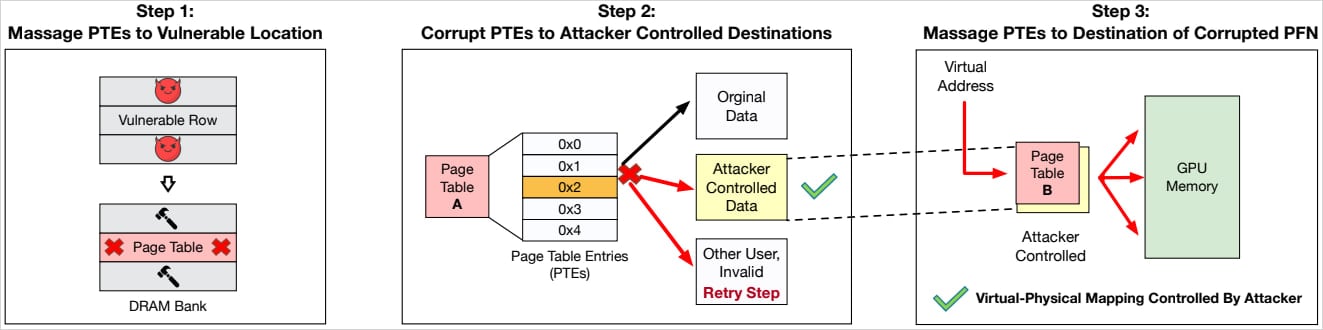
GPUBreach attack steps – Source: University of Toronto
IOMMU is a hardware unit that protects against direct memory attacks. It controls and restricts how devices access memory by managing which memory regions are accessible to each device. Despite being an effective measure against most direct memory access (DMA) attacks, IOMMU does not stop GPUBreach.
“GPUBreach shows that GPU Rowhammer attacks can move beyond data corruption to real privilege escalation,” the researchers explain.
“By corrupting GPU page tables, an unprivileged CUDA kernel can gain arbitrary GPU memory read/write, and then chain that capability into CPU‑side escalation by exploiting newly discovered memory‑safety bugs in the NVIDIA driver.”
“The result is system‑wide compromise up to a root shell, without disabling IOMMU, unlike contemporary works, making GPUBreach a more potent threat.”
Read more from the researchers.
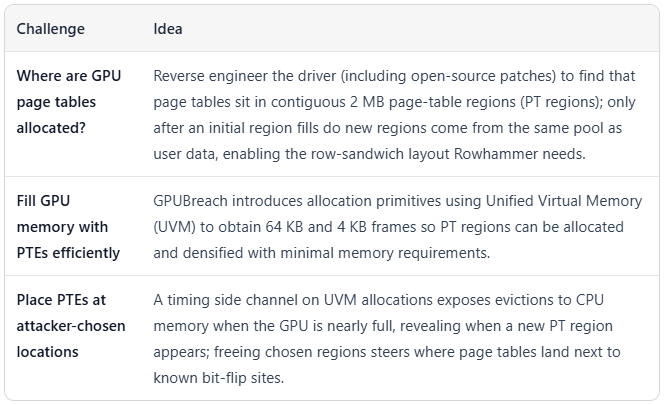
Overview of how GPUBreach works – Source: University of Toronto
The same researchers previously demonstrated GPUHammer, the first attack showing that Rowhammer attacks on GPUs are practical, prompting NVIDIA to issue a warning to users and suggesting the activation of the System Level Error‑Correcting Code mitigation to block such attempts on GDDR6 memory. GPUBreach takes the threat to the next level, showing that it is possible not only to corrupt data but also to gain root privileges with IOMMU enabled.
The researchers exemplified the results with an NVIDIA RTX A6000 GPU with GDDR6, a model widely used in AI development and training workloads.
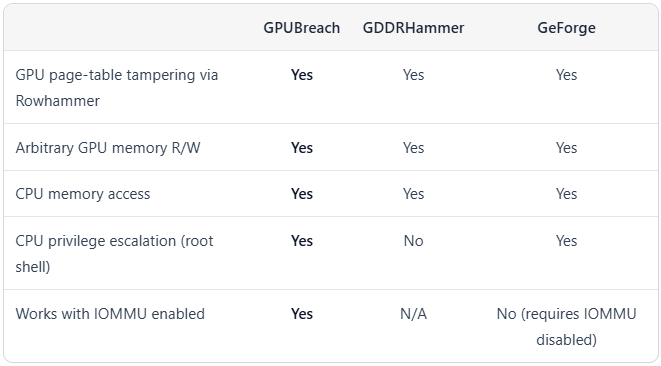
Comparison to other GPU attacks – Source: University of Toronto
Disclosure and Mitigations
- The University of Toronto researchers reported their findings to NVIDIA, Google, AWS, and Microsoft on November 11, 2025.
- Google acknowledged the report and awarded the researchers a $600 bug bounty.
- NVIDIA stated that it may update its existing security notice from July 2025 to include the newly discovered attack possibilities.
As demonstrated by the researchers, IOMMU alone is insufficient if GPU‑controlled memory can corrupt trusted driver state, so users at risk should not rely solely on that security measure. Error‑Correcting Code (ECC) memory helps correct single‑bit flips and detect double‑bit flips, but it is not reliable against multi‑bit flips. Ultimately, the researchers underlined that GPUBreach is completely unmitigated for consumer GPUs without ECC.
The full details of the work, including a technical paper and a GitHub repository with the reproduction package and scripts, will be published on April 13.