
NASA announces overhaul of Artemis program amid safety concerns, delays
Source: Hacker News
Revised Flight Schedule
-
2027 – Preparatory Flight
- Astronauts will dock with new commercial Moon landers in low‑Earth orbit.
- Objectives: detailed tests of navigation, communications, propulsion, life‑support systems, and rendezvous procedures.
-
2028 – Lunar Landing Missions
- At least one, possibly two, Moon‑landing missions will follow, incorporating lessons learned from the 2027 flight.
The goal is to accelerate the launch cadence of the Space Launch System (SLS) while executing Artemis flights in evolutionary steps—avoiding missions that rely on too many untested technologies and procedures at once.
“We’re going to get there in steps, continue to take down risk as we learn more and we roll that information into subsequent designs,” Isaacman told CBS News. “We’ve got to get back to basics.”
Isaacman outlined the plan in an interview with CBS News space contributor Christian Davenport and again during a news conference Friday.
Safety Advisory Panel Findings
The announcement came two days after the Aerospace Safety Advisory Panel released a sharply‑worded report deeming the existing plans too risky. The panel highlighted the large number of “firsts” required by the original Artemis III mission and recommended that NASA restructure the program to achieve a more balanced risk posture.
“It is interesting that a lot of the things that we are addressing directly go to the points they raised in their report,” Isaacman said. “I can’t say we actually collaborated on it because I generally think these were all pretty obvious observations.”
Current Launch Challenges
NASA has been struggling to launch the delayed Artemis II mission, which will send four astronauts on a trip around the Moon.
- Original launch window: early February 2026
- Delays: hydrogen leak repair, followed by a helium‑pressurization issue in the upper stage
- Current status: on hold until at least April 1, 2026
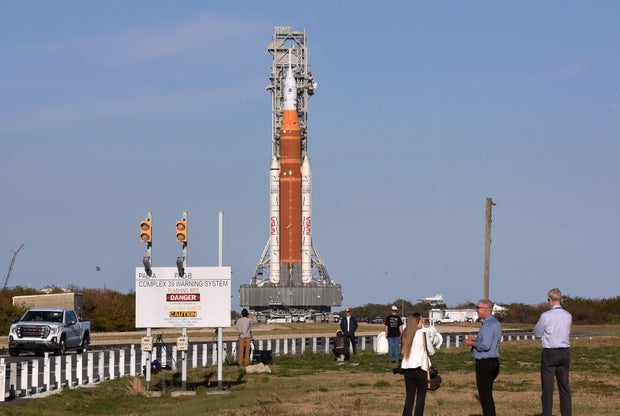
NASA’s Artemis II Space Launch System (SLS) rocket is rolled back from the launch pad to the Vehicle Assembly Building at the Kennedy Space Center on Feb. 25, 2026.
Photo: Paul Hennesy/Anadolu via Getty Images
Artemis III – Redefined
The Artemis III mission, originally slated to land astronauts near the Moon’s south pole in 2028, will now launch in 2027 but won’t go to the Moon. Instead, the yet‑to‑be‑named crew will rendezvous and dock in Earth orbit with one or both commercially built lunar landers currently under development by SpaceX and Blue Origin.
- Purpose: gain near‑term flight experience before attempting a crewed Moon landing.
- Future plan: after Artemis III, NASA hopes to launch two Moon‑landing missions in 2028—Artemis IV and Artemis V—using one or both landers, followed by one Moonshot per year thereafter.
“What helps us get to the Moon? Well, for sure, rendezvous and docking with one or ideally both landers… that gives you an opportunity to do some integrated testing of a vehicle that we are going to depend upon the following year to take those astronauts down to the surface of the Moon,” Isaacman told CBS News.
The Artemis III test flight mirrors the concept of Apollo 9, which launched a command module and lander to Earth orbit for flight tests in 1969, paving the way for the Apollo 11 landing four months later.
Isaacman added that SpaceX and Blue Origin are “both looking to do uncrewed landing demonstrations as part of the existing agreement.”
“So we want to just take advantage of this to set up both vendors for future success on a lunar landing… This, again, is the right way to proceed in order to have a high‑confidence opportunity in ’28 to land.”
Artemis IV & V – 2028 Moon Landings
- Artemis IV & V will use whichever lander(s) are deemed ready for service.
- If only one company’s lander is available, it will be used for both missions.
- If both are ready, each mission will use a different lander.
Launching Artemis III, IV, and V before the end of 2028 will be challenging. Isaacman emphasized that NASA must rebuild its workforce and regain technical competence to support a higher launch cadence, moving from one flight every 1 + year to a more frequent schedule.
8 months or so to a flight every year.
That pace, he argued, will reduce risk.
“When you regain these core competencies and you start exercising your muscles, your skills do not atrophy,” he said.
”It’s safer. And yes, you are buying down risk, because you’re able to test things in low Earth orbit before you need to get to the moon, which is exactly what we did during the Apollo era.”
He said he did not blame NASA’s contractors for the current slow pace of Artemis launches. Instead, he noted:
“We should have made better decisions (in the past) and said, you don’t go from Artemis II to landing on the moon with Artemis III.”
Safety Advisers Call for Changes to “High‑Risk” Plans
The Artemis overhaul was announced two days after the release of a report by the Aerospace Safety Advisory Panel. The panel said the original plan—to move directly from Artemis II to a lunar touchdown in 2028 using a SpaceX lander—did not have the proper margin of safety and did not appear realistically achievable.
The panel raised concerns about the number of “firsts” required by that mission in its current form and recommended that NASA restructure the Artemis Program to create a more balanced risk posture for Artemis III and future missions.
The plan outlined by Jared Isaacman appears to address many of the core issues raised by the safety panel.
Industry Response
- Boeing – “Boeing is a proud partner to the Artemis mission and our team is honored to contribute to NASA’s vision for American space leadership. We are ready to meet the increased demand.” – Steve Parker, President & CEO, Boeing Defense, Space & Security
- SpaceX – “We look forward to working with NASA to fly missions that demonstrate valuable progress towards establishing a permanent, sustainable presence on the lunar surface.”
- Blue Origin – “Let’s go! We’re all in!”
Isaacman said he had discussed accelerating lander development with both SpaceX and Blue Origin, and both were on board. He also consulted with Boeing (SLS rocket manager and first‑stage builder), United Launch Alliance (upper‑stage builder), Lockheed Martin (Orion builder), and other Artemis contractors. All parties reportedly agreed with the new direction.
Changes to the SLS Architecture
Isaacman announced that NASA will halt development of the more powerful Exploration Upper Stage (EUS) and instead move forward with a standardized, less‑powerful upper stage. This approach will:
- Minimize major changes between flights.
- Use the same launch gantry for all missions.
Under the original Artemis architecture, NASA planned multiple SLS versions:
| Block | Description |
|---|---|
| Block 1 | Current configuration (in use). |
| Block 1B | SLS with EUS‑equipped upper stage. |
| Block 2 | Larger vehicle with advanced solid rocket boosters (requires taller mobile launch gantry). |
“It is needlessly complicated to alter the configuration of the SLS and Orion stack to undertake subsequent Artemis missions,” said Amit Kshatriya, NASA’s Associate Administrator.
Visual Reference
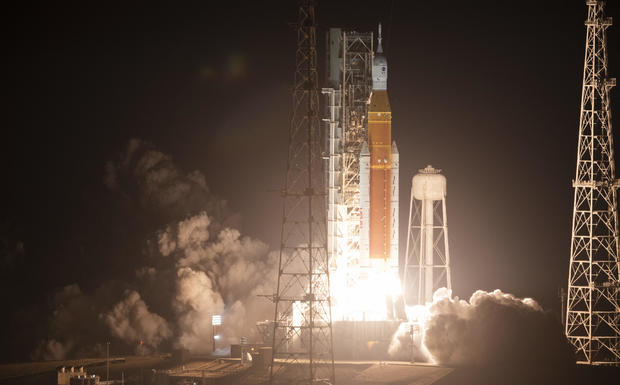
Photo: Joel Kowsky/NASA via Getty Images
“The entire sequence of Artemis flights needs to represent a step‑by‑step build‑up of capability, with each step bringing us closer to our ability to perform the landing missions. Each step needs to be big enough to make progress, but not so big that we take unnecessary risk given previous learnings.” – NASA statement
As a result, NASA will stick with the current SLS version plus the standardized upper stage. No further details were provided.
Closing Remarks
Isaacman concluded the CBS interview by emphasizing that flight‑tested hardware, a revitalized workforce, and an Apollo‑like management strategy are only part of the solution. He added:
“There’s another ingredient that’s required, and that’s the orbital economy—whether it happens in low‑Earth orbit or on the lunar surface. We’ve got to do something where we can get more value out of space and the lunar surface than we put into it. That’s how you really ignite an economy, and that’s how everything we want to do in space is not perpetually dependent on taxpayers.”
Report contributed by Christian Davenport